
 E-Paper



Delhi may bring back masks amid case uptick
The people added that the messaging from the removal of the ₹500 fine for not wearing masks appeared to have led to a lowering of the guard, and consultations are now underway on bringing back the mandate.


The Delhi administration is considering steps to ensure people wear face masks, including making them mandatory for entry to indoor public spaces and bringing back fines to ensure compliance, people aware of the discussions said, after a slight uptick in cases brought back the focus on the lack of public discipline.
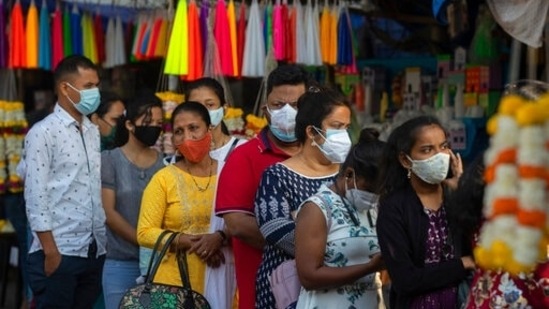
The people added that the messaging from the removal of the ₹500 fine for not wearing masks appeared to have led to a lowering of the guard, and consultations are now underway on bringing back the mandate.
“When we released the order removing fines on wearing masks in public places, the message was not sent across to the public in the way we intended. Wearing masks in public places is still important for your safety and for the safety of others around you, even if as a collective, we are safer (compared to 2020 and 2021) because a majority of people now have the protection of vaccination and infection,” said a senior health official, asking not to be named.
The person said the state health department believes mask mandates should be tightened, and is likely to propose that masks be made mandatory in crowded public places, especially in indoor settings, so that infections can be controlled.
A second person, also a senior official in the health minister’s office, said the possibility of reintroducing fines for not wearing masks is on the table. “We are definitely discussing the possibility of making masks mandatory and also reintroducing the fines. Any other steps that are required to bring down cases will also be discussed because Delhi is currently in the orange zone,” said the official, asking not to be named.
The recommendations will be considered by the Delhi Disaster Management Authority (DDMA) when it takes a call on the pandemic-related rules in a meeting on April 20.
Delhi is not the only city that eased the rules on masks. On April 1, mask mandates were effectively dropped in most parts of the country when they removed fines after sections of the central law, the Disaster Management Act, were revoked.
According to the health bulletin issued on Friday by the government, there were 366 new cases, comprising 3.95% of all tests conducted. The rise in numbers has been expected since all restrictions and limits have now been eased. Overall, there is no region demonstrating worrying trends since hospitalisation and death rates have remained flat.
Delhi chief minister Arvind Kejriwal and independent health experts stressed on Friday that there was no cause for panic.
In a joint statement issued on Friday, Kejriwal and health minister Satyendar Jain sought to address concerns over a recent rise in cases, saying that the number of people being admitted to hospitals was not increasing. “...Therefore, there is nothing to worry about right now,” they said.
“Wearing a mask while leaving the house can prevent most cases… DDMA will meet on April 20 to discuss the rise in corona (virus) cases and measures to contain the spread of the epidemic. In the future strategies will be discussed,” said Jain in the statement.
The Delhi health department’s internal assessment has attributed this spike in cases to complete opening of economic activities, including the opening of schools.
The government, Kejriwal said, has prepared 37,000 Covid beds, and 10,594 Intensive Care Unit (ICU) beds, and plans to increase 100 oxygen beds in every ward of Delhi within two weeks and also 65,000 additional beds, if infection spreads.
Looking at the uptick in Covid cases -- the average daily new infections are up from 95 in the week ended on April 3 to 201 in the latest seven-day period -- DDMA has decided to meet on April 20 to discuss measures to control the spread of the virus. Covid numbers peaked over the last two days, with the city reporting a 45-50% jump in cases every day since April 11.
On April 1 this year, the Delhi health department issued an order doing away with the need to levy fines on people for not wearing masks in public places, a day after DDMA agreed to lift the rule in the wake of a significant improvement in the Covid-19 situation.
Studies on viral dynamics have shown that face masks are among the most effective tools to minimise the spread of the virus from an infected person. The Sars-CoV-2, which causes Covid-19, spreads mainly via airborne droplets that are spread when an infected exhales, talks or coughs. Once exhaled, the virus particles rapidly lose their ability to cause infection with a couple of minutes, which makes stopping an immediate exposure one of the most effective methods to prevent an infection.
Mandatory, universal mask policies also minimise the risk of people accidentally infecting others since people often are highly contagious before they develop any symptoms.
According to information procured from the Union health ministry, Delhi has featured in the list of six states where the rise in Covid cases has been the highest. Other states in the list are Haryana, Karnataka, Madhya Pradesh, Odisha and Uttar Pradesh.
Health experts said that misinterpreting this rise in cases as the beginning of another Covid wave is premature and would unnecessarily fuel panic among people.
“With the relaxation of restrictions, there is more mobility compared to what we have seen over the last two years. There have also been long stretches of holidays, particularly over the last week. When you have more interaction of people, you should expect to see an increase in the number of cases being detected. Cities are sentinels for what is happening in the rest of the country; we should be watchful but we are not there yet,” said Dr Gagandeep Kang, a leading microbiologist and professor at the Christian Medical College in Vellore.
Dr Suneela Garg, professor and a member of the Lancet Commission Covid India Task Force, said that Covid appropriate behaviour needs to be reaffirmed and surveillance needs to be increased to assess why the cases are rising.
“These minor variations in cases are not alarming and we should not panic, but at the same time this is not the time for us to lower our guard. Our surveillance teams need to be proactive and contact every positive individual and undertake contact tracing. People with symptoms need to excuse themselves from routine settings such as offices, public transport modes etc, and get themselves tested. In private setups, salaries should not be deducted if the person with symptoms is absent or needs to be tested,” said Dr Garg.


