E-Paper



Capital now in midst of 'worst' bad air spell
Taking Thursday’s 4pm average air quality index (AQI) of 437, the city has now recorded “severe” air pollution on seven of the nine days this month.

 Prefer HTon Google


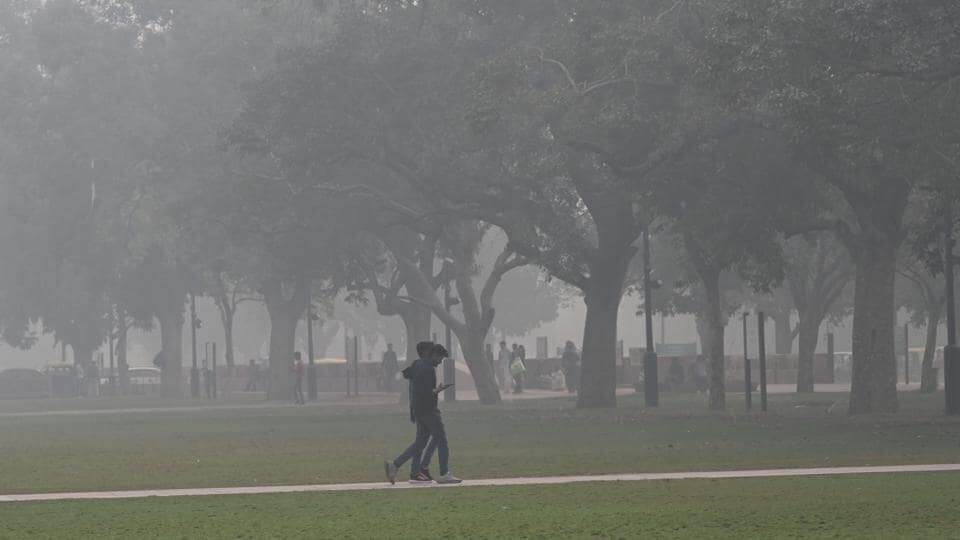
The national capital on Thursday recorded an average AQI of 437, making this year’s crisis the longest the citizens in Delhi have had to endure as authorities scrambled for solutions and prepared for another tough day at the Supreme Court.
Also Read: At 423, Capital’s AQI ‘severe’, Delhi govt to meet, decide on emergency steps
As the chokehold of bad air continues — weather forecasters said marginal relief is only likely over the weekend — the focus also shifted to farmlands in Punjab, where the state government was told to pull up its socks, first by the Supreme Court on Tuesday and then by the Union government on Thursday.
“For the period from 15th September to 7th November, a total of 22,644 stubble burning events have been recorded, out of which 20,978 (93%) were in Punjab and 1,605 (7%) in Haryana,” an official said, asking not to be named, following a high-level meeting chaired by the Union cabinet secretary who issued directions — primarily to Punjab — to halt the practice among farmers to set alight paddy stubble.
The Centre asked the Commission for Air Quality Management (CAQM) to send out flying squads to Punjab and Haryana for daily assessments on whether the Supreme Court’s Tuesday directive on farm fires was being complied with. It also noted how the government of Punjab under the Aam Aadmi Party (AAP) launched schemes “so that stubble burning can be prevented in the remaining part of this year and next year”.
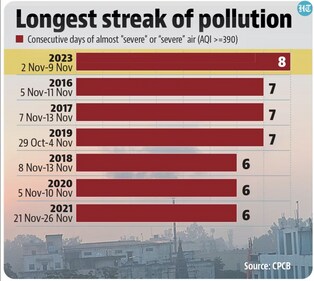
Taking Thursday’s 4pm average air quality index (AQI) of 437, the city has now recorded “severe” air pollution on seven of the nine days this month. On the two days with the mild improvements, the pollution level was still on the cusp of severe, coming in at 392 on November 2 and 397 on November 7.
In fact, such small improvements from the “severe” threshold cannot be taken seriously when the number and location of stations that feed the Central Pollution Control Board’s AQI bulletins are not necessarily the same on every day. For example, 31, 33, and 35 stations were used to calculate Delhi’s average AQI on November 7, 8, and 9, respectively.
It is for this reason that it is important to check if Delhi’s air has been this long around the “severe” threshold. If an AQI of 390 or higher was considered “severe” enough, the current eight-day spell is the longest of bad air streaks among the 74 such spells Delhi has recorded since 2016.
“There has not been much change in the meteorological conditions over the last 24 hours. The wind direction was predominantly westerly to northwesterly,” said Kuldeep Srivastava, scientist at India Meteorological Department (IMD).
He said there were strong winds — up to 12km/hr — for a brief period in the afternoon. “However, winds were largely calm before and after that. At Safdarjung, predominant calm wind conditions prevailed throughout the day, with a maximum wind speed of 8km/hr recorded around noon there,” he said.
A significant increase in wind speed — to over 15 km/hr — was expected only on Saturday, he added.
To be sure, the following day is the festival of Diwali when many are likely to --- as they do every year --- ignore the ban on firecrackers and add a toxic cocktail of smoke to the already high level of pollution in the air.
The weekend is also time when the air quality is expected to improve to “very poor”, according to the Early Warning System (EWS) for air quality forecasts of the Union government.
“Delhi’s AQI is likely to remain in the ‘severe’ category on November 10. The air quality is likely to improve after that and should be in ‘very poor’ on November 11 and 12. The outlook for the subsequent six days shows the air quality is likely to be between ‘very poor’ and ‘severe’,” said EWS on Thursday.
The Supreme Court is scheduled to hear the pollution matter again on Friday. The cabinet secretary, after a detailed deliberation during the meeting, told the district collectors and magistrates, police officers and police station in-charges to ensure there is no further stubble burning, the official quoted in the first instance said.
Union environment minister Bhupender Yadav accused the AAP, running the government in Punjab and Delhi, failing to provide alternatives to farmers in Punjab.
“This country is yet to see a bigger liar than Arvind Kejriwal. 93 percent of farm fire events this year have happened in Punjab, turning Delhi-NCR into a gas chamber, because the Aam Aadmi Party has failed to provide alternatives to farmers. This is a criminal failure of governance on the part of AAP,” Yadav posted on X.
He said the Centre has given ₹1,426.41 crore to Punjab for procurement of machines to manage crop residue and that AAP convener Arvind Kejriwal and Punjab chief minister Bhagwant Mann should answer how they spent the money.