E-Paper



CBSE Class 10, 12 board exams begin tomorrow, 4.2 million students to appear
The 2024-25 academic year CBSE board exams will be conducted at 7,842 centres across India and in 26 other countries

 Prefer HTon Google


New Delhi: Over 4.2 million students are set to appear for the Class 10 and 12 Central Board of Secondary Education (CBSE) exams, which begins on Saturday. The 2024-25 academic year CBSE board exams will be conducted at 7,842 centres across India and in 26 other countries.
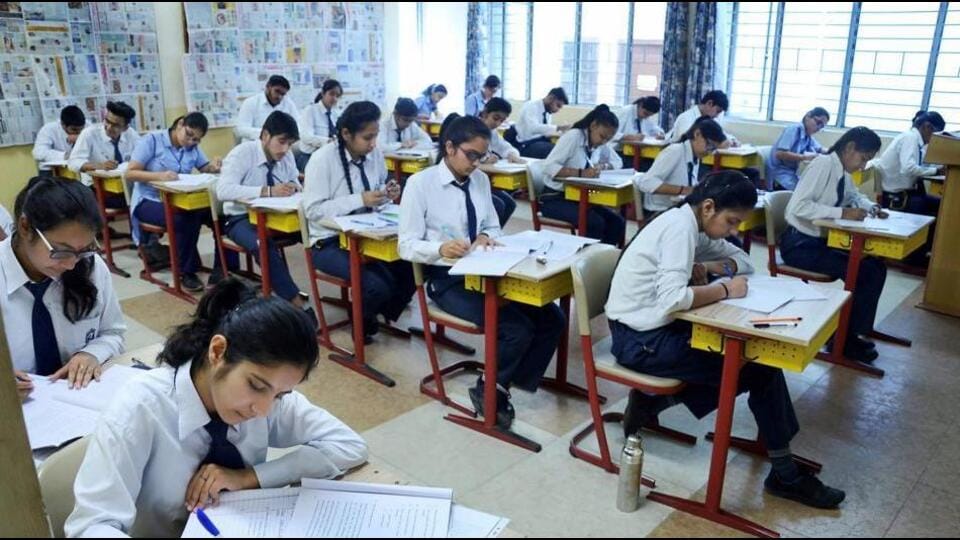
A total of 24,12,072 Class 10 students will take exams across 84 subjects, while 17,88,165 Class 12 students will appear for exams in 120 subjects, according to data shared by the board. The Class 10 examinations will end on March 18, while Class 12 exams will end on April 4.
The total number of students appearing for the board exams in 2025 is 42,00,237, an increase of 3,14,695 compared to last year’s 38,85,542 students.
On the first day of the CBSE board exams, Class 10 students will appear for the English (Communicative) and English (Language and Literature) papers from 10.30 am to 1.30 pm. Class 12 students will take the Entrepreneurship paper in the same shift.
“No student will be permitted to enter the examination centres after 10 am and will not be allowed to leave before 1.30 pm, when the exam ends. For entry to examination centres, regular students must bring their admit card along with the school identity card, while private students must bring their admit card and any government-issued photo ID. Regular students are required to wear school uniforms, while private students can wear light clothing,” said a CBSE official.
Also Read: CBSE 10th Science Exam 2025: Key topics, preparation tips and time management tricks
“The conduct of board exam in a free and fair manner is of utmost importance. The examination department of CBSE is continuously engaged in improving the processes starting from setting model question papers, then the actual question papers, and ensuring their security and secure transport right up to examination centres. The security of the question paper before the examination is to be secured and ensured at all costs,” CBSE chairperson Rahul Singh said, explaining the modalities for the conduct of the board exams 2025 during a webcast with school administrators.
CBSE controller of examination Sanyam Bhardwaj said the board examination centres will be equipped with closed-circuit television (CCTV) and the marks verification process for students had also been updated.
Also Read: Delhi Metro announces measures to aid students in travel during CBSE exams
“A total of 24 students will be sitting in each room of the examination centres and two invigilators will be monitoring them. CCTV will be installed in each room,” Bhardwaj told HT.
In September last year, CBSE issued a CCTV policy to ensure the integrity and fairness of board exams 2025 to deter, detect and address unfair practices during examinations.
“The assistant superintendent of the examination centres will be deputed for every 10 rooms to monitor the footage and report any incident of unfair means practices. The recording will be kept safely for a certain period after the declaration of the board results. We can also demand CCTV recordings from schools prior to the declaration of the results if we get any complaints. Following complaints, schools that fail to provide CCTV footage upon request will be deemed involved in unfair practices and action will be taken against them. Schools have to ensure the proper functioning of CCTVs,” he added.
Teachers have been instructed to evaluate 20 to 25 answer books in eight hours to ensure error-free evaluation. “Earlier students were asking for verification of marks, then photocopy of their answer books and then re-evaluation. This time students can directly ask for photocopies, and they will go through their answer books and find out the mistakes and based on mistakes they will request CBSE for marks verification or re-evaluation or both,” Bhardwaj added.