
 E-Paper



China’s ‘gross aggression’ driving members of Quad: US official
The official’s remarks, made during a background media briefing, followed the meeting on Tuesday of the foreign ministers of the four countries in the informal grouping—India, Australia, Japan and the US


China’s actions across the region and its “sudden turn toward gross aggression” are the factors currently driving the members of the Quadrilateral Security Dialogue or Quad, a senior US state department official has said.
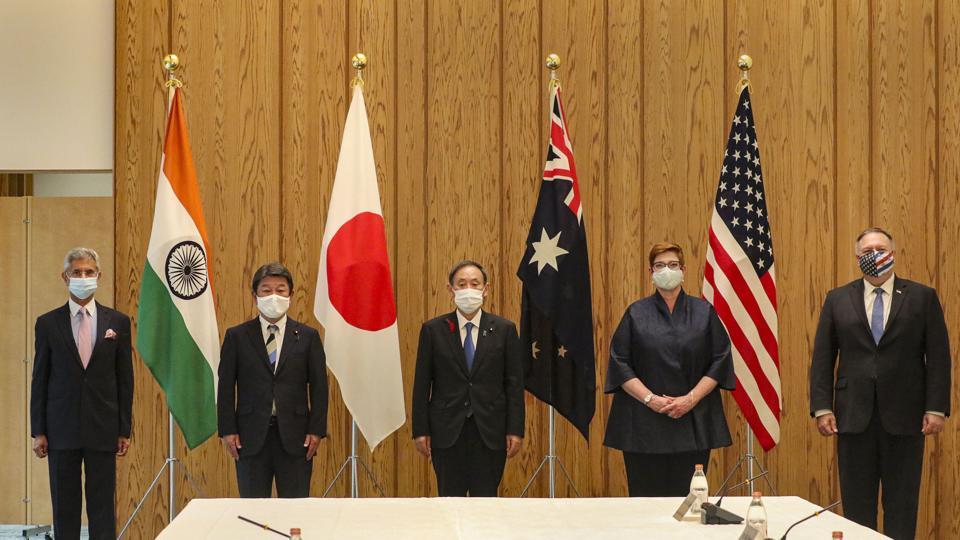
The official’s remarks, made during a background media briefing, followed the meeting on Tuesday of the foreign ministers of the four countries in the informal grouping—India, Australia, Japan and the US. The Quad members, during their discussions, pushed for a rules-based world order and the peaceful resolution of disputes.
Referring to the Quad ministerial meeting and secretary of state Mike Pompeo’s interactions with his counterparts from the three other countries, the state department official, who wasn’t named, said that “there’s no avoiding the fact that it’s China and its actions in the region that make the Quad actually matter and function this time around”.
Also Read: India makes China point, US hints at ‘formal’ Quad
Asked by the media about the fact that Pompeo was the only one of the four foreign ministers who explicitly named China in his opening remarks at the meeting, the official responded by saying that “the single thing that’s driving all this [is] a sudden turn toward gross aggression by the Chinese government in its entire periphery”.
The official referred to the five-month border standoff between India and China and said: “I mean, if you look at the conflict...in the Himalayas between China and India, something that has been in the past handled according to unspoken or unwritten rules...to prevent these things from getting out of control, and then you look at what happened here recently, where you’ve got actually people beating each other to death...”
The official was referring to the June 15 clash at Galwan Valley that left 20 Indian soldiers dead and resulted in unspecified Chinese casualties. The two sides have been unable to move forward with the disengagement of troops at friction points despite several rounds of diplomatic and military talks.
The official further said that China’s aggressive activities were witnessed in many areas. “I mean, you take it all the way around the Indo-Pacific and its western borders, you’re seeing things that you haven’t seen before, and these are responding to that,” he remarked.
Also Read: 4-nation Quad gets cemented at Tokyo meet, sends stern message to China
During their second ministerial meeting, external affairs minister S Jaishankar and his counterparts from Australia, Japan and the US discussed the post-Covid-19 world order and sought a coordinated response to challenges, including financial problems, emanating from the pandemic. They also focused on increasing the resilience of supply chains, and enhancing access to affordable vaccines.
The ministers also discussed connectivity, humanitarian assistance, maritime security, health security and counter-terrorism, and reiterated their support to the centrality of the Association of Southeast Asian Nations and their readiness to work towards realising a common vision for the Indo-Pacific.
Pompeo said in an interview on Tuesday that the US wants to formalise and expand the Quad, with other countries joining the grouping at an appropriate time to “counter the challenge that the Chinese Communist Party presents”.
A second US state department official present at the briefing said Pompeo had spoken earlier about “results-oriented multilateralism” and “voluntary groupings of like-minded nations [which] share common values of democracy, the rule of law, a respect for human rights and individual freedom”.
“So this is a piece of a much larger vision...for multilateralism that really works—effective multilateralism,” the second official added.
The second official further said the issue has to be framed correctly: “This isn’t about a US-China dispute. This is about the free world versus Chinese authoritarianism. And [Pompeo] speaks frequently about that, and that’s the way he framed his discussions, and there was a lot of agreement around that table.”
The Quad remains a loose and informal grouping and there was no joint statement after Tuesday’s meeting, with the four countries issuing separate read-outs on the discussions. This has raised questions among experts as to whether the Quad can effectively work as a counterweight to China.


