
 E-Paper



Chinese spy ship to reach Male, Indian Navy keeps a watch
Maldivian President is continuing with his anti-India campaign for a win at Majlis election in April.

 Prefer HTon Google


A Chinese dual-use survey ship will enter Malé seaport for rotation of personnel and replenishment on Thursday afternoon even as India has decided that a civilian crew will replace the existing non civilian one from India for one Maldivian ALH helicopter in March. HT learns that civilian crew will replace the current ones for the second ALH and the Dornier in April and May. Maldivian President Mohammed Muizzu has made the replacement of the crew of the three aircraft, operated by India in the Maldives for relief and rescue, an election issue for the Majlis elections in April.
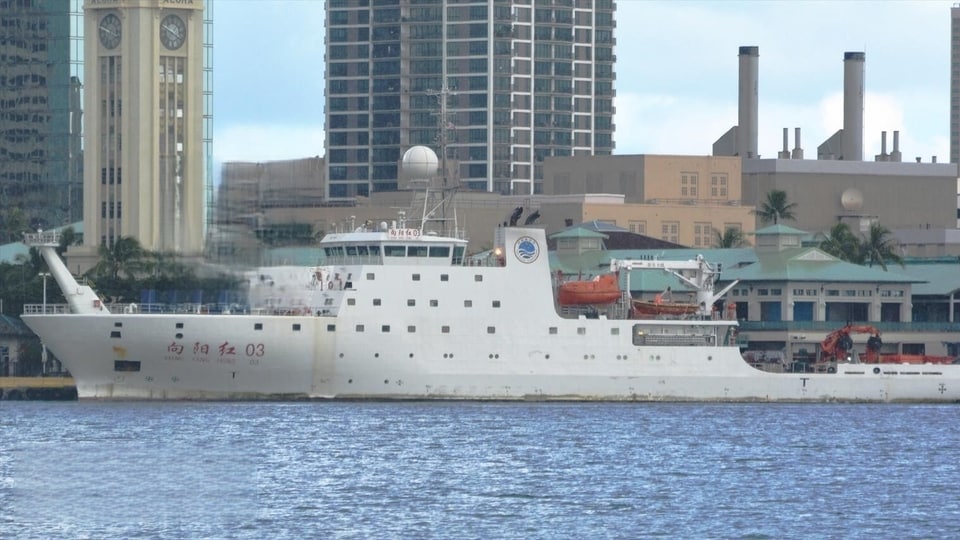
While the Muizzu government has made it clear that the Chinese ship Xiang Yang Hong 3 will only be allowed into Malé port for operational turnaround and will not be conducting any “research” in the Maldivian exclusive economic zone, the ship has both civilian research and military surveillance capabilities. The ship has been behaving suspiciously since it left its port of Sanya in China and the crew was pulled up by Indonesian Navy for switching off its transponder at least three times while crossing the Sunda Straits. Ships do this only when they do not want to be tracked.
Also read: PM Modi hits out at Opposition over China remarks: ‘Acting as someone's agent’
Even though the Chinese ship has been monitored by the Indian Navy since it entered the Indian Ocean Region (IOR), Marine Traffic monitoring sites show that the vessel transponder has been switched off since it entered the Indo-Java sea around a fortnight ago.
According to people familiar with the matter, close monitoring of the ship shows that the vessel has not conducted any research or surveillance activity since it has entered IOR but the possibility of the same cannot be ruled out after the rotation and replenishment in Malé.
The same ship was expected to reach Colombo for maritime research on February 5 but the Sri Lankan government on December 22 decided to close its ports to any Chinese surveillance at New Delhi’s request. The Narendra Modi government conveyed its serious concerns over Xiang Yang Hong 03’s proposed research in Sri Lankan and Maldivian waters at the apex level to Colombo and Malé in 2022 itself.
The Chinese Navy has been extremely active in IOR in 2023 when around 23 warships including a conventional diesel electric submarine were deployed . In addition, around 11 Chinese research and survey ships were spotted in the region. China also had 11 satellite ballistic missile tracking ships in the region that year.
While the Xi Jinping regime claims that these ships are only carrying out surveys in support of Maldives and Sri Lanka, Indian intelligence inputs indicate that the PLA is charting Indian Ocean bed for new submarine routes through Sunda, Lombok and Ombai-Wetar straits. The main reason for new routes to IOR is that submarines have to surface if they come into Andamans Sea through Malacca Straits due to depth issues.


