
 E-Paper



Culprits of 26/11 Mumbai attacks must be brought to justice, say India, US
Pakistan’s support of terrorism was brought up by Vice-President Kamala Harris, unprompted, during her discussions with Prime Minister Modi on Thursday.


India and the United States bilaterally, and with Quad partners Australia and Japan, on Friday strongly denounced “cross-border terrorism”, usually a pointer to Pakistan, the use of terrorist proxies and the need to cut logistical, financial and military support to terrorists.
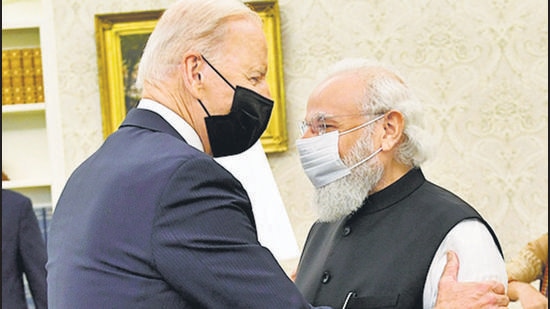
Terrorism along with Afghanistan, a free and open Indo-Pacific, the fight against Covid-19 pandemic and climate change emerged as key issues of concern and discussion for the two platforms that met one after the other at the White House on Friday.
US President Joe Biden hosted his first bilateral summit with Prime Minister Narendra Modi and then the first ever in-person summit of the Quad, joined by Australia’s Prime Minister Scott Morrison and Japan’s Yoshihide Suga. The American and Japanese leaders ended the day with their separate bilateral meet.
At the India-US bilateral summit, the two sides agreed that the issue of terrorism remains important. “Counterterrorism efforts in cooperation between the two countries will be given a lot of emphasis,” India’s foreign secretary Harsh Vardhan Shringla said while briefing reporters on India’s participation in the two meetings. “Both sides denounced any use of terrorist proxies and emphasized the importance of denying logistical financial or military support to terrorist groups, which could be used to plan or launch terror attacks.”
The India-US joint statement said the two leaders reaffirmed that the United States and India stood together in the shared fight against global terrorism, and will take concerted action against all terrorist groups, including groups proscribed by the UN Security Council. The statement condemned cross-border terrorism, and called for the perpetrators of the 26/11 Mumbai terror attacks to be brought to justice.
Pakistan’s continued support of terrorism came up a in the context of Afghanistan, where the Taliban has seized power after the US army withdrew from the country, and Pakistan’s continued support for a “certain approach” that is not seen to be conducive to the international community’s expectations of what Afghanistan should be like.
Pakistan’s support of terrorism was brought up by Vice-President Kamala Harris, unprompted, during her discussions with Prime Minister Modi on Thursday.
As a long-time victim of terrorism, most of it emanating from across its western border, India has made counterterrorism a key foreign policy objective. It has been a part of the India-US dialogue for years. On Friday, it also became a key element of the Quad’s agenda at India’s insistence.
“I think we are looking at fairly strong language with regard to the Quad’s commitment on terrorism and the need to counterterrorism, anywhere in the world,” India’s foreign secretary said, speaking of India’s role in making counterterrorism an issue for the Quad as well. “It reinforces the Quad’s thinking on this issue, and the need to combine efforts to deal with this common scourge.”
“We denounce the use of terrorist proxies and emphasized the importance of denying any logistical, financial or military support to terrorist groups which could be used to launch or plan terror attacks, including cross-border attacks,” the Quad said in a joint statement.
Afghanistan was discussed at length at the Modi-Biden meeting. The two leaders resolved that the Taliban must abide by a UN Security council resolution that was passed in August during India’s presidency and ensure that Afghan soil is never again be used to threaten or attack any country or shelter and train terrorists, or plan and finance terrorist attacks. The meeting underscored the importance of combating terrorism in Afghanistan.
The Taliban should grant free and safe passage to Afghans and foreign nationals, respect the rights of all Afghans, especially women, children and minorities, and afford access to agencies providing humanitarian aid.
The two sides also discussed the need to reinvigorate trade talks, enhance cooperation on defence production, intensify joint efforts on fighting the Covid-19 pandemic through vaccines, climate change, people-to-people ties, which included H-1B visas for specially skilled workers, and other issues that the two sides are engaged in at the same time.
The India-US agenda is so exhaustive that President Biden said the summit meeting should have been allocated two days, Shringla said. The meeting overshot its scheduled time by 30 minutes.
At the historic first in-person summit, the Quad announced the launch of several new initiatives, such as an annual fellowship for 100 students in science and technology, a working group to enhance cooperation between the four countries on space, a new infrastructure partnership, formation of a green shipping network, establish a clean hydrogen partnership; and publish a Quad statement of principles on the use of technology.


