
 E-Paper



Cyclone Amphan leaves a trail of destruction; at least 12 people killed
A task force would meet at the state secretariat at 3pm on Thursday to make a preliminary assessment of the damage caused by the cyclone Amphan.


Super cyclone Amphan, which had hit the West Bengal coast with wind speed gusting up to 185 km per hour (kmph) around 2.30pm on Wednesday, is estimated to have killed at least 12 people and left behind a trail of destruction that the cyclone-prone south Bengal has not faced in many years.
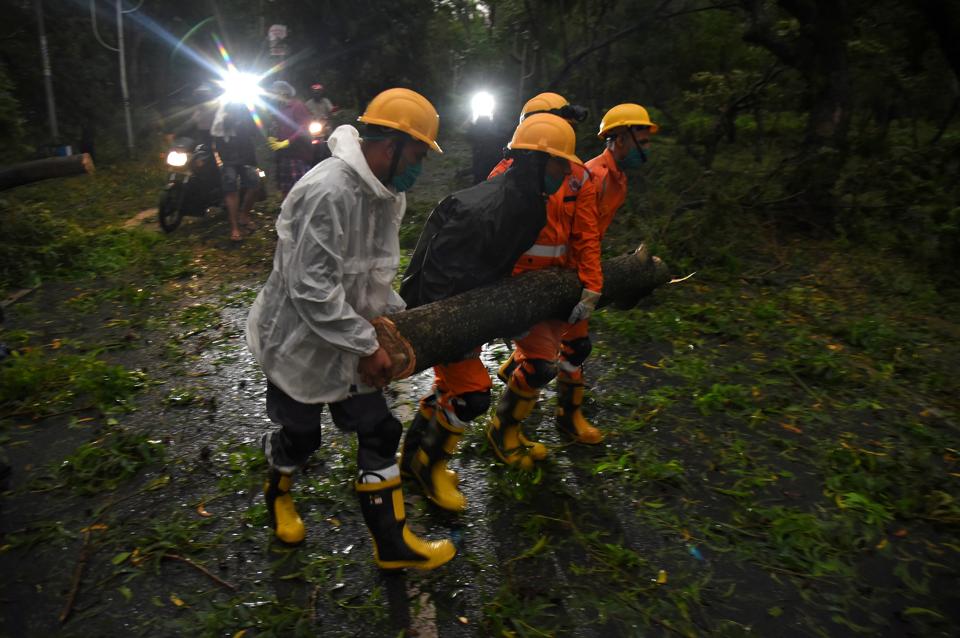
“Up to 12 people are likely to have been killed. The cyclone has devastated the state. At least two districts – North 24 Parganas and South 24 Parganas -– have been totally destroyed. We never thought that it would be so devastating,” chief minister Mamata Banerjee said on Wednesday night.
Click here for cyclone Amphan LIVE updates
In the coastal blocks and riverine areas in the south Bengal, the cyclone damaged embankments and saline water from the Bay of Bengal, whose levels rose at least six metres because of swirling tidal waves, gushed in, destroying farmlands and houses. Around five lakh people have been evacuated to relief camps.
“Cyclone Amphan’s devastation was worse than both cyclones Bulbul and Aila. Many would’ve died had we not evacuated five lakh people. Around 1.8 lakh were evacuated during cyclone Bulbul. Some were comparing Amphan with a storm that had struck Bengal in 1737 that had killed thousands,” said a senior government official, who is entrusted with the responsibility of relief work.
“I can see only water, wherever my eyes take me. The trail of destruction is unimaginable. Cyclone Amphan couldn’t have hit us at this worst time, when we’re struggling with the coronavirus disease (Covid-19) induced lockdown restrictions. We’re at our wit’s end. We don’t know what to do,” said Pinaki Mondol, a resident of Gosaba, one of the worst-hit blocks in the South 24 Parganas district.
A task force would meet at the state secretariat at 3pm on Thursday to make a preliminary assessment of the damage caused by the cyclone Amphan.
“It would take three to four days for the news to come in from all the districts. We’ll make the assessment on the basis of the inputs. Bengal has borne the maximum burnt. Communication links in a large part of the state are cut off. We’re not being able to establish contacts in the worst-hit south Bengal districts,” she added.
In the state capital, Kolkata, hundreds of trees, lamp posts and traffic signals have been uprooted. They are lying strewn on main thoroughfares, blocking traffic movement, and also damaged stationary vehicles. In Kolkata, the wind speed reached up to 130kmph.
At least two persons – a mother and her son -- were killed in Kolkata when a wall collapsed on them. Large parts of Kolkata plunged into darkness on Wednesday night, as power supply went off.
“Our building was swaying and water gushed in through the windows. It was scary. I have never seen such a storm in my life. It was worse than cyclone Aila, which hit in May 2009 and caused severe damage,” said Arpita Pal, who resides on the 10th floor of a high-rise building in east Kolkata, where cyclone Amphan grazed before gathering momentum and gusting into neighbouring Sunderbans.
Bengal Governor Jagdeep Dhankhar tweeted a video on Thursday morning in which several trucks could be seen lying on their sides on a highway in the wake of cyclone Amphan.


