
 E-Paper



Day after IED attack on bus carrying DRG jawans, Chhattisgarh police clueless
Intelligence sources said that the IEDs were wrapped in a carbon paper and were planted just ahead of the culvert where the blasts took place, but senior police officials denied the theory.


A day after the IED attack on a bus ferrying security forces in Narayanpur by Maoists, the Chhattisgarh police is perplexed about how the IEDs were planted and triggered near a culvert on the road, when a Road Opening Party (ROP) was guarding the stretch for the safe passage of security forces.
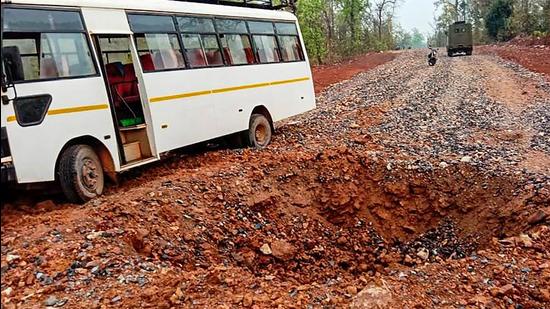
On Tuesday, special director general (Anti-Naxal operations), Ashok Juneja told the media that demining of the road was also done for the movement of security forces, which raises questions about how IEDs were not detected even after the exercise.
In Maoist affected areas, a police party which is called ‘ROP’ is deployed on both sides of the road before any movement of security forces or VIPs.
The ROP sanitizes around 100 meters on both sides of the road to avert any possible ambush or Maoist movement.
Intelligence sources said that the IEDs were wrapped in a carbon paper and were planted just ahead of the culvert where the blasts took place, but senior police officials denied the theory.
Officials also believe that a better network of human and technical intelligence would have alerted security agencies regarding the incident, but it was not properly done.
Around 90 DRG jawans were returning in four buses after a two-day anti-Naxal operation which took place in the jungles of Abujhmad in Narayapur district when the blast took place on Tuesday evening on the under-construction Barsoor-Palli road which is surrounded by the dense forest of Abujhmad. The buses were moving on the road with a gap of 15 minutes and the first bus was targeted by Maoists with three IEDs.
Five jawans who were sitting on the front seats of the bus, including the driver were killed since the blast took place as soon as the bus reached a culvert on the road. A total of 17 were injured and four are admitted to a hospital in Raipur.
“As most of the IED incidents have happened near culverts, security forces should have been present near the culvert so that IED handlers would not have dared to trigger the IED. How is this possible that even after ROP was deployed, someone was within 100 meters near the culvert and triggered the bomb? This raises serious concerns over the ROP. What if the Maoists were in a team and ambushed the jawans? It would have led to more casualties,” a senior police official who did not wish to be named said.
Officials believe that a blast could have been averted if bikes were used to bring back companies to base camps instead of buses.
“As the location of the forces was revealed during the operation, the Maoists must have noticed that DRG comes back to district headquarters after every operation. Maoists must have been following the bus from the origin and thus must be doing real time monitoring,” another official said.
Director General of Police, DM Awasthi, who visited the spot said that he had ordered an investigation to arrest the accused.
“I have asked the concerned official to provide all necessary details about the attack,” the DGP said.
When asked how the Maoists managed to trigger the IED when there was ROP guarding the road, Inspector General of Police, Bastar Range, Sunderaj P said that the cadres who triggered the explosion were in civil camouflage.
“The Maoists must have used IEDs of around 30 kg. It was a command IED operated by electric wire and battery for power source. Since, the place of the incident is a dense forest and most likely the IEDs were operated by a couple of cadres in civil camouflage. After road opening was done by security forces, demining was also done but unfortunately the IED were not detected. We are examining the reasons and modus operandi,” said the IG.
-kW0H-U20214218012MgB-250x250%40HT-Web.jpg)


