
 E-Paper



Decoding PM Modi’s pre-poll run in Bengal and Assam
During these day-long tours, Modi not only inaugurated projects and welfare schemes as prime minister but also sent strong political messages as the BJP’s face. The location of Modi’s events, be it political or administrative, also gave a glimpse of BJP’s geographical priorities in the upcoming elections


Voters in West Bengal, where the Bharatiya Janata Party (BJP) has gone on a war footing against the Mamata Banerjee government, and Assam, where the saffron camp wants its coalition government to continue, have had a special visitor thrice over the last 30 days — Prime Minister Narendra Modi.
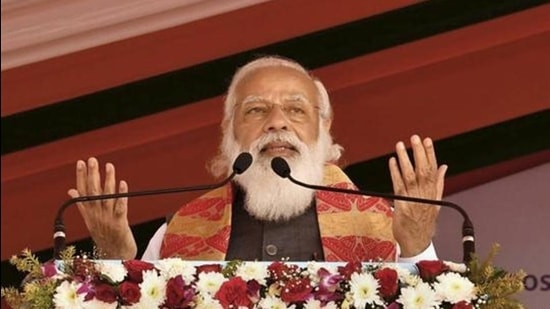
Modi’s plane landed in each state on January 23, February 7 and February 22 and BJP leaders are planning his fourth visit on February 28.
During these day-long tours, Modi not only inaugurated projects and welfare schemes as prime minister but also sent strong political messages as the BJP’s face. The location of Modi’s events, be it political or administrative, also gave a glimpse of BJP’s geographical priorities in the upcoming state elections.
So what are the broad patterns that can be gleaned from the PM’s pre-poll visits to eastern India?
Owning Bengal’s icons
Modi’s first visit to Kolkata in this period, on January 23, was focused entirely on the Centre’s decision to celebrate the birthday of freedom fighter Subhas Chandra Bose, Bengal’s cultural icon, as Parakram Diwas, or day of valour, but the political subtext was hard to miss. The Trinamool Congress, for its part, celebrated January 23 as Desh Nayak Diwas (day of the national hero) while the Forward Bloc, the party Bose formed in 1939, observed Desh Prem Diwas (day of patriotism). This competitiveness was in stark display when Banerjee disapproved the raising of the Jai Sri Ram slogan by BJP supporters present at Modi’s main event. That was the last time she shared the dais with Modi.
Also Read | PM Modi to inaugurate super specialty hospital at IIT Kharagpur today
The visit — and the tussle — represented a deeper battle. The BJP is keen to own and appropriate a Bengal icon, at a time when the Trinamool is accusing the BJP of being a party of “outsiders” with no organic connection to the state. The slogan of Jai Sri Ram — which so irked the CM — is a feature of the same battle; it has become a rallying cry for the BJP, particularly among the subaltern, while the TMC sees it as out of tune with Bengal’s cultural vocabulary.
Vikas, welfare, identity in Assam
On the same day, the PM then visited Assam, where he distributed land allotment certificates to 106,000 landless indigenous families who will get seven bighas (a bigha is equal to 14,400 sq. ft.) of agricultural land and another bigha for building a house. In urban areas, people will get 1.10 katha while in Guwahati, the state will allot 1.50 “katha”. In Assam, a “katha” is equal to 2,880 sq. ft. In 2016, this was BJP’s electoral promise, and the party clearly wanted to be seen as “delivering” before the polls. The move also aligns with the BJP’s attempts to tap into the indigenous vote, and build on its politics of welfare.
Significantly, Modi also addressed a rally at Jerenga Pathar, a historic site where Joymoti, an Ahom princess, sacrificed her life in the 17th century to save her husband, Prince Godapani, who later became a king of the Ahom dynasty.
“Jerenga Pathar is the ‘balidan-bhoomi’ (land of sacrifice) of Joymoti. We are taking steps to include this land in a list of five iconic archaeological sites in the country,” Modi told the crowd. But with it, he was sending a signal to the broader Ahom community, as well as acknowledging the cultural distinctiveness and rich history of the state.
Also Read | Will make more trips till poll dates out: PM
Modi’s next visit to Assam on February 7 was marked by his rally at Dhekiajuli, launch of an ambitious road network project and laying the foundation stones of two medical college and hospitals to be built at a cost ₹1,122 crore in Biswanath and Charaideo districts. The Asom Mala statewide road project will cost another ₹5,500 crore. This was clearly an attempt to showcase the infrastructure and development-oriented political messages of the party.
But that day, the big takeaway from Modi’s public remarks was his allegation, at a tea garden, that an international campaign is on to tarnish the image of the Indian tea industry to which Assam’s contribution is sizeable.
“I want to tell these conspirators from Assam’s soil that the country will never allow their plans to succeed. Our tea workers will win this fight as these attacks are not capable of countering their hard work,” he said. The PM also spoke about giving ₹3,000 each to 750,000 tea garden workers and praised the Union budget which allocated ₹1,000 crore for tea garden workers in Assam and West Bengal.
The PM appeared to be attempting multiple messages here — a signal to the rest of the country about the looming “foreign conspiracy”, a key tenet of the government’s response to global tweets in solidarity with the farm protests, and a signal to Assam that only the BJP can protect the tea industry and cares for it.
Selecting Dhekiajuli for Modi’s rally was also significant. In September 1942, police gunned down 17 people in this town in Sonitpur district during the Quit India movement. Modi did not miss the symbolism.
“This is the land where the people of Assam defeated the invaders, showcased their unity, power and valour. In 1942, the freedom fighters of Assam sacrificed their lives for our freedom and the honour of the tricolour,” Modi said in his address.
Experts feel that while the meeting at Sivasagar was held to address Ahom votes, the one at Dhekiajuli focused more on tribal people who work for the tea industry. The BJP has been promising to grant scheduled tribe status to both along with four other communities.
Nearly 1.1 million workers are employed in around 800 large tea gardens in Assam. They can influence poll results in 35-40 of Assam’s 126 assembly seats. Similarly, Ahom votes play a crucial role in Upper Assam districts.
“The BJP has been able to influence the tea tribes with a number of policies of which their political representation is a part,” said professor of political science at Gauhati University, Akhil Ranjan Dutta.
“Though the party managed to win some seats in the Ahom strongholds in the last Lok Sabha and assembly polls, the margins of victory were not high. The PM’s rally in Sivasagar was an attempt to consolidate Ahom votes,” Dutta added.
Winning over South Bengal
Modi’s visit to Haldia in Bengal’s East Midnapore district on February 7 was significant. The district is in the eye of a political storm since December 19 when former cabinet minister Suvendu Adhikari joined the BJP. His elder brother Dibyendu Adhikari, the TMC Lok Sabha member from Tamluk in East Midnapore, was present when Modi inaugurated some major power and road projects that day while their father, Sisir Adhikari, the TMC’s most senior Lok Sabha member from the district’s Kanthi seat, skipped the event citing illness.
With the TMC in control of all 16 assembly seats in East Midnapore, which has Muslim and well as tribal voters, the Adhikari family now plays a crucial role for the BJP. Banerjee has decided to contest the Nandigram assembly seat that Suvendu Adhikari represented.
Also Read | Focus should be on providing defence equipment to smaller nations: PM Modi
Although the saffron camp won seven of the eight Lok Sabha seats in the north Bengal region in 2019, these seats comprise only 56 of the state’s 294 assembly segments, and that is why there is now focus on south Bengal.
“South Bengal, which accounts for the remaining 238 assembly seats and where the BJP was ahead of the TMC in only 87 in 2019, will decide the fate of Bengal,” a senior executive of IPAC, the company owned by Banerjee’s election strategist Prashant Kishor, told HT.
At the BJP rally on February 7, Modi talked of East Midnapore district’s contribution to Bengal’s history but focused on development in entire south Bengal as well as east and north-east India.
At the government event, he launched an LPG import terminal built by Bharat Petroleum Corporation Limited at a cost of ₹1,100 crore. “The project will provide LPG to Bengal and other states in east and north-east India,” said Modi.He also launched the 348 km Dobhi-Durgapur Natural Gas Pipeline section, which is part of the Pradhan Mantri Urja Ganga project and will help revive the HURL Sindri (in Jharkhand) fertiliser plant, supply gas to Matix Fertiliser Plant at Durgapur in Bengal’s West Burdwan district, and provide gas to industrial, commercial and automobile sectors as well as domestic consumers in major towns of Bengal.
The PM returns to the east
On his third visit to Assam on February 22, Modi launched several oil and gas projects, inaugurated an engineering college and laid the foundation stone of another. He accused the erstwhile Congress governments of treating the north bank of Brahmaputra in a step-motherly manner.
After his plane touched down in Bengal later that day, Modi called for “asol paribartan” (real change) while mounting an attack on the TMC at a rally in Hooghly district where the BJP would win only one Lok Sabha seat in 2019. Later, he flagged off some railway projects, including the extension of the north-south Metro corridor, which connects Kolkata to its adjoining areas where the BJP could not make much headway in 2019.
“Development of Bengal is not possible as long as extortionists rule. No investor will come to Bengal,” Modi said in Hooghly in a bid to connect with the region’s jobless industrial workers.
The ruling party’s leader in the Rajya Sabha, Derek O’Brien, tweeted the image of a decade-old press release which said Banerjee, who was then Union railway minister, introduced 34 projects, including the ones Modi inaugurated.
An examination of the venue for the PM’s speeches, political messaging, and the projects he has chosen to unveil indicate that not only are elections in Bengal and Assam are high up on the agenda for him, and the BJP is betting a mix of development, infrastructure, identity-based pride, specific welfare measures for specific communities, and its broader nationalist appeal to win Bengal and defend Assam. With the PM promising to return to them states before elections are announced in early March, even before the campaign has officially begun, Narendra Modi has set the stage for the BJP’s outreach to voters in the two states.


