E-Paper



Deficit, excess, deficit: Uneven rains mark monsoon this year
By October, the annual summer rain-bearing system retreats from most of the country, leaving only patchy spells of precipitation behind.

 Prefer HTon Google


Monsoon 2023 has been a story of swings, and as the months progressed, the variations only became more intense: 9% deficient in June, excess by 13% in July, deficient again by 36% in August and, finally in September, excess by 13%.
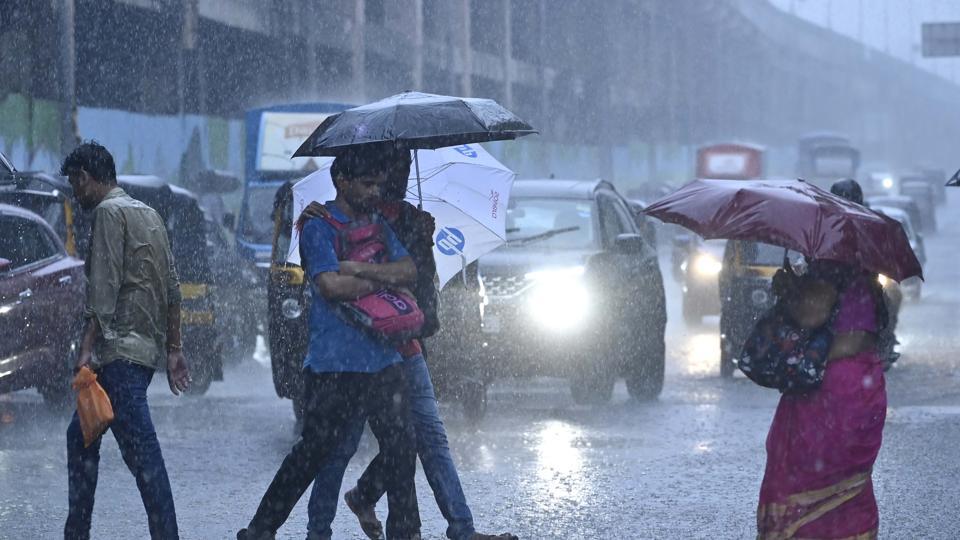
By October, the annual summer rain-bearing system retreats from most of the country, leaving only patchy spells of precipitation behind. But the coming month is likely to be consistent with the wild swings seen this year, with two low-pressure areas over the Bay of Bengal and the Arabian Sea bringing in moisture over land.
We are on WhatsApp now. Click to join.
Experts said there is little understanding of what has caused this wobbling pattern, but added that it is a sign of things to come as the climate enters uncharted territory with human activity over decades having pushed warming to unprecedented levels.

“This year monsoon was very interesting. It is not a very text book pattern. Even though we may end up with 6% deficiency, there are close to 70% districts under mild [deficient] category or worse,” said M Rajeevan, former secretary, ministry of earth sciences and climate scientist, adding that a number of global climatological phenomenon may have led to this.
“El Niño had its impact but was overshadowed in September. We are not sure what else must have helped. Negative Pacific Decadal Oscillation (PDO) and positive Indian Ocean Dipole (IOD) favourable Madden Julian Oscillation (MJO) phases must have helped,” added Rajeevan.

El Nino is a warming of the equatorial pacific waters that, among other effects, is known to sap the monsoon rains of their vigour in India. Positive IOD --- the temperature differential between the western and eastern Indian Oceans --- on the other hand is good for southwest monsoon over India.
MJO is described as an eastward moving pulse of cloud and rainfall near the equator that typically recurs every 30 to 60 days.
The monsoon is critical for India’s economy, where 51% of India’s farmed area — accounting for 40% of production — is irrigated by rain. As many as 47% of the country’s population is dependent on agriculture for livelihood, making such inconsistency a challenge not just for farmers who need to time their sowing and harvesting right, but also the larger economy.
“This year is well known for large spatial and temporal variability. Past data shows temporal variability is increasing which will increase in future climate also,” he added.
A second scientist concurred. “During end of August we suddenly saw the pattern change. During August the impact of El Nino was strong but positive IOD and favourable MJO location neutralised the impact of El Nino to an extent. This is clear in the data,” said DS Pai, senior scientist, IMD.
A third expert said the monsoon itself is very complicated. “Monsoon is a very dynamic system which cannot be completely dominated by global meteorological phenomenon,” said M Mohapatra, director general, IMD.
To be sure, similar trends have been captured in the past but they have been subtler, usually playing out as extended dry periods or less rain over the northeastern region and to an extent over parts of north India. The rainy period over west and northwest India has conversely been increasing.
According to data from the India Meteorological department, there was 9% rainfall deficiency over northwest India; 26% deficiency over east and northeast India; 49% excess over central India and 22% excess over peninsular India in September – figures that underscore the highly skewed distribution of rainfall during the month.
September was dominated by effects of several cyclonic circulations and low-pressure areas which are normally recorded in August.
In August, there were 20 break monsoon days, compared to 16 such days in 2005, which held the previous record for the spells when the monsoon is extremely weak.
That month was also marked by large-scale rain-triggered devastation in Himachal Pradesh and Uttarakhand, even as much of the country remained parched.
On Friday, the IMD said the low-pressure area over eastcentral Arabian Sea, south of the Konkan-Goa coast, is likely to intensify, as will another similar formation over northeast and adjoining east-central Bay of Bengal. These will together bring rains to parts of east-central and west India in the coming days, in a month when the rains are supposed to wind down.
The wild swings were also captured by intense bouts of rain in north India. An interaction between a western disturbance and the monsoon trough led to extremely heavy rain over Himachal Pradesh, Uttarakhand, Punjab and Haryana in July, causing landslides and flash floods that washed away highways and settlements.
“Northeast India is recording below normal rainfall in recent years. This year east India also recorded some deficiency. The span of monsoon rainfall has increased over northwestern region, two years ago when we issued new onset and withdrawal dates, the onset dates for west and northwest have advanced with withdrawal dates have been delayed. Before than monsoon would begin withdrawing from September 1 but now new date for commencement of withdrawal is September 17. So, the monsoon period over the western region has increased,” said Pai.
“The peak monsoon month continues to be July,” he added.
Overall, the monsoon --- which officially ends on September 30 --- will close with below normal rain on Saturday. There is a 6% deficiency overall in the country, with 19% deficiency over east and northeast India; 8% deficiency over South Peninsula; 0% deficiency over central India and 1% excess over northwest India.
Rainfall of 90 to 95% of long period average is considered to be in the “below normal” category while less than 90% is considered “deficient.” Monsoon rainfall between 96 to 104% is considered “normal.”
This is likely to be the first below normal monsoon after four consecutive years of above normal or normal monsoon. In 2022 monsoon was 106% of LPA’ 99% in 2021; 109% in 2020 and 110% in 2019.
Due to El Nino, there were fears that deficiency in rainfall could be very high and hit a sector that depends most on it: agriculture. But September’s unexpected resurgence allayed those fears, with sowing figures showing a clear uptick.