
 E-Paper



Delhi, Punjab working on joint proposal to pay farmers for not burning stubble
The Aam Aadmi Party (AAP) governments in Punjab and Delhi are proposing a scheme that would give Punjab’s farmers ₹2,500 per acre as an incentive for not burning crop residue during the upcoming kharif harvest season, people familiar with the matter said. The move is aimed at tackling paddy stubble fires — a major contributor to severe air pollution in the National Capital Region before the advent of winter.

 Prefer HTon Google


Chandigarh: The Aam Aadmi Party (AAP) governments in Punjab and Delhi are proposing a scheme that would give Punjab’s farmers ₹2,500 per acre as an incentive for not burning crop residue during the upcoming kharif harvest season, people familiar with the matter said. The move is aimed at tackling paddy stubble fires — a major contributor to severe air pollution in the National Capital Region before the advent of winter.
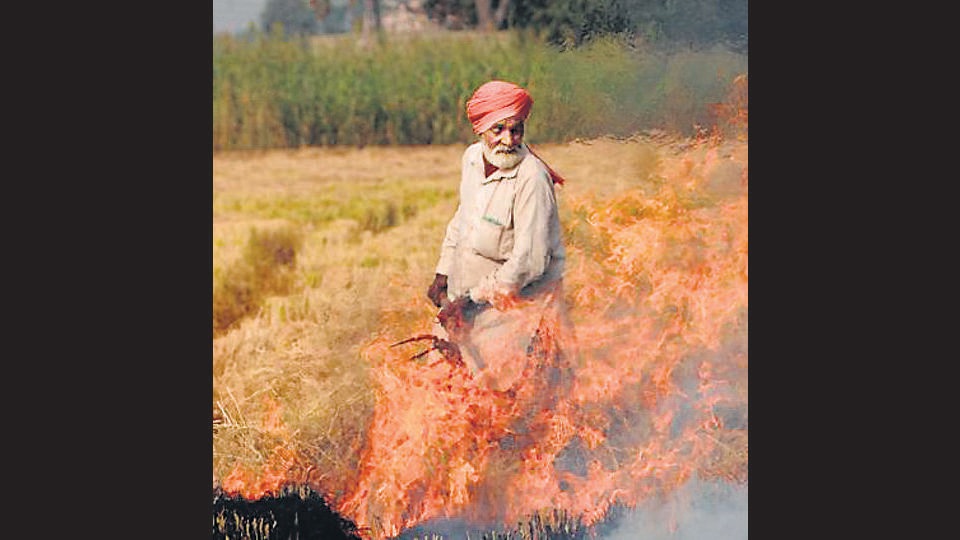
HT learns that the AAP government in Delhi has agreed to share a part of the cost for the scheme, which may also require a significant contribution from the Union government. Punjab chief secretary VK Janjua confirmed that the proposal is being fine-tuned. The scheme involves an expenditure of ₹1,875 crore.The Punjab and Delhi governments may contribute ₹375 crore each, and the two governments are hoping that the Centre will contribute the remaining ₹1,125 crore, officials indicated.
“The proposal will be shortly sent to the finance department and subsequently it will be forwarded to the Delhi government. We are also writing to the Centre to allocate funds for its share of promised incentives,” said a senior officer in the agriculture department, asking not to be identified.
The previous Congress government in the state had sought ₹100 per quintal as incentive from the Centre to check stubble burning in 2019. Punjab’s farm unions have also been demanding a direct cash incentive instead of subsidy for machines for in-situ management of paddy straw. The funds, however, did not come through.
“ In case the Centre doesn’t accept our demand for its share in cash hand-out scheme, the AAP governments in Chandigarh and Delhi will still go ahead with their plan and will give at least ₹1,000 acre to farmers,” says a senior bureaucrat in Chandigarh in the know of matter.
A spokesperson for the Delhi government on Tuesday refused comment when asked about the scheme.
During the kharif season, paddy is sown over 29-30 lakh hectares (70-72 lakh acres) in Punjab. According to the proposal, all farmers who desist from burning paddy residue will be covered under the incentive plan.
The state produces roughly 185 lakh tonne of paddy crop residue every year. Of this, 49% is managed in-situ (mixing the residue in the soil) and ex-situ (used as fuel) methods and rest is set ablaze.
After the paddy harvest, the window for rabi (wheat) sowing is very short. The farmers prefer to burn the stubble as it is the cheapest method to ready their farms for next sowing.
In the past four seasons, at least 90,000 machines have been supplied to farmers in Punjab, with the Centre releasing ₹269 crore, ₹273 crore, ₹272 crore and ₹331 crore in 2018, 2019, 2020 and 2021, respectively.
The Centre has allocated ₹275 crore (against a demand of ₹474 crore) to Punjab for in-situ management of stubble for the current kharif harvest season. All these grants, however, have failed to bring down the raging farm fires, with 2021 alone reporting a total of 71,246 incidents during the paddy harvest season.
The Punjab government, according to officials, will ask the Centre to be a contributor in the proposed scheme of cash incentive instead of funding the existing scheme of subsidy for machinery for stubble management.
“It’s a good step if the government is serious to lend support to the farmers. I believe Punjab farmers are eager to do their bit for the environment and if they are offered an incentive, they will readily do so,” said Bharatiya Kisan Union (BKU) president Balbir Singh Rajewal. However, he was sceptical about the funds. “From where will the government bring funds? An incentive of ₹1,500 per acre to farmers for adopting sowing of direct-seeded rice (this doesn’t require transplantation) is already pending,” he said.
The Punjab government has kept an outlay of ₹200 crore in its budget this year to check the menace of stubble burning.
In Delhi and its surrounding areas, pollution becomes the focal point of the discourse around public health every year as winter sets in as the area becomes one of the most polluted regions in the world owing to a series of factors such as stubble burning by neighbouring states, emissions from millions of vehicles, construction and road dust.
Data collated by pollution monitoring bodies show that anywhere between 25%-40% of pollutants that form the toxic haze over Delhi between the months of September and November are caused by paddy stubble fires.
In previous years, the AAP government in Delhi has blamed the public health emergency on inaction by neighbouring governments, particularly Punjab, often leading to Twitter battles between Kejriwal and former Punjab CM Amarinder Singh. But with the AAP in power in both states now, the pressure has built on the party to find a solution to the crisis.


