
 E-Paper



Despite ban, workers continue to demand gawking charges in Kerala
‘Nokku koolie’ or gawking charge was banned in 2018 by the Left Front government, but it is still prevalent in many parts of the state. The high court has pulled the state government over the practice.


Thiruvananthapuram:
A consultant with a Mumbai-based private logistics company, Rajeswari S Pillai, who was transporting heavy equipment cargo to the Vikram Sarabhai Space Research Centre (VSSC), took 10 days to cover 70 kms from Kollam to Thumba on the outskirts of Thiruvananthapuram. Almost every day she walked six to 10 kms with the consignment-laden truck with 80 wheels that moved at a snail’s pace, and rested in the accompanying car for several days.
She was happy to notice that people waited for the giant truck along the national highway and clicked enough, and that police and district authorities were at their best to ensure smooth passage to the heavy vehicle. But a dramatic twist was awaiting her at the finishing point -- a group of people lied on the road asking for ‘nokku koolie’, gawking charges, for unloading the cargo.
Nokku koolie is the money charged by trade union workers for the work either done by machine or others from the customer as their right.
Pillai told the people that only heavy cranes can unload the equipment. They said they have no problem with it, but they should get gawking charges. Initially the demand was ₹I0 lakh, later it came down to ₹5 lakh. But she stood her ground. Stranded on the road for three hours, the blockade was finally lifted after the CM’s office intervened and some of the protestors were arrested. Later 50 people were booked.
“I am against paying people who are not doing any work. I don’t want to explain the incident anymore. But I wish it is the last such ‘nokku kooli’ incident in my beautiful state,” Pillai said.
Last week the Kerala high court cited the incident while hearing another case related to ‘nokku kooli’ and asked the government to explain new measures taken to end the menace once and for all.
“This practice was banned years ago, but it is still continuing. It is inviting bad name to the state. We are getting regular complaints. The government should take strict action against those who demand it,” the HC said, seeking a detailed report from the state police chief in two weeks.
‘Nokku koolie’ was banned in 2018 by the Left Front government, but it is still prevalent in many parts of the state. In 2002 a law was framed -- Kerala Loading and Unloading (Regulation of wages and restriction of unlawful practices) Act -- to restrict the practice, but it continued. In 2017 the high court had pulled up the state government, forcing it to ban the practice in 2018, but the menace is far from over.
There were many judgments against the organised crime of fleecing, but often police and the government authorities turn a blind eye to it, fearing retaliation by militant trade union workers. Investors say the practice debilitates industrial growth of Kerala.
Facing criticism, the government is planning to give more teeth to the law banning “nokku kooli’. “The government is considering stringent provisions, including non-bailable provisions, to deal with the menace,” said a senior official who did not want to be named. Though almost all trade unions admit that such worn-out practices invite bad name to the state, they discreetly support such elements.
Last week K N Nair, who was building a house on the outskirts of Thiruvananthapuram, brought marbles and other household material from north India, and headload workers sought ₹25,000 to unload them. When he refused, he was threatened and he finally called the police. Though police settled the issue, he met some of the headload workers on the advice of local leaders and paid them ₹8000 even as the work was done by others. “I was scared that they will destroy unloaded material in the night,” he Nair.
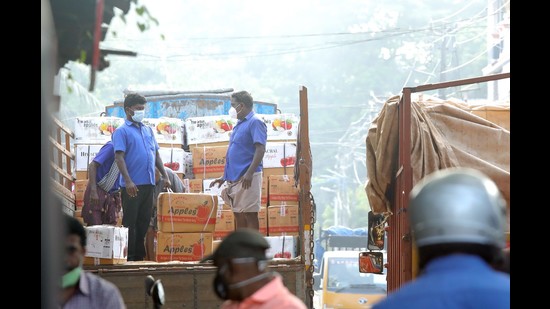
Around 300,000 headload workers are registered under the workers’ welfare board representing various trade unions and their resting places on roadsides are a common sight in the state. Besides these registered workers, many others also play their role to fleece money. They survey industrial areas and residential colonies frequently to spot vehicles carrying goods and reach there immediately. They demand payment though they only watch while goods are unloaded by cranes or in-house workers.
Statistics with the labour department shows that only 11 major cases were filed since the ban came into force in 2018, but industrialists and others say it was only tip of the iceberg and many complaints are getting withdrawn forcefully. They say the practice is continuing because militant workers enjoy political patronage. Though there are units the of Kerala headload workers’ welfare board and labour offices in every district to deal with such issues, many do not approach them fearing retaliation, say builders and industrialists.
“Gawking charge is an unhealthy practice and it invites enough bad publicity. If workers are facing any problem, it should be addressed. There should be a proper mechanism to enforce labour rules at the grassroots,” said a spokesman of the Confederation of Indian Industry Kerala chapter on condition of anonymity.
“Leaders’ words and deeds never match in the state. They support such elements and disown them in public. These leaders are responsible for making the state a graveyard of industries,” said Kitex group MD Sabu Verghese. His group had recently shifted its bases to Telangana alleging witch-hunt.
Many trade union leaders said they are against the practice but a concerted campaign is on to portray workers in bad light and dent the state’s image citing isolated incidents. “We are against it. We have taken strong action against erring ones. But some vested interests portray isolated incidents to paint a grim picture,” said CITU (Centre of Indian Trade Unions) state president Anathalavattom Anandan.
He said the equipment-laden truck at Thumba was blocked by local people led by a parish priest demanding jobs to locals, but the blame was put on workers of the area. The priest was not available for comments. But many said headload workers provoked local people to join the blockade and when it turned a big issue, they backtracked.


