E-Paper



Domestic travel bans can increase total number of Covid-19 infections: Research
The working paper by academics at the University of Chicago published in the Becker Friedman Institute for Economics’ website uses data from travel restrictions imposed in Mumbai during the first wave of Covid-19 last year


A new study has concluded that policy makers should resist imposing domestic travel bans if they cannot commit to sufficiently long restrictions. Certain travel bans can not only cause severe hardship to the poor migrant population but also counter-intuitively lead to an increase in Covid-19 cases.
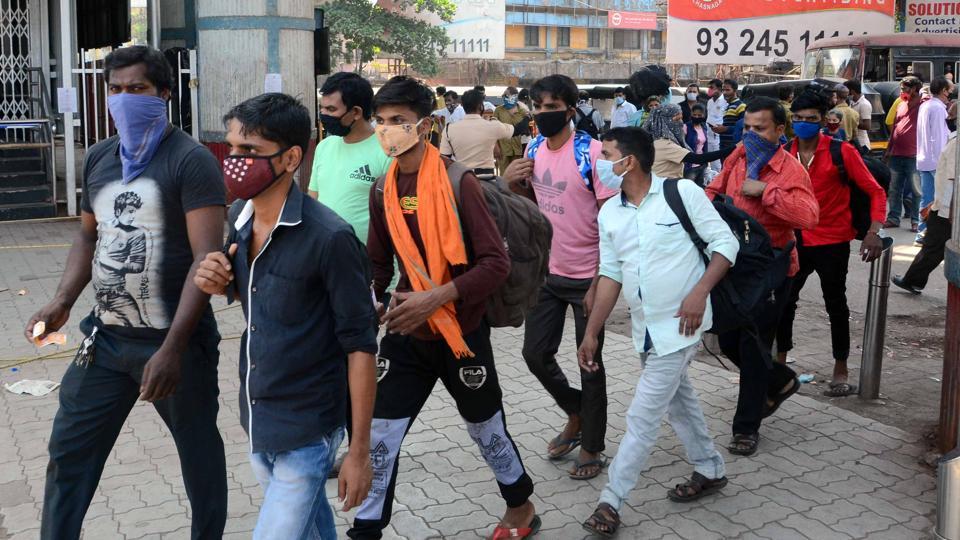
This is because release of travel bans of intermediate duration are associated with an increase in the total number of infections in the country as the sink destination—where migrant workers (many of whom are likely to be infected due to the time spent in Covid-19 hot spots before being allowed to travel) return — also record a spike. This was seen in the case of Mumbai last year.
The working paper by academics at the University of Chicago published in the Becker Friedman Institute for Economics’ website uses data from travel restrictions imposed in Mumbai during the first wave of Covid-19 last year. A nationwide lockdown was imposed on March 25 which caused immense suffering among migrant workers as the economy rapidly contracted and unemployment rose, according to the paper. Under intense pressure, the government allowed the first wave of migrants to return to homes outside Maharashtra on May 8 (Phase 1). Migrants returning to districts in the Mumbai Metropolitan Area were allowed to leave on June 5 (Phase 2); migrants departing to all other destinations were able to leave on August 20 (phase 3).
Also Read | Around 500,000 left Maharashtra in special trains since April 1
The researchers used the susceptible-exposed-infective-recovered (SEIR) model, commonly used to study epidemics, to understand the impact of the travel ban in Mumbai on cumulative infections. The approach uses the evolution of Covid-19 cases in each migrant home district from before a ban release and after the release. “After the bans are relaxed, we find that cases rise somewhat in Phase 1 districts (relatively short ban), substantially in Phase 2 districts (intermediate ban), and negligibly in Phase 3 districts (relatively long ban),” the paper states.
“The national lockdown in the first wave trapped millions of migrants inside big cities like Mumbai that were fast-growing coronavirus hot spots. Eventually people were able to leave, but variations in government policy meant that the length of time they were detained depended on where they wanted to go. In the case of rural districts where people could return quicker – using the Shramik Special Trains for example – cases rose modestly at the destination. But for those areas where bans were in effect longer, there was a much more intensive increase in coronavirus, likely because the returning population was now more likely to be infected, having been trapped in the hot spot longer,” explained Anant Sudarshan, South Asia Director of The Energy Policy Institute at the university of Chicago and co-author of the paper.
The paper refers to travel bans in China, Indonesia, the Philippines, South Africa, and Kenya. The ending of intermediate length bans in South Africa and India produced substantial excess cases per 1,000 migrants. In the Philippines, which had a slightly longer ban duration, ban release led to increase in cases, but to a lesser extent than India or South Africa. Kenya’s long travel ban also increased rural cases. In China, hot spot cases had fallen more quickly than in other countries, nearing zero at the time of ban release, the paper said.
“The evidence indicates that if the duration of a travel ban is not long enough, we may end up imposing hardship on people while perversely seeing more spread of infection. Getting the duration wrong is easy because it is not possible to predict in advance what the optimal length should be, and in a democracy, such restrictions cannot be easily sustained. There may be merit in letting people go home early, and indeed encouraging them to do so, rather than forcing them to stay,” said Fiona Burlig, Assistant Professor at the Harris School of Public Policy at the University of Chicago, one of the co-authors of the study in a statement on Thursday.
Some of the Covid-19 restrictions, such as large-scale lockdowns, are also associated with significant economic harm. These costs have been especially pronounced in developing countries, where economic slowdowns associated with Covid-19 policies combined with weak social safety nets were expected to push between 71–100 million people into extreme poverty in 2020, the paper said referring to World Bank estimates.
"Lockdowns with travel bans within a country are always the last resort. International travel bans are feasible because they are easily applied. Kumbh mela and lockdown are two extremes of a pendulum. Together they don't sound right. Why not consider universal mask wearing? It's the most effective way of slowing down infection transmission. Last year's Covid-19 number graphs show a smooth rise indicating the lockdown had no impact on the numbers. Limited restrictions like cutting down numbers to weddings, funerals other gatherings are more effective," said Lalit Kant, a scientist and former head of epidemiology and communicable diseases at the Indian Council of Medical Research (ICMR).