
 E-Paper



Election on his mind, Donald Trump goes after WHO chief and China
India has supported calls for reforms in the World Health Organisation in the past. At the G-20 meet on Covid-19, PM Modi had asked if a body set up in the last century was equipped to handle new-age diseases

 Prefer HTon Google


US President Donald Trump has halted funding to the World Health Organisation for its handling of the coronavirus pandemic, a decision attributed to his assessment that the Tedros Adhanom Ghebreyesus-led global health body had been biased towards China and given the world, and him, what he has described as “faulty recommendations”.
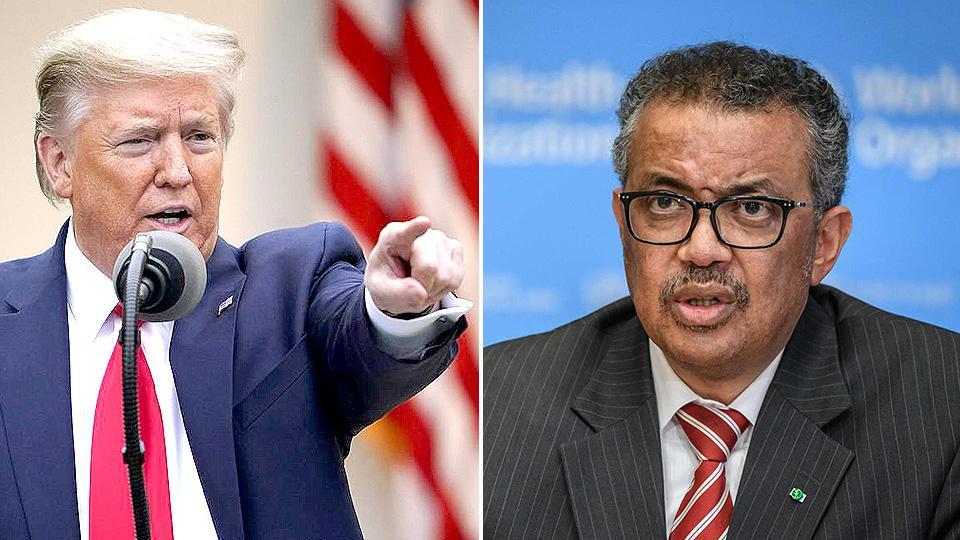
Trump’s decision to hold back funding for the WHO at a time the world is still struggling to stop the virus that has infected close to 2 million and killed over 1.2 lakh has been criticised by several countries. Australian Prime Minister Scott Morrison said he sympathised with Trump’s criticisms of the WHO and it wasn’t immune from criticism. But, he underlined, they weren’t going to throw the baby out of the bathwater here.
People familiar with the developments in Washington and New Delhi suggest that Trump’s targeted attacks on the WHO chief could be also linked to the Ethopian microbiologist’s May 2017 election with China’s backing. Tedros Adhanom Ghebreyesus had defeated the US-backed Dr David Nabarro, who was the candidate of the UK.
Coronavirus outbreak: Full coverage
Tedros Adhanom Ghebreyesus’s term as WHO director general is due to end in 2022. “If the support that Dr Tedros has received after the attacks on him are anything to go by, it is clear that the WHO director general may be on his way to get a second term if he so chooses,” a person familiar with the development said.
The 55-member African Union and 120 member Non-Aligned Movement (NAM) have already come out in support of Dr Tedros’ handling of the Covid-19 outbreak. He would just need a simple majority in the world health body that has 194 countries as members.
This means that the United States - President Trump if he returns to power in the US presidential elections just months away - will have to do some serious heavy lifting to ensure the China-backed microbiologist is not re-elected.
As the Trump administration did last month to ensure that the US-backed Singaporean candidate Daren Tang is elected as Director General of World Intellectual Property Organization (WIPO) defeating heavily-favoured Wang Binying, the candidate from China, which has been accused of having a shaky record on intellectual property protection and enforcement.
President Trump’s suspension of funding to the WHO is a huge setback. The United States is the biggest overall donor to the Geneva-based WHO, contributing more than $400 million in 2019, roughly 15% of its budget.
American taxpayers provide between $ 400 million and $ 500 million per year to the WHO, in contrast, China contributes roughly USD 40 million a year and even less, Trump said.
Chinese Foreign Ministry spokesman Zhao Lijian rushed to the WHO director general’s defence, and its own, according to news agency Press Trust of India.
Both China and WHO faced serious criticism over lack of transparency especially about the discovery of the coronavirus in December last year and its silent spread in Wuhan until Beijing imposed lockdown in the city on January 23.
India has steered clear of the debate over the WHO’ role, determined that it first wanted to fight off the virus outbreak before getting into any discussion over reforming the WHO.
Rather than wait for WHO to declare Covid-19 outbreak as a pandemic as it did in March, India, followed by the US and later Europe, banned flights from China. This helped mostly block infected people coming to India from China. But the infection still came through Europe and the Gulf, hitting US hard and landing Europe in a health disaster.
But PM Modi, however, made it clear in his G-20 address last month that the time had come to assess whether organizations of the past century were capable of handling the new age diseases.
For the record, WHO sent 100,000 testing kits to India late February and another 100,000 kits at the end of March.
International groups such as the African Union Commission have been more vocal. On April 8, Moussa Faki Mahamat of the AUC tweeted his ‘surprise’ to learn of the campaign against WHO’s global leadership. “The African Union fully supports WHO and DG Tedros. The focus should remain on collectively fighting Covid-19 as a united global community. The time for accountability will come,” he said.
The New York-based NAM coordinating bureau, on the other hand, issued a statement the next day in support of the WHO and its DG. It said: “ The Coordinating bureau of the NAM extends its full support to the WHO and to the leadership of its DG, Dr Tedros Adhanom Ghebreyesus, while recognising the critical role and guidance it is currently playing on the frontlines.” The NAM also expressed confidence in the leadership of Dr Tedros and asked the global community to stop politicising the virus.


