
 E-Paper



Explained: What is driving farmers' protest?
Protesting farmers demand MSP for sunflower seeds. BJP alleges political motive. Congress supports farmers. JJP seeks balance. Elections loom. All explained.

 Prefer HTon Google


Protesting farmers led by the Samukt Kisan Morcha (SKM) have given the Haryana government an ultimatum to accept their two demands: procurement of sunflower seeds at the minimum support price (MSP) and the release of arrested farmers, or the protest and blockade will continue.
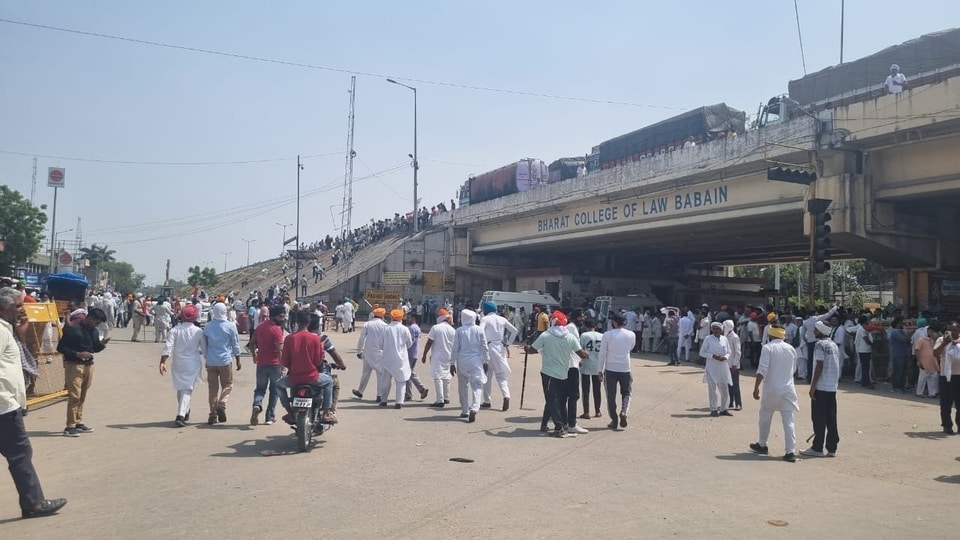
What is the demand of protesting farmers?
The protesting farmers said that the state government was not buying sunflower seeds at MSP, forcing them to sell their output to private purchasers for roughly ₹4,000 per quintal instead of ₹6,400.
However, this is not the only issue!
Since the farm laws protest, Haryana and Punjab have seen many farmers protest off late. They have backed the protesting wrestlers, and the SKM (Non-political), a breakaway faction of the SKM, has been protesting against the Punjab government outside the office of the Punjab State Power Corporation Limited in support of their power supply demands for many days.
BJP cries protest politically motivated
The Bharatiya Janata Party claims that the protest is politically motivated. Haryana CM Manohar Lal Khattar chastised farmer union leaders and accused them of playing politics.
To address the worries, the Khattar administration has offered farmers with interim assistance of ₹1,000 per quintal, totalling ₹29.13 million distributed to 8,528 sunflower seed growers. This takes the current price per quintal to ₹5,800, however, farmers' unions are calling for a raise to ₹6,400 under the MSP scheme.
Separately, Khattar announced the creation of a sunflower seed oil factory in Shahabad, with an annual capacity of 20,000 metric tonnes of sunflower oil.
Congress says it supports farmers
The opposition Congress is supporting the farmers' protest. Deepender Hooda, a Member of Parliament (MP) from the party, said that the government had not been purchasing sunflower seeds at the MSP, leaving farmers with no choice but to sell their produce to private buyers at significantly lower rates.
“The government kept giving dates on the date of starting the procurement and then it was said that it would be taken under the Bhavantar scheme. Even if it is assumed that the farmer will get ₹1000 in the Bhavantar scheme, even then the farmer would suffer a loss of Rs. 1900-2200 per quintal,” he said.
JJP finds it hard to balance
The BJP's coalition partner in the Haryana government, Jannayak Janta Party is trying to maintain a delicate balance.
JJP's Member of Legislative Assembly (MLA) Ishwar Singh said that the gap between the current selling price of sunflower seeds (approximately ₹5,800 per quintal) and the MSP was causing financial losses for farmers.
The JJP party urges, Singh said, the government to provide maximum assistance to farmers and consider additional relief measures beyond the interim 'bharpai' of ₹1,000. Singh, however, also called for a more flexible approach from both the farmers and the government to reach a resolution.
Notably, the party's MLA Ram Karan Kala has stepped down as Sugarfed chairman in protest against lathi-charge on farmers.
Eyes on polls!
Haryana is gearing up for both assembly and Lok Sabha elections next year, and all political parties are vying to gain an advantage on the farmers' issue.
In the previous assembly elections held in 2019, the BJP and JJP formed a post-poll alliance to establish the government. Currently, the BJP holds 41 out of the 90 seats in the Legislative Assembly, including a victory in the Adampur by-poll last year. The JJP secured 10 seats, while the Congress managed to win only 31 seats.
In the 2019 Lok Sabha polls, the BJP swept all 10 seats in Haryana.
However, the JJP has added an element of excitement by stating that no decision has been made yet regarding an alliance with the BJP for the upcoming elections in Haryana.
(Inputs from agencies)


