
 E-Paper



Extensive damages to crops in various states stoke fears of inflation
Torrential rains have devastated summer crops in key Indian states, with Punjab facing its worst floods in 40 years, prompting government relief measures.

 Prefer HTon Google


New Delhi
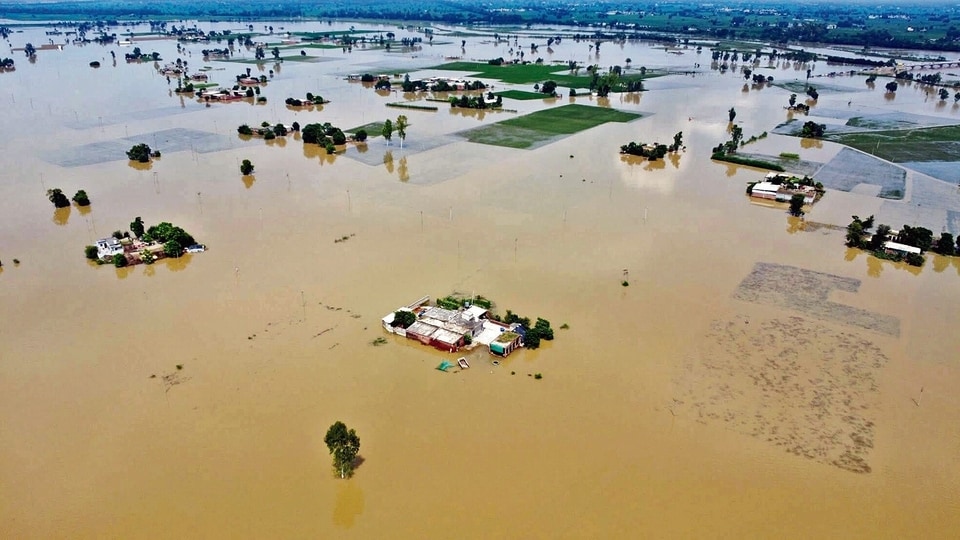
Torrential rains have battered summer-planted crops in key food-bowl states, especially in the northern and central plains, including paddy, cotton, gram and soyabean, said officials and farmers.
The monsoon has dumped overall 8% excess rainfall since its onset in June, as precipitation in August in Punjab, Telangana and Andhra Pradesh was nearly 50% above normal.
Punjab received 74% above-normal rainfall in August, leading to its worst flood in four decades. Overflowing rivers have submerged standing crops, raising the risk of pest attacks, yellowing and stunted yields. Rainfall deviations of between -14% to 10% are known to affect sowing, yields and prices
After a wet August, India is likely to get above-average monsoon rainfall in September too, the India Meteorological Department had said on August 31. Many summer-sown crops will be ready for harvests by mid-September.
Prime Minister Narendra Modi, who toured Himachal Pradesh and Punjab on Tuesday, announced a raft of relief measures, including cash assistance of ₹1600 crore for Punjab. The Centre will release a second instalment of funds under disaster relief and make cash transfer under the PM-Kisan scheme in advance for the state’s farmers, he said. For Himachal Pradesh, the PM announced a package of ₹1500 crore.
“Punjab and Rajasthan (were) staring at major losses after heavy rains” while impacts have been localised in other states, an assessment this week by Crisil, the ratings firm, said
“I had planted paddy in 60% of my farm. In the rest, I had sown gram and cauliflower, which have suffered maximum damage,” said Baljit Singh Sarara, a leader of the Bharatiya Kisan Union (Ekta Ugrahan), a farmers’ union, from Nurpur Bedi block of Ropar district.
In Punjab, 70,000 hectares of farmland out of 4.24 million hectares of arable land are estimated to have been inundated, the Crisil report said. Paddy, sugarcane and cotton crops have been submerged across several districts.
Until the first week of September, seasonal rainfall was 7% above normal in Jharkhand, Punjab, Himachal Pradesh, Rajasthan, Madhya Pradesh and Telangana. Widespread damage to crops have also been reported from Rajasthan, a major producer of spices, gram and onion, which received 18% excess falls in August.
Flooding is likely to tank yields of several crops across states, the Crisil report said. In Andhra Pradesh and Karnataka, “paddy, maize and cotton have been mostly unaffected, though yield has declined for pulses (black and green gram) from flower drop”, the report said. Disease has affected vegetable crops in Karnataka, with tomato showing blight and leaf spot, gourds affected by powdery mildew and onions hit by rot.
The government is assessing the situation and it is too early for states to start field assessments due to submergence, a Union agriculture ministry official said. “Official estimates of crop losses are not available yet. There has been widespread submergence and the focus of district authorities is on pumping out excess water to save crops,” said G Srinivas, an agriculture department official from Telangana.


