
 E-Paper





Follow the latest breaking news, major developments and agenda-setting stories from India and around the world with the newsdesk at Hindustan Times. Operating round the clock, the desk brings together experienced editors, reporters and correspondents to deliver fast, accurate and contextual reporting across subjects that influence public policy, governance, business, society and international affairs. The HT News Desk covers politics, elections, government policies, the economy, business and markets, science and technology, the environment, law and order, infrastructure, education, climate issues and geopolitics, while closely tracking developments across states, institutions and global capitals. The team also leads coverage of major breaking news events, policy announcements, court proceedings, natural disasters, public emergencies and significant international developments. Reports published by the newsdesk are based on information gathered from reporters on the ground, official statements, government agencies, court records, regulatory filings, recognised institutions and other authoritative sources. Stories undergo editorial scrutiny and verification processes to ensure accuracy, fairness and relevance, and are updated as events evolve and additional information becomes available. Whether covering a key political decision in New Delhi, an economic policy shift affecting millions, a landmark court ruling or a major global event, the HT News Desk aims to provide readers with reliable, fact-based journalism that delivers not only the latest developments but also the context and analysis needed to understand their wider implications.
FAO sounds high alert for India for next 4 weeks over locust
The FAO has warned that although locust control operations are in place, a northerly movement of the swarms in these countries is on the cards.


The United Nation’s (UN) Food and Agriculture Organisation (FAO) in its latest situation update has asked India, Pakistan in Asia and Sudan, Ethiopia, South Sudan and Somalia in Africa to be on high alert for the next four weeks in view of locust breeding.
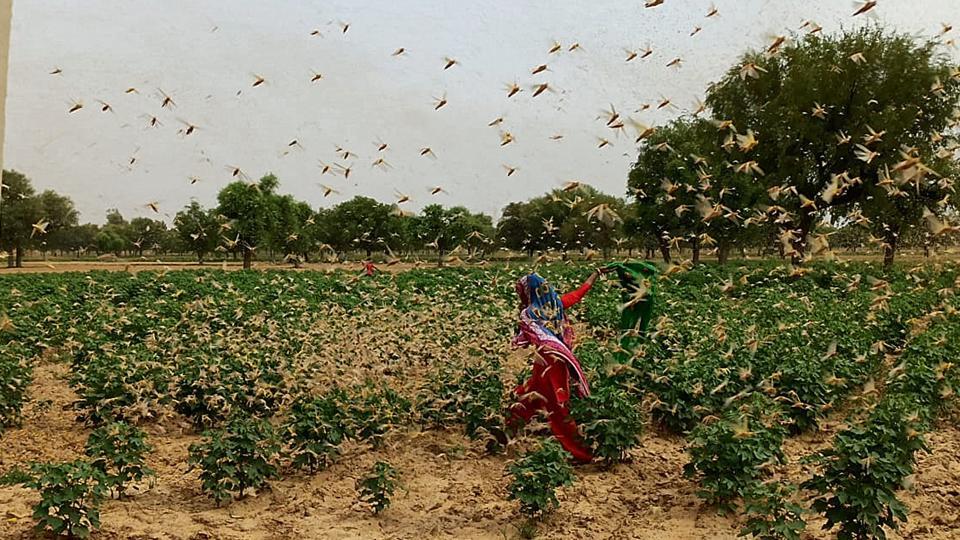
The FAO has warned that although locust control operations are in place, a northerly movement of the swarms in these countries is on the cards.
Some of the swarms in north-west Kenya are expected to transit through South Sudan to reach the summer breeding areas of Sudan, which has reported some monsoon rains.
The swarms could move towards eastern Chad and spread westwards across the northern Sahel part of west Africa.
Swarms that accumulate in northern Somalia are likely to migrate across the Indian Ocean to the summer breeding areas along the Indo-Pakistan border.
“Spring-bred swarms are present along both sides of the Indo-Pakistan border where they are awaiting the onset of the monsoon rains that will start in the coming days and allow the swarms to mature and lay eggs. In Pakistan, some swarms have already started laying eggs in Nagaparkar of south-east Sindh province near the Indian border, while swarms are present in the Indus Valley and are starting to form the hopper bands in the Khyber-Pakhtunkhwa province,” the FAO said.
The UN organisation said swarms and adult groups are largely present in the west of Jaipur in Rajasthan but some infestations have been reported in parts of Madhya Pradesh (MP) and Uttar Pradesh (UP). At least one small group of immature adults moved north of UP last Saturday, reaching the northern districts of Kushinagar and Sidharth Nagar where they split up and a few crossed across the border to the central lowlands near Butwal in Nepal’s Terai region.
In Iran, locust infestations declined further in the south. Only adult groups remain along the Pakistan border in the interior of Sistan-Baluchistan province and hopper groups are also present in South Khorasan province.


