
 E-Paper



Faulty weather forecast system worsened Chennai’s rain woes
Those privy to functioning of the regional weather department said Chennai’s weather radar, which helps with “nowcasts” (forecasting weather for short term up to six hours), has aged and data on upper air has been lacking that is crucial for making weather forecasts (for longer periods).


A failure in weather system to forecast the 210 mm rain that lashed Chennai in the intervening night of November 6 and 7 caught authorities unprepared for one of the city’s heaviest rain spells, officials said on Wednesday.
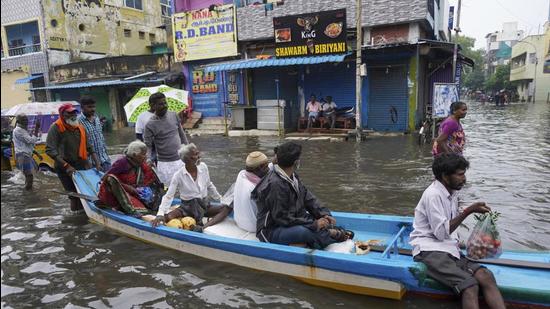
Those privy to functioning of the regional weather department said Chennai’s weather radar, which helps with “nowcasts” (forecasting weather for short term up to six hours), has aged and data on upper air has been lacking that is crucial for making weather forecasts (for longer periods).
“We have rectified the radar this (Wednesday) morning,” said a Regional Meteorological Centre (RMC) official, who did not wish to be named. “We haven’t been able to use it till now.”
The RMC is currently relying on satellite data feeding it with numerical weather models for forecasts.
CPI (MP) from Madurai S Venkatesan spoke to union earth sciences secretary M Ravichandran who informed him that repair work was ongoing at Chennai Meteorological Department’s radar near Chennai Port Trust and it will be operational soon.
Ravichandran had ordered an enquiry into the malfunctioning radar during the current north east monsoon. The RMC is currently providing rain forecasts with the help of radars from Sriharikota and Karaikal, he said.
“Radars are very reliable to give specific forecasts but it has aged and stopped working in Chennai so it was also not being operated continuously. It generally runs non-stop,” said a meteorological expert, who did not wish to be identified.
“So no rainfall warning was given to Chennai. There has been a failure in giving a correct forecast. They only predicted rainfall from Sunday (November 7) onwards. The rain was caused by an upper air circulation and it unexpectedly moved in-land. If a day’s warning was given, we could have been better prepared.”
India Meteorological Department’s (IMD) bulletin on November 6 forecast very heavy rainfall in north coastal Tamil Nadu which includes around 14 districts and issued an orange alert (the second highest warning which means to “be prepared”) and a red (highest warning meaning “take action”) alert was issued only on Sunday.
“It is correct that this spell of rain could not be predicted by the numerical weather data model,” the expert quoted above said. “Any model will can errors. But observations are important. If you don’t have the correct observations the forecast will not be very good. satellite data gives a lot of information. But upper air circulation data gives more accuracy.”
An instrument called radiosonde or GPS sonde observations are the primary source of upper air data which uses parameters such as winds, pressure, humidity, temperature to accurately predict changes. This instrument isn’t available for Chennai, the RMC official quoted above said.
“Even if radiosonde data is not available still we can get satellite data but that works on algorithms as an input for numerical weather prediction,” says former IMD deputy director YEA Raj. “Whereas radiosonde is actual data, satellite data can be checked for accuracy only with data generated from radiosonde.”
IMD has issued another red alert for Chennai until November 11. It forecast very heavy rainfall with extremely heavy rain at isolated places over Chennai and delta districts such as Cuddalore, Villupuram, Pudukottai, Sivaganga, Ramanathapuram and Puducherry and Karaikal.
Chennai registered 23.7 mm of rainfall on Wednesday up to 15.30 pm. Coastal districts Nagapattinam and Karaikal, where rains pounded on the intervening night between November 9 and 10, receive with 245 mm and 272 mm rainfall, respectively.


