For Opposition unity in 2024, the key role of the ‘sutradhaar’
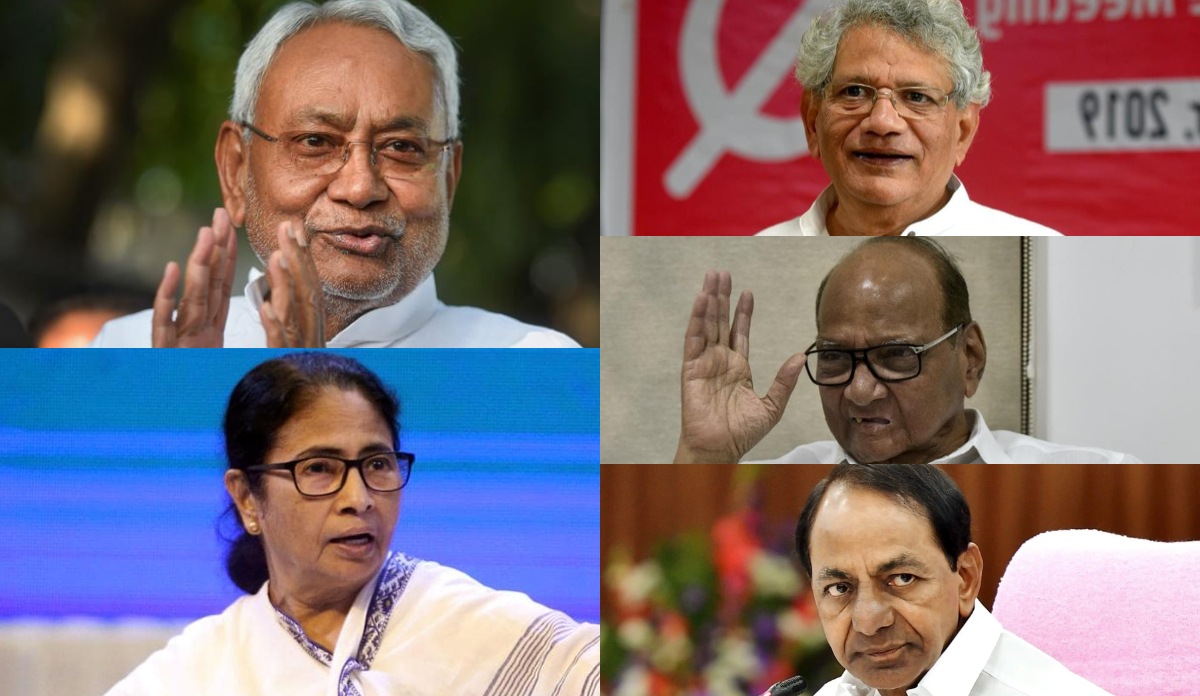
At least five Opposition leaders are poised for a key role: To be the sutradhaar or the "political anchor" of the force against the National Democratic Alliance in 2024. However, some may be placed ahead of others.
New Delhi: As the race for 2024 intensifies, all key Opposition leaders have stated their reluctance to lead the camp against the National Democratic Alliance (NDA). But at least five of them are poised for another key role: To be the sutradhaar or the political anchor of the group.
With several top-ranking leaders positioning themselves to play the role of a sutradhaar, their chances will depend on their wider acceptability and how the number game evolves in the 2024 elections. (PTI, HT, ANI, Agencies )
If Bihar chief minister (CM) Nitish Kumar’s recent Delhi trip and meeting with seven Opposition leaders, including the Congress’ Rahul Gandhi underlines his acceptability cutting across the party lines, it was West Bengal CM Mamata Banerjee who announced this a year ago at a press conference in Delhi, “I want to play the role of a soldier. I want to work for the unity among various parties.” Her Telangana counterpart, K Chandrashekar Rao, has echoed the same ambitions and has already travelled to Patna, Kolkata, and Mumbai to hold parleys.
On September 11, following the Nationalist Congress Party (NCP)’s national council meeting, party leader Praful Patel announced that NCP chief Sharad Pawar “will play an important role” to bring Opposition forces together. Patel also repeated the common position of nearly all Opposition stalwarts: Pawar is not eyeing the prime minister (PM)'s chair and Opposition unity is of vital importance.
The importance of the anchor
In the tumultuous political times of 1996-1999, India got four PMs — Atal Bihari Vajpayee (two terms), HD Devegowda, and Inder Kumar Gujaral — between May 16, 1996, and March 19, 1998. Hours after the general election delivered a hung Parliament during that period, Lalu Prasad Yadav, the then CM of Bihar, told Doordarshan that the PM is still locked in the ballot boxes and he is rushing to Delhi to become the “kingmaker” — a synonym for a political anchor.
The sutradhaar must have the rare talent of bringing different parties with varied ambitions and ideological standpoints to a common platform. It requires skilful negotiations, sharp political understanding, and a rapport with key leaders of the alliance.
In 2004, when Sonia Gandhi decided to anoint Manmohan Singh as the PM, she left the job of securing support for Singh to an unusual leader: Communist Party of India (Marxist) or CPI(M) general secretary, the late Harkishan Singh Surjeet.
Unlike the NDA, which was a solid, pre-poll pact, the United Progressive Alliance (UPA) was stitched after the 2004 election results were out. While Surjeet, Pranab Mukherjee, and Ahmed Patel were busy rallying support behind Singh, CPI(M) leaders Sitaram Yechury and Prakash Karat and Congress leader Jairam Ramesh meticulously drafted the all-important Common Minimum Programme — the manual of the coalition.
This time too, all Opposition parties have already made it clear that there won’t be any national alliance in the run-up to the polls and that they will wait for the results of the national election to firm up any alliance.
Power play ahead of 2024
June 16 was a busy day for the Opposition leaders jockeying for key positions. While the Congress and Left parties were planning to call a meeting on that day, West Bengal CM Banerjee got a whiff of it and outwitted them by suo moto calling a meeting of all Opposition parties — a bid to position the Trinamool Congress among the leadership positions in the Opposition bloc.
When the clock turned for the vice-presidential election, it was the turn of Sharad Pawar to call all Opposition parties for a meeting, underlining his seniority. At that meeting, CPI(M) leader Yechury found loopholes in Banerjee’s proposal to nominate either Mehbooba Mufti or SY Qureshi as the Opposition’s VP candidate and proposed senior Congress leader Margaret Alva.
It took Leader of Opposition Mallikarjun Kharge (a former CM of Karnataka) and Jairam Ramesh (a Member of Parliament from the state) by surprise. But Yechury scored a vital point: He learnt that he, too, can take decisive steps in Opposition’s volatile ground.
Last year, when Rahul Gandhi hosted a breakfast meeting with all Opposition leaders — an effort to consolidate his position as a prominent leader of not just the Congress, but the entire Opposition — Mamata ordered her top-ranking MPs to skip the event. Party leader Derek O’Brien was entrusted to create a sub-group of the Opposition camp in Parliament with the help of the Aam Aadmi Party, the Telangana Rashtra Samithi (TRS), the Samajwadi Party, and the Shiv Sena.
TRS, too, is not sitting idle. Telangana CM K Chandrashekar Rao has already travelled to Mumbai to meet Sharad Pawar and Shiv Sena chief Uddhav Thackeray met Mamata in Kolkata, and flew down to Patna to hold parleys with Nitish Kumar for Opposition unity in 2024.
Number game
With several top-ranking leaders positioning themselves to play the role of a sutradhaar, their chances will depend on their wider acceptability and how the number game evolves in the 2024 elections.
In terms of acceptability, Banerjee, Pawar and Nitish Kumar are ahead of the others. However, after the toppling of the Maha Vikas Aghadi (MVA) government in Maharashtra, Pawar and the NCP’s chips are down. Similarly, CPI(M) boss Yechury might not be a match for Banerjee after the Left is reduced to being in power in Kerala alone. The TRS’s efforts so far have an intrinsic problem: KCR has met leaders who themselves are eyeing a larger role.
But if the Congress can dramatically improve its seats and emerge as the clear leader of the pack in terms of numbers, the equation would alter rapidly. Yechury, Nitish or Pawar — three leaders who have a close equation with the Congress — can emerge as stronger candidates for the envious task of stitching an alliance.
Follow India news real-time updates and the latest news covered on Hindustan Times, featuring today's critical updates on Sonam Wangchuk LIVE and more across India.
Home/India News/For Opposition Unity In 2024, The Key Role Of The ‘sutradhaar’

 E-Paper