
 E-Paper



From 780 units to 80: How Kollam lost its cashew capital status
Now, Omana is among 200,000-odd cashew workers rendered jobless in the last four years in Kollam district and neighbouring areas.

 Prefer HTon Google


58-year-old P Omana proudly flaunts burn marks on her finger caused by the caustic cashew sap. Worked as a cashew peeler for 35 years, initially, she never wore safety gloves as she was an expert in extricating kernel from the hot shell without scratches or breaks with the help of a small wooden hammer.
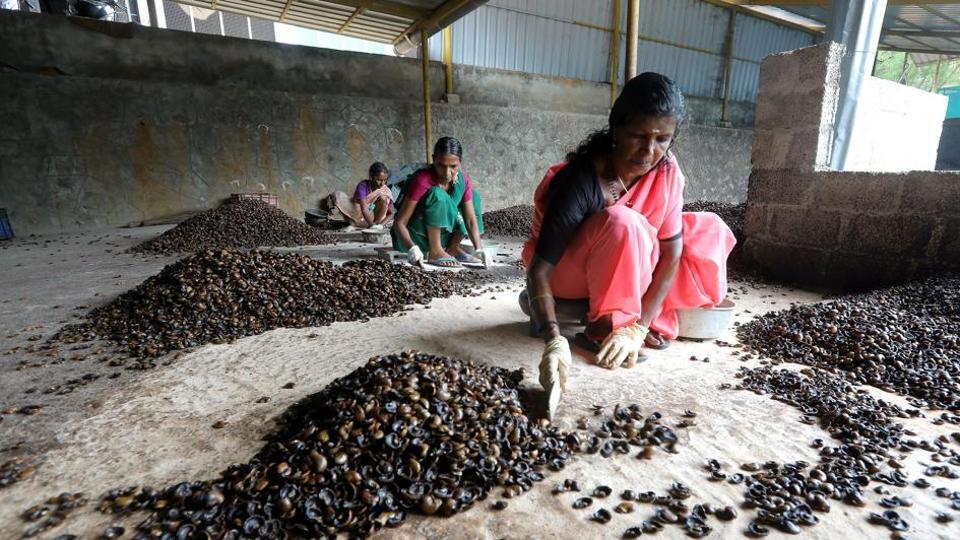
Her long years of work helped her marry off her two daughters and build a two-room house with the help of a loan from a co-operative bank in Kollam, in south Kerala. Her husband, a labourer, died when she was 32.
Now, Omana is among 200,000-odd cashew workers rendered jobless in the last four years in Kollam district and neighbouring areas. The condition of innumerable factories in the area is no better.
Without a job, Omana frequents her closed cashew factory for arrears once in a while. She was paid ₹35 for shelling one kg of raw cashews and ₹45 for peeling the kernel. An expert in top grade kernel, she used to take ₹500 a day during the last days of her work in 2017. Now, she does casual work with a neighbourhood self-help group for ₹200 till noon.
The house of the owner of the factory where Omana worked is already mortgaged for non-payment of loans, and he died two years ago. His son is now living in a rented house and pleads helplessness.
“I have to get six months’ wages from my firm. In red, my owner committed suicide two years ago,” says another peeler K Vijaya (48) from Paripally.
The story is the same for more than 80 per cent of these workers, who belong to socially and economically weaker strata.
Cashew factory owners often blame high wages and militant trade unionism for their plight, but a close look at the industry shows both workers and employers are in dire straits. Unable to bear huge losses and mortgages, six cashew factory owners have committed suicide in the last couple of years, industry insiders say.
Lured by high value and quick returns, many jumped into the fray. But now, only pioneers and well-entrenched stay afloat, while others fell aside or took other pastures.
The port city of southern Kerala Kollam was once known as the cashew capital of the world for many years. Its exporters once decided on the global price of the nuts. The district produced some well-known business tycoons like the late Rajan Pillai (Britannia), K Ravindran Nair aka Achani Ravi, K Parameswaran Pillai and Thangal Kunju Musliar.
Kollam’s cashew industry, once the highest earner of forex (foreign exchange) after basmati rice, is a shadow of its former self. In the past, more than 780 licensed cashew factories functioned, which has now dwindled to less than 80. In the 1980s and 1990s, cashew export peaked at 125,000 metric tonnes, which has scaled down to less than 20,000 m tonnes. According to old-timers, once you enter the city, the burning smell of cashew shells wafted through the air. Now, old boards, rickety factories, dark chimneys and helpless workers stand testimony to its fall.
The reasons are many, say industry insiders.
“Slow mechanisation, little farming, militant trade unionism, excess government interference and protectionism and competition from other countries broke the backbone of the industry,” said third-generation cashew businessman Pratap R Nair, who owns Vijayalakshmi Cashews Limited (VLC) with a turnover of ₹450 crore. The company was a leading brand in the country.
At its peak, the country imported raw cashew from Vietnam and other south-east Asian countries, on a large scale and process. Exporting agents from Vietnam who came here, learned tricks of the trade fast and introduced it there in the 1980s, piping the port city fast. As the industry was crumbling, high import duty of 9.3 per cent on raw cashew in 2006 shook it further, though it was slashed to 2.5 % two years later.
“Cashew farming in Kerala also depleted as people switched to rubber and other fast-buck cultivation. After the Gulf boom, there was intense pressure on land to make houses. Once agricultural land was a status symbol in the state, but now it is big mansions. Though cashew does not need excess fertilisers or care its cultivation slowed down,” said P Sundaran, chairman of the Cashew Export Promotion Council of India and MD of Sreelakshmi Cashew Enterprises, a firm with a ₹100-crore turnover.
HISTORY OF CASHEW IN KERALA
In India, cashew, a native of Brazil, is believed to be introduced by Portuguese explorers five centuries ago. Initially, it was introduced in Goa and later extended to the Malabar Coast. The coast’s tropical and humid climate helped it to flourish. With a thriving port, Arab and Chinese traders soon started frequenting Kollam, say trade historians.
Experts in the industry say that by the early 20th century, Kollam turned cashew capital of the world, producing the best quality nuts. The records show first cashew processing on a commercial scale was started by Rocha Victoria, a Sri Lankan who migrated to the city in 1924. Two years later, a British W T Anderson established Indian Nut Company Factory, the first export firm in the city.
Cashew was considered an elite snack, but after the 1990s, became more common among people. Cashew Export Promotion Council data shows the country overtook the largest consumer, the US, five years back. In 2019, the country consumed 275,000 metric tonnes against US 183,900. Its consumption rose manifold after its extensive use in sweets, biscuits and savoury. In payasam, burfi and a thickening agent in curries and medicine, cashew is used everywhere.
In India, cashew is cultivated across 1.2 million hectares of land, with a productivity of 706 kg per hectare, according to 2020 government data. Maharashtra, Andhra Pradesh, Orissa, Kerala, Karnataka and West Bengal are among the major producers.
In Kollam, on average, 800,000 tonnes of raw cashew are imported for processing every year, and at least 20 per cent of the export quality kernels are from here – in the past, it was more than 60 per cent. As global demand for cashew grew, India started importing row nuts in the 1960s. Between 1995 and 2015, the compound annual growth rate was 3.1 per cent, while the domestic demand rate grew to 5.3 per cent, according to the Cashew Export Promotion Council of India (CEPCI), and to bridge this gap, the country started importing many Africa and Asian countries.
“We can’t depend on import to run the industry in India as many African countries have started processing cashew locally. We have to scale up production of cashew domestically to get out of the sorry situation. Though cashew cultivation needs little care and less manure, it failed to attract cultivators, especially in Kerala,” said R K Bhoodes, an expert on cashew, who did extensive studies on the nut and was a former chairman of the CEPCI.
He said the country will have to raise yield from the current 706 kg per ha to over 3000 kg per ha, and it can be done with proper planning, execution and support from all quarters. Though the country developed many high yield varieties and replaced senile trees improved farming techniques are needed for sustainability, he said.
“What happened to coir in Alapuzha is happening to cashew in Kollam. We failed to change with the times. Though it is very labour intensive with a 90 per cent women workforce, it never got the consideration it needed. Trade unions also played their role in stalling modernisation. Kollam needs a cashew revival package from both union and state governments. Otherwise, the once-powerful industry will fade into oblivion,” said Kollam member of parliament (MP) N K Premachandran.
There are 33 different types of nuts, but only 26 are available for purchase, said, experts. Nuts are categorised based on size, colour and moisture content. W-180 is the best and priced five-six times to normal quality W-320, the most popular and widely available grade. The broken nut market is also in demand for bakery and savoury industries. Cashew shell oil is used in a big way in the paint and adhesive sectors.


