The quiet of a sunny May afternoon at Antroli on the outskirts of Surat is broken by the metallic whirr of drilling. Standing deep amid lush green fields, is a rhombus-shaped structure—India’s first bullet train station on the Mumbai-Ahmedabad route that will be readied before year-end. The first 50 km trial run of the high-speed rail (HSR) project between Surat and Bilimora in Gujarat will commence early next year while the entire HSR route is expected to get operational by 2029.
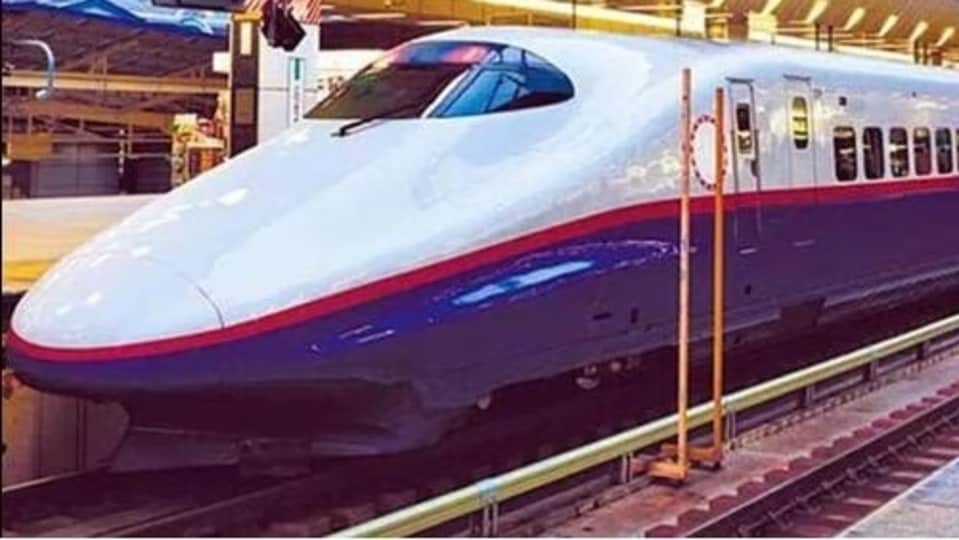
India’s first bullet train station on the Mumbai-Ahmedabad route will be readied before year-end. (Representational image)
On Tuesday the National High Speed Rail Corporation Limited (NHSRCL) announced that the ₹1.08 lakh crore project has reached “a significant construction milestone with the successful completion of 300 km of viaducts”. “The achievement was marked by the launching of a 40m long full-span box girder near Surat, Gujarat,” said a press release. A viaduct is the girder between two pillars and on which the highspeed rail tracks will be laid. 383 km of foundational pillars have already been laid on the 508 km route between Mumbai and Ahmedabad.
Earlier this month, Hindustan Times travelled along the route to report on the progress of one of India’s most ambitious infra projects. All 12 stations on the bullet train route have been designed thematically to mirror local specialities. The rhombus at Surat—India’s largest diamond polishing centre—for instance, resembles an uncut diamond, said an NHSRCL official who asked not to be named. The next station at Bilimora is designed like a mango in a hat tip to the town’s famous alphonso and kesar orchards. Likewise, closer to Mumbai, the station at Virar is being built with curvatures that are being likened to the undulations of the Satpura ranges.
At Surat, work is on in full swing to complete the tiling work at the station, building its glass façade and laying of the specialised tracks imported from Japan. “Work at the Surat HSR station is 90% complete,” added the NHSRCL official. The air-conditioned three-storeyed station will house retail spaces, restaurants and ticket counters on the ground floor. The concourse on the first floor will have the security apparatus and office space, including rest and recreational rooms for the loco pilots while the platforms will be on the third floor. The entire station has been designed in silver and pink to resemble the colours of diamonds according to the NHSRCL official.
The 425-metre-long platforms are ready to accommodate 16-car Shinkansen train from Japan expected to arrive for trials by 2026. The Surat HSR will cater to both High Speed and Rapid High-Speed trains that will operate in the future. The High-Speed line will halt at all 12 stations on the Mumbai-Ahmedabad Corridor and take 2 hours and 27 minutes to complete the journey. The Rapid High Speed train services on the other hand will cover the distance of 508kms in 1 hour 58 mins with limited halts at Sabarmati in Ahmedabad, Vadodara, Surat and Bandra Kurla Complex in Mumbai.
The tracks in Surat rise 30 meters above the ground and are connected to the rolling stock depot about 2 kilometres away from the station where the E5 and E3 Shinkansen trains will be parked in future. Two similar depots are to be set up at Thane and Sabarmati. At the 30-acre depot teams of Japanese trainers are imparting a 45-day crash course to the workforce to track technology. “They are training the staff about a unique coating of cement, asphalt and mortar called CAM that is critical for running Bullet train on ballast-less tracks. This system is being used for the first time on Indian Railways. All staff working here must pass certain tests to be certified,” explains another NHSRCL official who too asked not to be named.
So far 500 personnel from Railways and private contractors have been trained and certified by Japan Railway Technical Service (JARTS) and will undergo further training in Japan.
Unlike regular rail lines where tracks are clipped with cement concrete sleepers, tracks for bullet train are flat girders over which a mixture of cement, asphalt and mortar (CAM) mixed with other chemicals is poured. When solidified, it takes the shape of track slab and acts as a shock absorber when the high-speed rail runs on it. Metal clips and specialised ‘rail turnover prevention device’ made of carbon fibre are then used to fasten the actual tracks to these slabs preventing them from getting uprooted in case of derailment.
Before the actual rails are affixed to the track slabs, they undergo a special ‘magnetic particle inspection’, that scans for any invisible anomalies in the welded track. “As of now we have finished the entire process of laying track slabs, the CAM underneath and tracks above with fittings on 350 meters stretch on the Bilimora-Surat section,” says the first NHSRCL official at the Navsari site.
Travelling south on the HSR route, Virar is the first station within Mumbai’s extended suburbs. Away from the bustling suburban rail network, the Virar HSR is being built at the foothills of the famous Jivdani Temple hills, on a plateau on the Satpura range with tunnels on its either side. “The challenging part on this station is the tunnelling work beneath the Jivdani Hills that requires burrowing 2.663kms deep into the ground,” says the second NHSRCL official.
Seven tunnels cumulatively 6 km long are being dug along the Mumbai-Ahmedabad route. Work is also on to build another 21-km-long underground corridor that includes a 7-kms undersea pass below the Thane Creek ahead of the terminus at the Bandra Kurla Complex.
This will be the country’s first underground rail terminus that will lie ten storeys deep in the ground, atop which will rise a 95-meter-tall building to be leased for commercial establishments, possibly to house an international finance centre that the government of Maharashtra has been working on, says a senior railway official, requesting he not be quoted.
There will be a total of 6 platforms at BKC and the station itself, being built at a cost of over ₹3000 crore, will be spread over 4.5 hectares.
Around 76% of the excavation work at BKC has been completed. Railway officials say that initially two Shinkansen trains of E5 and E3 series will be sent to India for trials, but the Indian government has already sent a request for the E10 series trains which Japan runs on its network, to India when the bullet train actually starts plying four years from now.
Get the latest India News, breaking headlines and real-time updates from across the country. Stay informed about politics, government policies, crime, weather and major national developments.
Home/India News/From ‘diamond’ In Surat To ‘mango’ In Bilimora, Bullet Train Work Picks Speed

 E-Paper