
 E-Paper



G-7 closes ranks on Indo-Pacific, reliable tech and vaccine IPR
Despite having tested negative four times in as many days, foreign minister Jaishankar followed Covid-19 protocols. The two officers who tested positive for coronavirus had recovered from the infection and their samples came out negative in the second RT-PCR test. UK Prime Minister Boris Johnson lauded Jaishankar and his delegation's efforts to keep all the other delegates safe.

 Prefer HTon Google


The G-7 plus three ministerial meeting was instrumental in convincing the United States to grant an IPR waiver for Covid-19 vaccines in the name of extraordinary situation arising out of the pandemic and preparation for building reliable supply chains and technologies to counter possible virus waves in the future.
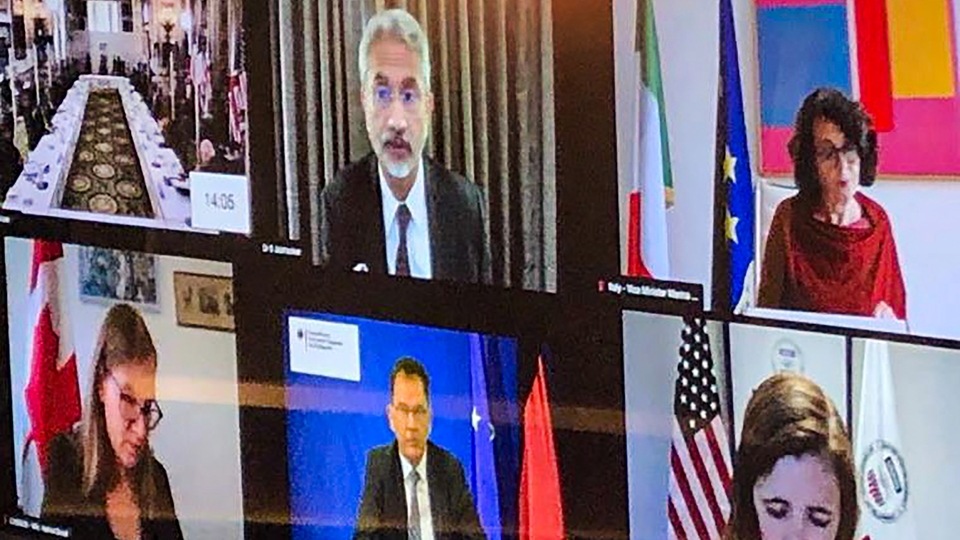
For India, external affairs minister S Jaishankar-led four-member delegation’s participation at the G-7 was dramatic as two senior delegates apparently tested positive for coronavirus after landing in London for the meeting. The two officers had already recovered from Covid-19 infection and the entire delegation boarded the flight to London with negative RT-PCR report including minister Jaishankar. Even at the airport, the rapid antigen of all the delegates came negative but an RT-PCR of two officers showed positive before the G-7 meeting on May 5.
While Jaishankar decided to move virtual after the positivity report, and British Prime Minister Boris Johnson personally thanked him for that, the second RT-PCR report of the two officers came negative. However, keeping up with protocols, the entire delegation tested four times during the trip and returned safely to India on Friday night.
Despite the scare, Jaishankar met US Secretary of State Tony Blinken, South African foreign minister Naledi Pandor and UK home secretary Priti Patel physically while all the other meetings were held virtually with the UK government providing secure communications to the Indian delegation.
According to official sources based in London, the four big ticket items on the G-7 meeting were: Covid-19 and vaccine; Indo-Pacific, Reliable supply chains and reliable technology and Climate Change.
Also Read | G7 meet: 2 Indian delegation members test positive for Covid-19 in London
While India and South Africa were able to convince the US Secretary of State for an IPR vaccine waiver for the larger good of the world as the virus could not be confined geographically, all the G-7 members were seen converging on the Indo-Pacific with EU and UK the latest to join the band wagon in support of rules based open seas and navigation.
Significantly, the India-UK bilateral virtual summit also saw the Boris Johnson government recording a strategic shift on issues including trade and investment as well as Indo-Pacific. The EU putting the trade and investment agreement with China on a back burner was not lost to the G-7 club as well as the position of the European consortium on Indo-Pacific.
There was significant movement recorded by the G-7 ministerial on building reliable supply chains and reliable technologies for future handling of pandemics in order to ensure no single country can exercise veto in times of crisis. Foreign minister Jaishankar encouraged other G-7 players to take advantage of Modi government’s product linked incentive scheme and shift factories to India for transparent supply chains without any attached conditions. This issue was discussed in details in a trilateral with Japanese and Australian Foreign Ministers with Jaishankar.
Another significant issue that was discussed was climate change at the G-7 ministerial with India making it clear that it was open to green goal objectives as long as the rich and developed world kept the green resources window open.
On a bilateral front, India and UK recorded huge forward movement on trade and investment as well as convergence on Indo-Pacific goals with Jaishanker and Commerce Minister Piyush Goyal signing three agreements with the Boris Johnson government.


