
 E-Paper



Gyanvapi case: SC to wait for Varanasi trial court order; hearing in Oct
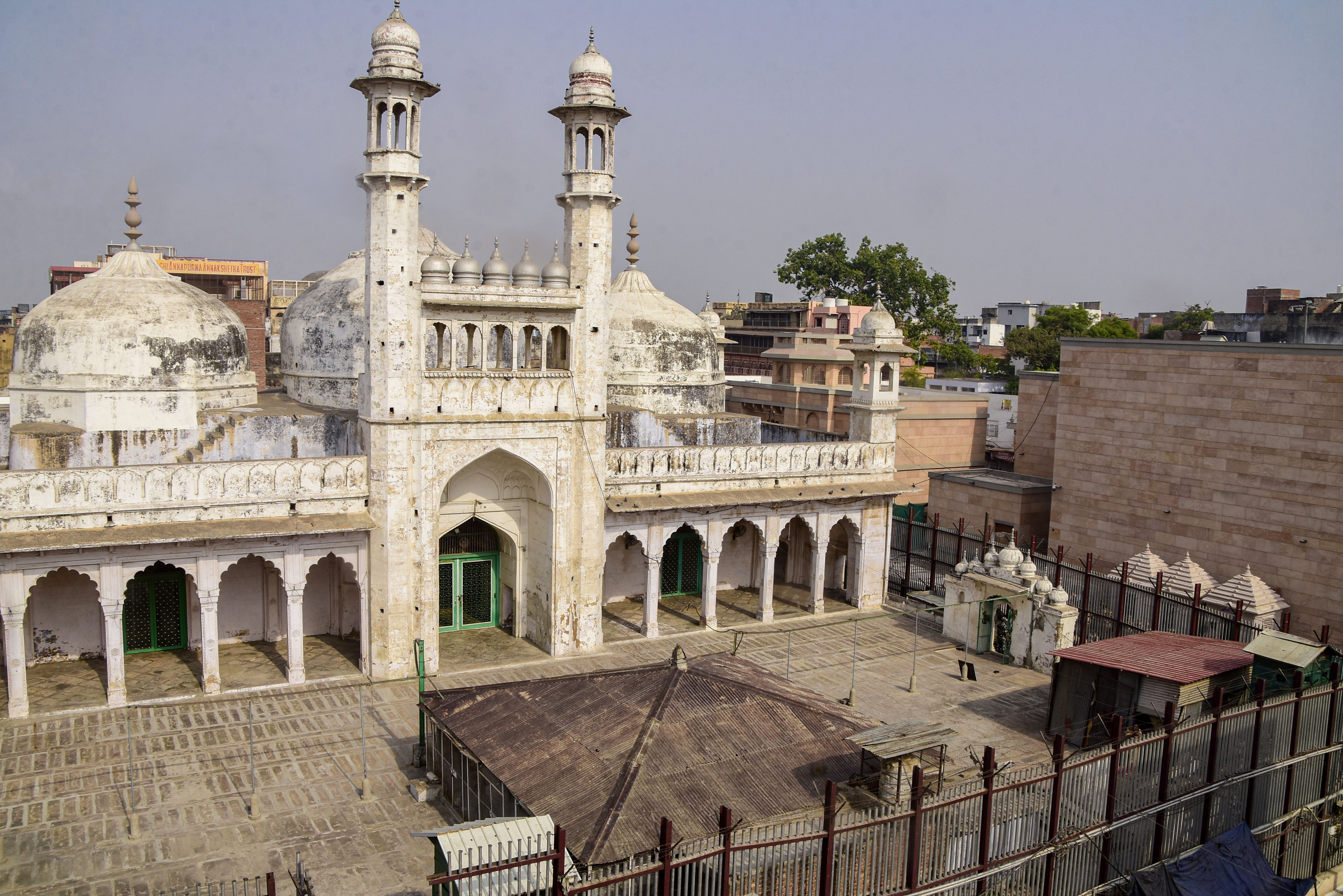
The section of Varanasi’s Gyanvapi Masjid complex, where the “Shivling” was found — the Muslim side says the object is not a Shivling but a part of a fountain — is currently protected under the May 17 order of the Supreme Court.


The Supreme Court on Thursday decided to wait for the final order of the Varanasi trial court on the maintainability of the suit filed by some Hindu women for a right to worship inside the Gyanvapi mosque before examining a spate of objections raised by the mosque management committee against the inquiry and sealing of a part of the premises.
Citing the pendency of the suit before the Varanasi district court, a bench led by justice Dhananjaya Y Chandrachud also refused to entertain two new public interest litigation (PILs) filed by Hindu petitioners for an interim order to worship a “Shivling” they claim was found during a civil court-mandated survey inside the mosque complex, and its carbon-dating.
The section of Varanasi’s Gyanvapi Masjid complex, where the “Shivling” was found — the Muslim side says the object is not a Shivling but a part of a fountain — is currently protected under the May 17 order of the Supreme Court.
The bench, which also comprised justices Surya Kant and PS Narasimha, noted that there is no occasion for the top court to intervene or pass any order when the Varanasi district judge is hearing the Order VII Rule 11 application, which has been filed by the mosque management committee challenging the maintainability of the suit. The court fixed the next hearing in the first week of October.
“Everything will depend on the outcome of the Order VII Rule 11 application. If your objections are upheld by the trial court, the suit goes and the parties will have to exercise their remedies under the law,” the bench told senior counsel Huzefa Ahmadi, who represented the Anjuman Intezamia Masjid Committee, the petitioner in the case before the Supreme Court.
It asked Ahmadi why the petition by the committee should remain pending in the top court when the district judge’s decision will change the entire course of the litigation.
The senior lawyer responded that the bench must examine the correctness of the April 21 Allahabad high court order that allowed the survey of the mosque although this order was passed by the civil judge without jurisdiction and without hearing them.
“The high court said that the order of survey is an innocuous order but look at what finally happened. An entire area has been sealed and the religious nature is sought to be changed,” added Ahmadi. The lawyer was referring to the sealing of a part of the precincts where the “Shivling” was ostensibly found during the survey by civil court-appointed commissioners in May.
To this, the court told Ahmadi that the survey report will not be looked into by the district judge at the time of deciding the application on maintainability and that it could further pass an order making it clear that the mosque management committee could raise all the objections, including the manner in which the survey was ordered, before the district judge as and when such occasion arises.
“We can keep the slate clear for you. The trial court can decide your objections uninfluenced by the observations of the high court. We can pass a protective order allowing you to raise all the objections that you were entitled to before the appointment of the court commissioner for the survey. What’s the great purpose of keeping it alive here now?” asked the bench.
Ahmadi replied that he is not concerned only about the Gyanvapi case. “I am also concerned about other cases being filed. The survey and the commissioner’s report (on the purported discovery of the “Shivling”) created a perception and ultimately, this report resulted in altering the status quo. There is now a domino effect,” complained the lawyer, emphasising that the validity of the survey and the commissioner’s report is a live issue that must be examined by the apex court.
At this point, the bench said that it would await the decision of the district judge on the maintainability of the suit before deciding the future course of action.
The mosque management committee has relied on Section 3 of the Places of Worship Act that imposes a prohibition against converting, in full or part, a place of worship of any religious denomination into a place of worship of a different religious denomination -- or even a different segment of the same religious denomination. Section 4 of the Act declares that a place of worship’s religious character “shall continue to be the same as it existed” as it was on August 15, 1947. The second clause of this provision stamps out all pending and future litigation demanding a change in the religious character of a place.
The committee has also cited the 2019 judgment of the Supreme Court in the Ayodhya case, in which the top court held that the law prohibits the conversion of any place of worship and in doing so, it speaks to the future by mandating that the character of a place of public worship shall be preserved and not be altered.
After the bench put off the hearing, two new PILs related to the Gyanvapi case came up before it. The first plea, filed by Rajesh Mani Tripathi, sought an interim order to worship the “Shivling” while another plea, filed by a group of seven Hindu women, argued for carbon dating of the “Shivling”.
“What is this? The suit is already pending? How can we entertain all this in the light of the Civil Procedure Code?” the bench asked the lawyers appearing for the two petitions, refusing to entertain the pleas. At this, the lawyers withdrew the petitions.
The court is hearing the appeal filed by the mosque management committee in May, opposing the suit of five Hindu women who demand an unhindered right to worship Maa Shringar Gauri Sthal, a shrine for Hindu goddess Parvati located behind the western wall of the mosque complex. The committee claims that the suit is barred by the provisions of the Places of Worship Act, 1991, which locks the position or “religious identity” of any place of worship as it existed on August 15, 1947.
Challenging the April 21 order of the Allahabad high court allowing the survey, the petition added that the suit has the propensity of disturbing the communal harmony, warranting an intervention of the Supreme Court in the wake of the 2019 judgment on the Act.
On May 20, the Supreme Court transferred a suit filed by the Hindu petitioners from the Varanasi civil judge to the district judge to decide on the mosque management committee’s objections against the inquiry. It asked the district judge to first rule on the maintainability of the suit filed by the Hindu women. Ascertainment of the religious character of a place may not be barred by the Places of Worship Act, 1991, the court also observed on that occasion as it refrained from interfering with the Gyanvapi mosque survey.


