
 E-Paper



Delhi HC seeks Ramani’s reply on Akbar’s plea against trial court verdict
Appearing for former Union minister M J Akbar, senior advocates Rajiv Nayar and Geeta Luthra contended that the trial court erroneously acquitted Ramani in spite of concluding that her allegations were defamatory in nature.


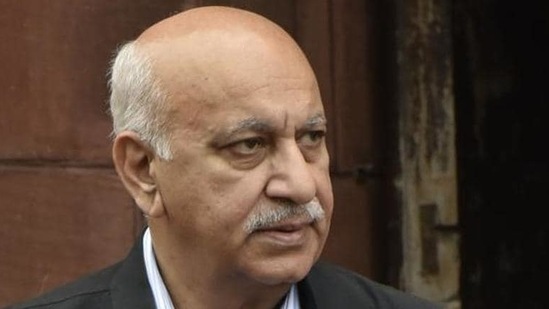
The Delhi high court (HC) on Wednesday admitted former Union minister M J Akbar’s appeal against a trial court order acquitting journalist Priya Ramani in a criminal defamation suit filed by Akbar in 2018 after Ramani accused him of sexual misconduct.
Justice Mukta Gupta issued notice to Ramani on the appeal and listed it for further hearing on January 13.
Appearing for Akbar, senior advocates Rajiv Nayar and Geeta Luthra contended that the trial court erroneously acquitted Ramani in spite of concluding that her allegations were defamatory in nature.
In his appeal, Akbar said that the trial court had decided the case as though it was a sexual harassment case instead of a defamation case. “The impugned judgement, being based on surmises and conjecture, cannot stand muster even from a prima facie view, and therefore, is liable to be set aside,” he said.
In February, a Delhi court acquitted Ramani in the defamation case stating that a woman has the right to voice her grievance even after several years.
Ramani had accused Akbar of sexual misconduct over social media publishing platform Twitter in 2018 in the wake of the Me Too movement, which Akbar argued were “per se defamatory”.
Referring to ancient epics ‘Mahabharata’ and ‘Ramayana’ in the judgement delivered on February 17, Additional Chief Metropolitan Magistrate Ravindra Pandey said they were written to show the importance of dignity of a woman and it was shameful that such incidents were still happening in the country.
The court accepted Ramani’s contention that Akbar was not a man of stellar reputation and said that a man’s right of reputation can’t be weighed over the right to life and dignity of a woman’s.
Akbar, who was a minister in the BJP-led cabinet at the time resigned shortly after a host of women, besides Ramani, made allegations of sexual misconduct and harassment against him.
On Wednesday, senior counsel Luthra contended that the trial court handed out the verdict without considering any objections raised during the trial. “Nothing is decided. The (trial) court went on to decide about Ram and Ravan. Objections are not decided or looked into,” she said.
The HC judge remarked that finding any content defamatory is the “first step” in the proceedings, after which the trial court has to consider the defence of the accused. “The trial court says per se they are defamatory but in the context of which she made the allegations, there was a valid defense,” Justice Gupta stated.
Niharika Karanjawala, senior associate of the Karanjawala & Co that filed Akbar’s petition in the high court, told HT: “The legal team delineated the reasons for which the appeal ought to be allowed, including the errors apparent in the record. The court was pleased to issue a notice.”
In October 2018, Ramani shared an article on Twitter which she had written in 2017 in Vogue India magazine following allegations of sexual assault and misconduct against Hollywood producer Harvey Weinstein made by several women as part of the Me Too movement in the United States. The article did not name Akbar -- it described her experience of an interview with a newspaper editor for a reporter’s position in 1993-- but the tweet did.
Akbar filed a criminal defamation suit under Section 500 of the Indian Penal Code (IPC) against Ramani arguing that the incident was not as she described it in her article. He also said that a tweet by Ramani describing him as a “predator” had caused irreparable damage to his reputation.
On February 17 this year, the trial court acquitted Ramani. It pointed out that a woman cannot be punished for raising instances of abuse.


