
 E-Paper



Health ministry issues pool testing rules
A pool of 25 samples from the target population will be tested using the reverse transcription polymerase chain reaction (RT-PCR) method to detect the presence of Sars-Cov-2, the virus that causes Covid-19.


Migrant workers and international passengers in institutional quarantine, people under isolation in hotels, and random samples of those living in green zone districts will be pool tested for prevalence of the coronavirus disease (Covid-19), according to new Union health ministry guidelines released on Thursday.
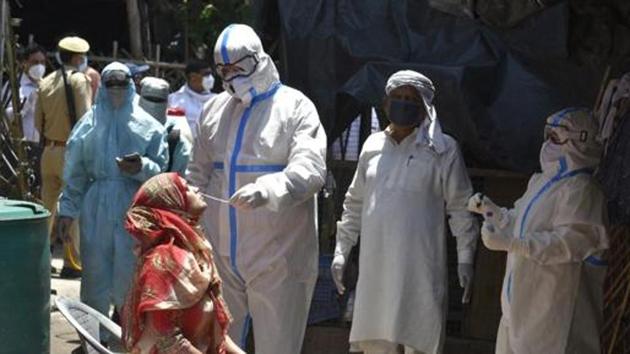
A pool of 25 samples from the target population will be tested using the reverse transcription polymerase chain reaction (RT-PCR) method to detect the presence of Sars-Cov-2, the virus that causes Covid-19.
In pool testing, throat or nasal swabs from two to five people are mixed and tested as a single unit. All individual samples in a negative pool are deemed as having tested negative; if a pooled sample tests positive, each person in the pool is tested individually to find out who is infected.
“Guideline for RT-PCR based pooled sampling for migrants/returnees from abroad/green zones… A decision has been taken to use one time RT-PCR based pooled sampling for surveillance purposes for migrant workers in institutional quarantine facilities, international passengers in institutional quarantine facilities/hotels ear-marked for quarantine and for surveillance purposes in green zones…” reads a health ministry directive.
The green zone districts from where samples will be collected are those from where no case has been reported to date, or districts which had reported cases earlier but have been clean for the past 21 days or more.
“It is one time only testing to check whether there is infection prevalent in a particular group or not. If a pool sample returns positive, then all the samples will be individually tested for the presence of virus,” said a health ministry official, who did not wish to be identified.
The responsibility of conducting the test will lie on respective state governments.
As per the protocol, a cohort of 25 people will be identified, and throat or nasal swabs will be collected by trained laboratory personnel using appropriate protective gear.
The sample will be packed in triple layer packaging, and transported to the identified laboratory under cold-chain as per the guidelines issued by the Indian Council of Medical Research for Covid-19 sample collection and testing.
“The samples will be aliquoted and thereafter pooled samples from 25 specimens shall be tested in the laboratory by RT-PCR method. The report will be conveyed to the quarantine/concerned facility within 24 hours. If any of the pooled samples tests positive, individual samples would be tested from the aliquoted samples preserved in the laboratory,” say the health ministry guidelines.
ICMR issued an advisory on the feasibility of pool testing of samples using RT-PCR last month. It was done after a feasibility study was conducted at ICMR’s Virus Research and Diagnostic Laboratory (VRDL) at King George’s Medical University (KGMU), Lucknow.
“The samples are pool tested for the purpose of surveillance. It is not advisable for diagnosis in areas where case load or its suspicion is high because if every other pooled sample tests positive, then you will end up individually testing a large number of samples, which will defeat the purpose,” Dr Amita Jain, head, ICMR-VRDL, KGMU, had earlier said about pool testing as she headed the feasibility study.
Dr Ekta Gupta, senior virologist at Delhi government-run Institute of Liver and Biliary Sciences, which is one of the ICMR-approved labs for Covid-19 testing, said, “In areas where the suspicion of finding a positive case is low, it helps to go for pooled testing as it will save a lot of precious resources. RT-PCR is an expensive test, and you need a proper laboratory setting to conduct the test. Pooling is feasible and if a batch comes positive, you can always go back and test individual samples. You will still end up saving a lot.”


