E-Paper



Hot and humid days ahead in NW India
Heatwave conditions are likely to abate gradually from Saturday. But heat-related discomfort will stay, according to the India Meteorological Department (IMD)


Swathes of northwest India are facing a heatwave with most places in West Rajasthan, Haryana, Chandigarh, Delhi, Punjab recording maximum temperatures of over 40 degrees C (°C). On Thursday, Delhi recorded a maximum temperature of 43.1°C, 6.3°C above normal.
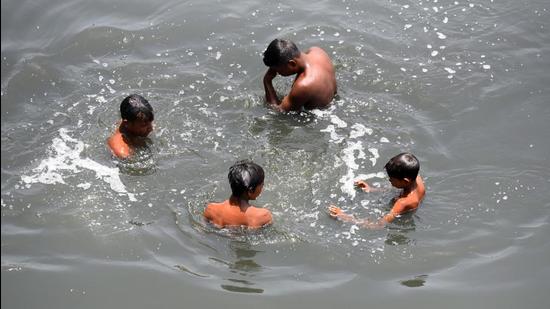
Heatwave conditions are likely to abate gradually from Saturday. But heat-related discomfort will stay, according to the India Meteorological Department (IMD). The wind direction was westerly and south-westerly. It was blowing mainly from the dry regions of Pakistan. The wind will blow from further south-westerly direction bringing moisture from the Arabian Sea.
“Heatwave intensity and spatial coverage will reduce due to southwesterly winds from the Arabian Sea. However, due to an increase in humidity in association with these winds, the human discomfort will continue during the next seven days,” M Mohapatra, director-general, IMD, said on Thursday.
Also Read | Capturing Delhi’s unusual weather patterns this summer
K Sathi Devi, who heads the National Weather Forecasting Centre, said the wind direction has started changing in lower levels as per their models. “Moisture incursion has started. There is a lot of heat in this region and when moisture-laden winds start blowing, there will be thunderstorm activity. We can expect some thunder and rain but that is not the monsoon. When humidity increases with heat obviously moist air will make it uncomfortable, but heat intensity will also reduce.”
Mahesh Palawat, vice president, Skymet Weather, said the winds from the Arabian Sea will bring moisture and cause thunderstorms and some light pre-monsoon showers for five to six days. “The monsoon trough will move southwards from the foothills after a week or so. We can expect monsoon to set in over this region after that. There will be some relief from extreme heat due to the change in wind direction.”
The northern limit of the southwest monsoon continues to pass through Barmer, Bhilwara, Dholpur, Aligarh, Meerut, Ambala, and Amritsar. It has been there since June 19.
“Prevailing meteorological conditions, large scale atmospheric features and the forecast wind pattern by dynamical models suggest that no favourable conditions are likely to develop for further advance of southwest monsoon into remaining parts of Rajasthan, West Uttar Pradesh, Haryana, Chandigarh, Delhi and Punjab during next five to six days,” IMD said in its Friday bulletin.
It added subdued rainfall activity was very likely to continue to prevail over the northwest, central, and western parts of Peninsular India during the next five to six days.
IMD said isolated/scattered thunderstorm activity accompanied with lightning and rainfall is also likely over these regions during this period. Under the influence of strong moist southwesterly winds at lower tropospheric levels from the Bay of Bengal to the northeast and adjoining east India and a trough (area of low pressure) at mean sea level from northwest Rajasthan to east Assam, fairly widespread to widespread rainfall is very likely in Bihar, Sub-Himalayan West Bengal, Sikkim, Arunachal Pradesh, Assam, Meghalaya during the next five days.
IMD said moderate to severe thunderstorms accompanied by frequent cloud to ground lightning are very likely in Bihar, Jharkhand, Gangetic West Bengal, and Chhattisgarh during the next 24 hours.
Dilip Malvankar, director, Indian Institute of Public Health, Gandhinagar, said there are two important things happening this time. “This is not the heatwave season. Heatwaves normally end by mid-June. It is very late this time. Secondly, if the humidity goes up, the heat index (an index that combines air temperature and humidity) also goes up which is a huge risk for old and co-morbid people. Desert coolers will not work. It is best if people working outdoors have staggered work hours.”