E-Paper



How many Indians are becoming richer with India?
As India's economic growth gains traction, a look at how many people in the country are enjoying high standards of living.
Published on: Jul 25, 2023, 22:58:49 IST


Share via


Copy link

A lot of India’s GDP traction comes from the fact that it has got a very large population (and hence more working hands). With India having replaced China has the most populous country sometime this year as per UN projections, this factor will become even more important going forward. While India is on its way to becoming the third largest economy in the world, and perhaps the second largest in PPP terms, how many Indians are enjoying high living standards? This is the question which the second part of this data-journalism article will try to answer.
The charts that matter
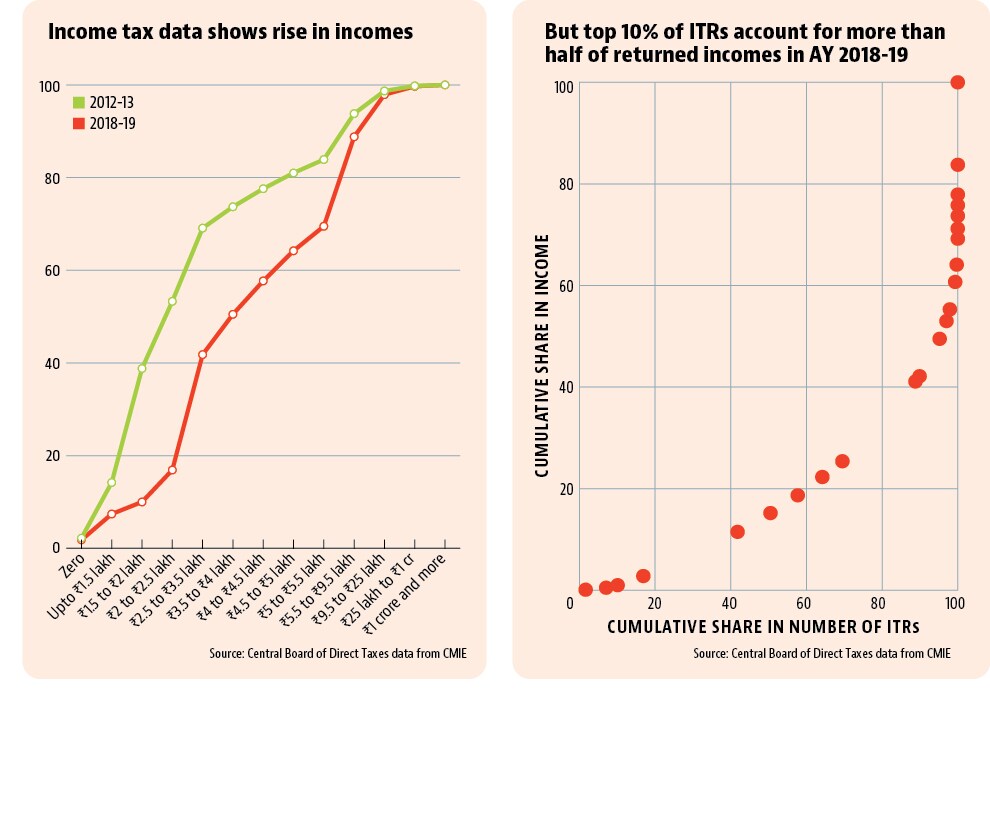
 What does income tax data tell us about Indian incomes?In an ideal world, income tax data should tell us about earnings of all workers in an economy. Unfortunately, that is not the case with India. According to the latest income tax data – it is available for assessment year 2018-19 which corresponds to fiscal year 2017-18 – only 58.7 million income tax returns (ITR) were filed in India. This is just 13% of the estimated 455.84 million workers in 2017-18 according to the Periodic Labour Force Survey (PLFS), the official source of employment statistics in India, and mid-year population projections used in National Accounts. The reason why the number of ITRs are significantly lower than the number of total workers in India is not because of tax evasion. It is possibly a reflection of agricultural incomes not being taxable and a large number of workers being employed in the informal economy. Of the 58.7 million ITRs which were filed for 2017-18, almost two-third report an annual income of up to ₹5 lakh and 90% have an income less than ₹10 lakh per annum. A comparison of these numbers with 2011-12 (fiscal year) data – this is the earliest available data – shows that there has been an upward movement in incomes of Indians filing ITRs. To be sure, the data also shows that even within the income tax payees, there exists a massive income inequality, and just 10% of ITRs account for more than 50% of returned incomes.
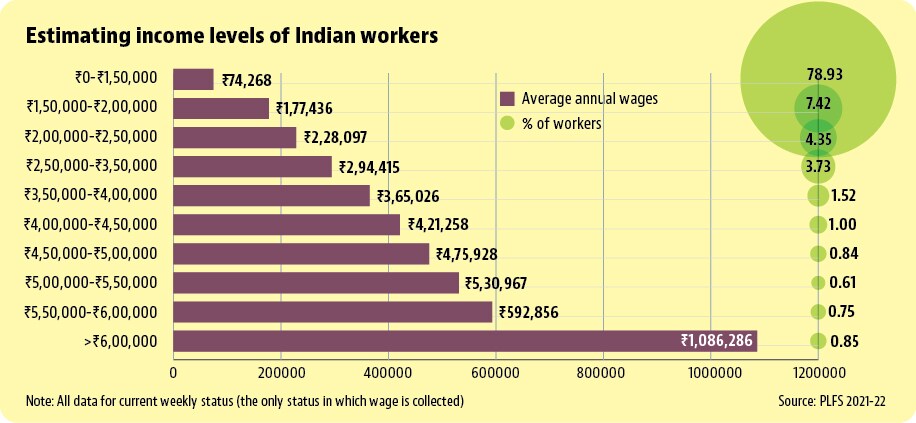
- What about workers who do not file ITRsBecause India does not collect income data and even official consumption numbers are not available after 2011-12, there is no foolproof way of estimating income levels of all workers in the Indian economy. One way to come to such an estimate is to use the PLFS numbers to estimate wages for workers. A caveat which needs to be kept in mind while reading the PLFS numbers is the fact that they do not really include the really rich and possibly count even the lower middle class. For example, only 3.05% of workers in the 2018-19 PLFS reported an annual income of ₹4.5 lakh or more which comes to an estimated 14 million. The number of ITR returns which reported an annual income of ₹4.5 lakh or more in AY 2018-19 was 24.8 million.
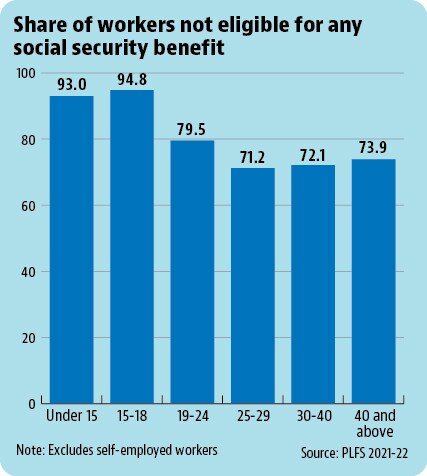
- Lack of social security/savings can emerge as an important headwind going forwardTo be sure, income inequality is not unique to India. What makes it particularly worrying is that an overwhelming majority of workers also have no social security in India. 74.2% of workers reported having no social security in the latest PLFS conducted in 2021-22. This problem could possibly become more acute going forward because the social security net is even smaller for the young, who are more likely to remain in the workforce than their older counterparts. 79.5% of those in the 19-24 years age group did not have any social security. To be sure, these figures need to be read carefully. It is possible that the figures given here grossly under-estimate the proportion of workers outside the social security net. This is because PLFS does not ask self-employed workers (who were 56% of workers in 2021-22) if they have any social security. Since 64% of self-employed workers were employed in agriculture, they are unlikely to have any social security. Unless this cohort of the workers experiences an improvement in earnings and social security, the impressive growth in India’s overall GDP will not translate into improved wellbeing for a very large section of the population. It is on this count that the future looks less promising because even if initiatives such as the Production Linked Incentive (PLI) scheme manage to give a boost to manufacturing, the employment impact is likely to be muted because of the levels of capital intensity in today’s technology. The fact that almost all commentaries see total factor productivity as the main driver of growth is a clear admission of this fact.