E-Paper



How Sardar Patel rose from the fields of Gujarat
In 1917, Kheda faced drought, floods, and plague. Mahatma Gandhi and Patel led a successful satyagraha for tax relief, shaping India's freedom movement.

 Prefer HTon Google


In the history of Kheda, a present-day eastern Gujarat district, 1917 was annus horribilis. The region had suffered a drought in 1915, then very little rain in 1916 and a deluge in 1917. When the sun finally came out in October, the farmers rushed to harvest their crops. But weeks later, the torrent returned, marooning the region and rotting crops. Then, a wave of plague ravaged the countryside, killing roughly 18,000 people over two years, wrote historian Rajmohan Gandhi.
But the British were not willing to suspend their newly announced higher taxes, triggering an impasse. In January 1918, Mahatma Gandhi returned to Gujarat fresh from his success in Champaran and roused the peasants in a satyagraha. As his lieutenant, he chose a young lawyer recently returned from London who also hailed from the region, Vallabhbhai Patel. By the end of the movement, now known as Kheda Satyagraha, the peasants had pushed the government to back down.
Ishwar Parmar, a resident of Bamroli village in Kheda district, grew up hearing stories about Patel and Gandhi, about how the two leaders galvanised the movement and inspired peasants. “My great-grandfather, Jawaharbhai Parmar, who was a farmer, had welcomed Gandhi and Patel to our village. There were no roads or electricity then, but people walked together with mashals (torches) at night. Our entire village would gather for the Satyagraha,” he said.
Over the next decade, two more satyagrahas, both in Gujarat, both by peasants against exorbitant taxes by the British authorities, were led by Patel that established him as one of the foremost leaders of the freedom movement – Borsad in 1923 and Bardoli in 1928 – and bestowed upon him the honorific that would immortalise him – Sardar, leader
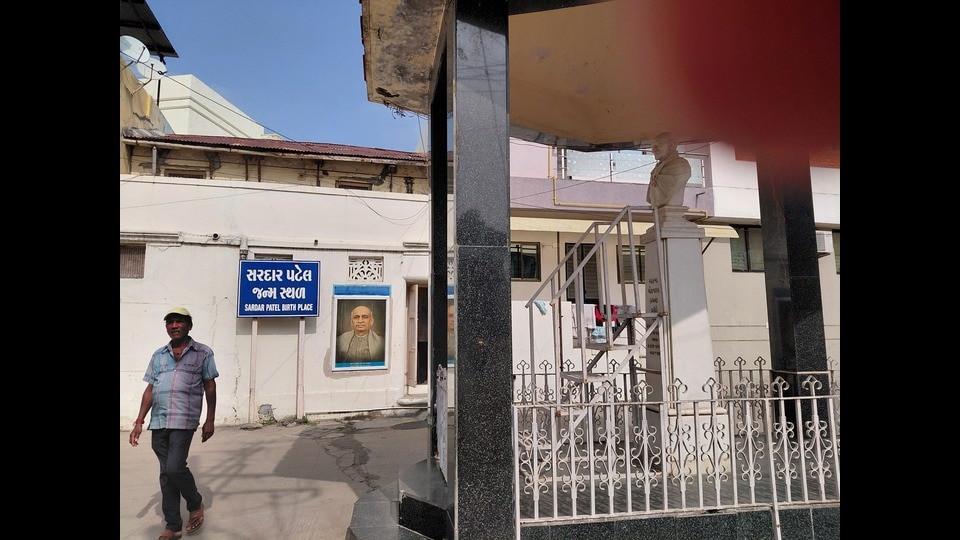
Born on October 31, 1875, in Nadiad hamlet of Kheda, Patel came from a family of small farmers. He grew up in Karamsad, where he attended village schools before moving to Petlad and Nadiad for his education.
At the Nadiad house, where Patel was born, the sense of his legacy is alive through those who protect it. Among them is 70-year-old Pradeep Desai, a fourth-generation descendant and current guardian of the property. Now based in Chicago after years of running a yarn business in Surat, Desai spends nearly six months a year in India. Local leaders have approached him with offers to buy the property, but Desai has refused. “I won’t part with the entire house,” he said, adding that he would gladly welcome a memorial to be built on the site to honour his ancestor.
The house, located in a quiet corner of Nadiad, continues to draw steady visitors. Sixty-seven-year-old Rajanibhai Desai, a neighbour who runs a small provision store and keeps the keys for visitors, said, “Sometimes groups of ten or twenty people come together.” Over the years, leaders across political lines — from Prime Minister Narendra Modi and home minister Amit Shah to Congress leader Rahul Gandhi and late Gujarat chief minister Vijay Rupani — have visited the site.
Suresh Thakor, a 29-year-old resident of Nadiad, said the presence of Patel is deeply rooted in the region. “The mark of Sardar is everywhere — in the schools of this town, in Vallabh Vidyanagar town built in his memory, and in the Statue of Unity at Ekta Nagar that stands as a tribute to his work. His contributions will always be remembered,” he said.
Nowhere is his footprint more visible than in the city of Ahmedabad, where Patel chaired the municipality for four years. As President of the Ahmedabad Municipality from 1924 to 1928, Patel introduced town-planning schemes for Ellisbridge and Maninagar, cleared overcrowded chawls, and modernised the drainage and water-supply systems. He insisted that all municipal proceedings be conducted in Gujarati, audited accounts personally, and opposed wasteful expenditure. His leadership during the 1927 floods, when he organised relief and medical camps and restored public utilities within days, drew praise across the province.
“When Sardar took charge during the 1927 floods, his disaster management was so swift and effective that it not only saved Ahmedabad but set a precedent for how a leader turns chaos into order, a skill he later applied to unify India’s princely states,” said historian Rizwan Kadri.
Patel also promoted cooperative housing. The Kochrab Housing Society, established under his initiative in 1924, was Gujarat’s first experiment in cooperative residence — a model later followed by the state’s milk and educational cooperatives, including Amul and Vallabh Vidyanagar.
One of the oldest landmarks of the city, the Gujarat Club in Ahmedabad carries a plaque at the entrance that, when translated from Gujarati, reads, “Gujarat Club — Established 1888 — Sardar–Gandhi First Meeting Place.” The club, founded in 1888, was a colonial-era gathering place for lawyers and professionals. It was here, over games of bridge, that Patel, then a 40-year-old barrister, first saw Mahatma Gandhi in 1915 — an encounter that would, within a few years, draw him into the centre of India’s political movement.