HT interview: Congress yatra an antidote to BJP’s divisive politics, says Kharge
The first non-Gandhi family president of the Congress in a quarter of a century, Mallikarjun Kharge spoke to HT about the challenge of reclaiming the party’s legacy.
The first non-Gandhi family president of the Congress in a quarter of a century, Mallikarjun Kharge spoke to Vinod Sharma about the challenge of reclaiming the party’s legacy, and about its ideology which is under fire from the Bharatiya Janata Party. He was ambivalent, however, on the organisational issues dogging the faction-ridden party which has faced a series of electoral defeats since the 2014 Lok Sabha polls. Edited excerpts:
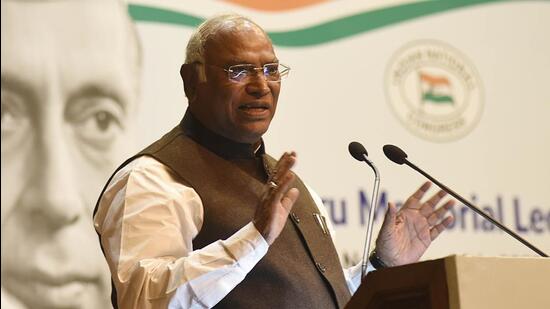
Congress president Mallikarjun Kharge. (HT photo)
You have your task cut out as the newly elected Congress president. Besides several organisational and leadership issues crying for attention, the party’s hamstrung by the lack of a cogent political narrative and hurdles in reaching the message to the people. There has never been a leadership issue in the Congress. Mrs Sonia Gandhi and Rahul Gandhi led the party with full support of Congressmen. Now we just had an election and I’ve been given the responsibility as party president by the workers. We have a clear message against the divisive, anti-people policies of the BJP. Our Udaipur resolve laid out a clear road map. Yes, there are hurdles in carrying the message as level playfield has been curbed. That’s precisely why we decided to go directly to the people. The Bharat Jodo Yatra led by Rahul Gandhi and similar yatras in states like Odisha and Assam are being conducted to overcome limitations placed by a dictatorial government.
But internal leadership disputes have resurfaced on the eve of the yatra entering Rajasthan. Can Ashok Gehlot and Sachin Pilot be made to sit together to come to a modus vivendi?Such issues arise in all parties. It is true that one should not air grievances in public. Our party has the forums and the capacity to deal with such matters.
The BJP’s ideological offensive has many dimensions. But it singles out Jawaharlal Nehru on the Kashmir question and the India-China war, not to mention his broader foreign and economic policies. Nehru is in the hearts and minds of all Indians. He spent almost nine years in jail and fought for our freedom. He built India brick by brick amid many challenges. He laid the basis of democracy, was the moving force behind the Constitution, especially fundamental rights, objectives, universal franchise. He worked to kick-start the economy in Independent India with a new concept of mixed economy in a planned approach. His policies led to self-reliance in skilled human resource, heavy industries, power and atomic and space sectors. He always got huge mandates, winning over 360 seats every time. The Congress then ruled almost all the states. He used that mandate to nurture democracy, to build an integrated India while celebrating its diversity.
The BJP vilifies Nehru because it believes in an idea of India that is against his philosophy. They want an India that’s exclusionary, serves a chosen few and doesn’t guarantee equal rights to all. Many commentators, authors and journalists have started writing about Nehru’s contribution for the benefit of younger generation. We recently had a Jawaharlal Memorial Lecture where I explained how Sardar Patel and Subhas Chandra Bose wrote several times praising the contribution of Nehru. Today, the BJP wants to divide our freedom fighters.
On March 6, 1936, Netaji, in a letter from Austria, wrote to Nehru: “Among the front-rank leaders of today, you are the only one to whom we can look up to for leading the Congress in a progressive direction... your position is unique and I think even Mahatma Gandhi will be more accommodating towards you than towards anybody else. I earnestly hope you will fully utilise the strength of your public position.” Even after Netaji parted ways with Congress, he named his Indian National Army battalions after Gandhi, Nehru, Maulana Azad and Rani Jhansi. That should help people judge the difference between the BJP’s propaganda and real history.
Why then has your party’s response been less than robust to BJP’s blitzkrieg?Let me answer that in a straightforward way. We have workers in every village in India. We need to mobilise them against those who divide our society. We are a party of all religions, all sects, all castes, all communities — everyone. The Bharat Jodo Yatra is an effort to unify people who truly believe in secular ethos. I commend all citizens who have extended their support to the Bharat Jodo Yatra, Rahul Gandhi and the 119 Bharat Yatris. They’re joined by thousands and lakhs everyday and are reaching out to people from Kanyakumari to Kashmir. Their determination to walk almost 20-25km daily is admirable. We interact with each stakeholder; the party is listening to everybody who wants to say something. We also have large public meetings wherever required. Many state units are undertaking their own Bharat Jodo Yatras at local levels. The only antidote to the hateful and divisive politics of the BJP is to show unity at the grassroots. That’s what we believe in and that’s what we are doing.
A fight over history is also playing out. By talking about leaders who were ostensibly denied their rightful place in history by successive Congress regimes, isn’t the BJP effectively staking claim to the legacies of Patel, Ambedkar, Bose, Bhagat Singh? The BJP and the RSS have a long history of creating divisions among our freedom fighters. Do you know why? The Hindu Mahasabha and RSS ideologues then were British supporters and sympathiser and believed in the British policy of “Divide and Rule.” For clarity, let me quote an excerpt from Sardar Patel’s birthday letter to Nehru on 14 November 1949: “Some people motivated by selfishness have tried to spread misconceptions about us and some innocent people even believe them, but in reality we have been working together as lifelong associates and brothers. (We) mutually adjusted according to each other’s point of view and always respected each other’s difference of opinion, as can be done only in deep trust.”
The BJP, over the last eight years, has attempted to spread canards on the so-called bad relations between Patel and Nehru. In reality, theirs was a respectful relationship. Nehru visited Patel for advice on all important matters. The Congress working committee meetings invariably took place at Patel’s house with Nehru in attendance. In any case, all these leaders, including Patel, were Congress leaders. They were not RSS leaders. Throughout their life, they fought the RSS, never allowing it to take the centre stage. We’re taking these undeniable facts to the people to bust their propaganda.
Did these issues weigh on your mind when you said in a speech at Hyderabad that Narendra Modi couldn’t have been Prime Minister but for the strong foundations Nehru laid of democracy and the contribution he and Patel made to the Constitution Ambedkar wrote?Modi ji keeps asking, “What did the Congress do in 70 years”? Our reply to that is simple: Had the Congress not done anything, Modi ji would never have become Prime Minister. Nehru, Patel and Ambedkar ingrained democracy and democratic ethos in this country. Had there been no democracy, there would have been one-party rule and the BJP would have never come to power. It is our leaders’ valuable contribution that different ideologies are able to hold their sway on the Indian people.
Nehru was such a democrat that half of his cabinet colleagues were not from the Congress. He even included the Hindu Mahasabha’s Syama Prasad Mukherjee who had been against the Quit India movement. What will BJP say about that? It is the Congress which drafted the Constitution. It is the Congress which will protect it from the onslaught of divisive politics.
To suggestions that Nehru’s qualifications were limited to his proximity to Gandhi, let me remind them that it was Nehru who first talked of Poorna Swaraj (complete freedom) and brought a resolution in the Congress convention in Madras in 1927. On becoming Congress President, he announced the call of Poorna Swaraj in the party’s Lahore Session (1929) and declared the Tiranga as the national flag. Of course, he had the guidance and support of Gandhi ji. That’s why he could conceptualise and present the Karachi Resolution of 1931 which for the first time spelt out the contours of the idea of a new and Independent India. The same Karachi resolution later laid the framework of fundamental rights in our Constitution. And who was the Congress President in the Karachi session? It was Sardar Patel.
When Bose became the Congress president, he asked Nehru to be the chairman of the national planning committee in 1937. It was under Nehru that 29 subcommittee laid the detailed policy framework for independent India in sectors as diverse as finance, labour, agriculture, health, women and child, industry, education, rural marketing, irrigation, power, soil conservation and so on. The hard work of 1937 provided a ready blueprint for administration and development in 1947 and this huge, but poor country didn’t collapse as it was predicted by experts throughout the world.
It was Nehru’s intellect, his youthful and revolutionary ideas, his communication with masses, his commitment that made him dear not just to the people but also leaders such as Bhagat Singh, who wrote in Kirti magazine that “Panjabi youth should go with him [Nehru] to understand the real meaning of revolution…” From Gandhi to Sardar Patel, from Netaji to Bhagat Singh, all believed in Nehru. That’s a historical fact. No one can deny it.
The emphasis on the making of modern India under Nehru was discernible as much in your November 14 address on the former PM’s 133rd birth anniversary. But you’d agree that one speech cannot make a summer.
No one is claiming that one speech in politics will and can fight propaganda built over years. Fighting propaganda is a continuous process. In the times to come, you will see more such occasions and campaigns to fight the BJP’s calumny against all our freedom fighters, not just Pandit Nehru. We are ready to counter them at every step of the way. It’s not just a fight between two political parties; it’s a fight between ideologies. We are doing this to protect democracy. People who value democracy need to do their bit; they need to speak against propaganda. In the days of manufactured WhatsApp truths, the younger generation needs to know facts of history.
Is the ongoing 3500-km Bharat Jodo yatra also a vehicle for retelling the freedom struggle and the evolution of post-Independence India?We are precisely doing that. You must have seen visuals of people handing over portraits of Gandhi, Ambedkar, Nehru, Patel and Indira Gandhi to Rahul Gandhi. We are involving progressive civil society in a big way in the Bharat Jodo campaign. We are deliberating on a daily basis. We are training our cadre while the Yatra is on. Volunteers are distributing pamphlets on the importance of unity — the common dream of our forefathers.
Follow India news real-time updates and the latest news covered on Hindustan Times, featuring today's critical updates on Sonam Wangchuk LIVE and more across India.
Home/India News/HT interview: Congress Yatra An Antidote To BJP’s Divisive Politics, Says Kharge

 E-Paper