
 E-Paper



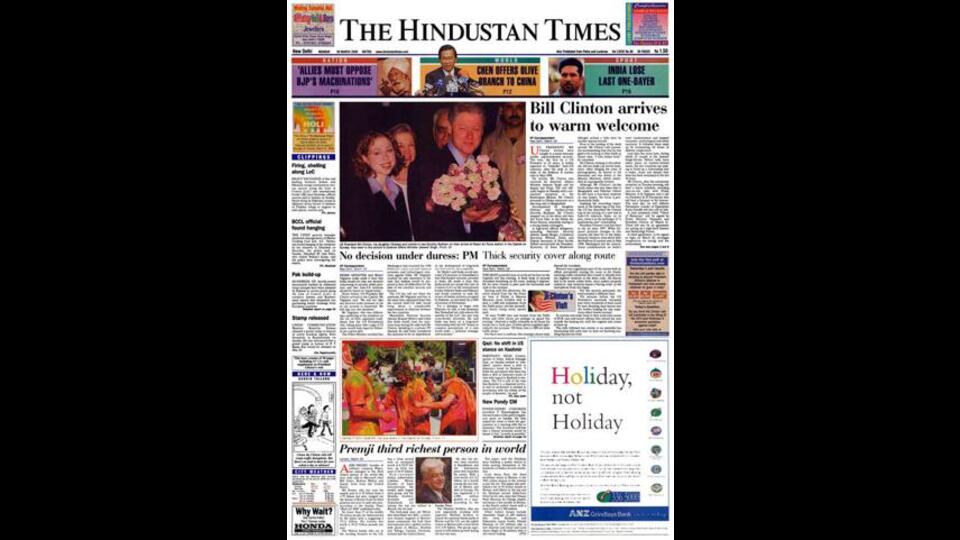
HT This Day: March 20, 2000 -- Bill Clinton arrives to warm welcome
US President Bill Clinton arrived here tonight to a warm welcome amidst unprecedented security. The visit, the first by a US President in 22 years, is widely expected to “rekindle” Indo-US relations, after the slide in the wake of the Pokhran II nuclear tests in May 1998.

 Prefer HTon Google


US President Bill Clinton arrived here tonight to a warm welcome amidst unprecedented security. The visit, the first by a US President in 22 years, is widely expected to “rekindle” Indo-US relations, after the slide in the wake of the Pokhran II nuclear tests in May 1998.
On arrival, Mr Clinton was received by External Affairs Minister Jaswant Singh and his deputy Ajit Panja. The visit officially begins on Tuesday with a ceremonial reception at the Rashtrapatt Bhavan. Mr Clinton proceeds to Dhaka tomorrow on a 2 day-long visit to Bangladesh.
Accompanied by daughter Chelsea and mother-in-law Dorothy Rodham, Mr Clinton stepped out of his white and blue ‘Air Force One’ at the Palam Air Force Station, cheerfully waving to a strong media contingent.
A high-level official delegation, including National — Security Adviser Sandy Berger, Commerce Secretary William Daley and Deputy Secretary of State Strobe Talbott arrived with the President, Secretary of State Madeleine Albright arrived a little later by another special aircraft.
Prior to the landing of the sleek aircraft, Mr Clinton told journalists accompanying him that he was glad to be arriving in New Delhi at dinner time. “I love Indian food,” he remarked.
Mr Clinton, sticking to the schedule, did not make any arrival statement. After obliging the army of photographers, he moved to his limousine and was driven to the Maurya Sheraton, which- resembled an impregnable fortress.
Although Mr Clinton’s six-day South Asian visit also takes him to Bangladesh and Pakistan (where he will have a four-hour stopover on way home), the focus is, predominantly India.
Implying the overriding importance of the Indian leg of the visit, the US has described the Clinton trip as the turning of a new leaf in Indo-US relations. India, on its part, views it as the harbinger of “a qualitatively new” relationship.
President Clinton’s visit has been in the air since 1997. While frequent political changes in this country did their bit in the delay, bilateral relations nose-dived after the Pokhran II nuclear tests in May 1998. Washington led the international condemnation on India’s overt nuclearisation and slapped economic, technological and entity sanctions. It followed these steps up by terminating all forms of defence cooperation.
Less than two years later, during which 10 rounds of the Jaswant Singh-Strobe Talbott talks have taken place on nuclear-related issues, the two countries are seeking to build up a relationship that is wider, closer and deeper than what has been witnessed in the last 50 years.
Mr Clinton, after the ceremonial reception on Tuesday morning, will have a hectic schedule, including one-on-one talks with Prime Minister A B Vajpayee and a call on President K R Narayanan who will host a banquet in his honour. The next day, he will address Parliament. Leader of Opposition Sonia Gandhi will also call on him.
A joint statement titled “Vision of Relations,” will be signed by Prime Minister Vajpayee and President Clinton on March 21. There will also be an agreement for setting up a high-level Science and Technology Forum.
A third agreement, to be signed in Agra on March 22, envisages cooperation on energy and the environment.


