
 E-Paper



HT THIS DAY: On October 21, 1977 — Parliamentary set up for Pakistan; accord at leaders’ meet
The agreement, signed today by Pakistani leaders convened by President ZA Bhutto, also provided for an Assembly of 200 members and a Senate of 60 members, the former to be elected by popular vote and the latter by provincial Assemblies


Rawalpindi A constitutional conference today reached agreement on general lines for a federal parliamentary Government for Pakistan, a spokesman said.
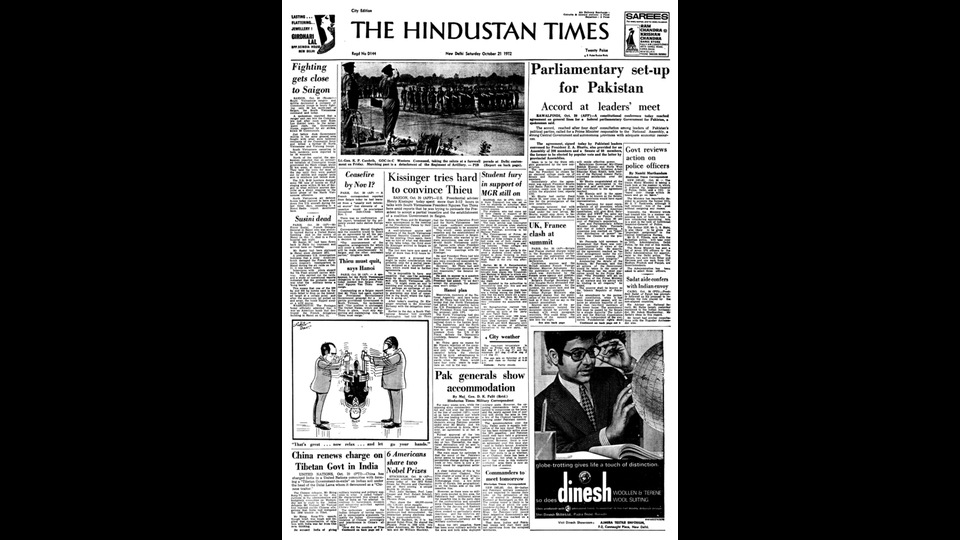
The accord, reached after four days’ consultation among leaders of Pakistan’s political parties, called for a Prime Minister responsible to the National Assembly, a strong Central Government and autonomous provinces with adequate economic resources.
The agreement, signed today by Pakistani leaders convened by President Z. A. Bhutto, also provided for an Assembly of 200 members and a Senate of 60 members, the former to be elected by popular vote and the latter by provincial Assemblies.
Islam is to be the State religion guaranteed by the new constitution.
The new constitution provides that the President be chosen by an electoral college made up of Senate and National Assembly members.
Immediately after the agreement was signed, President Bhutto told Radio Pakistan that the constitution could now be prepared within the stipulated time, reports UNI.
Mr Bhutto had earlier fixed March 23, next year, as the deadline for the promulgation of the new constitution.
Observers believed that with the President becoming a titular head under the new set-up, Mr Bhutto would step down to become the Prime Minister in whom will reside effective power.
Baluchistan Governor Mir Ghaus Bakhsh Bizenfo and North West Frontier Province Governor Arbab Sikandar Khan Khalil, both leaders of the National Awami Party, expressed satisfaction over the accord.
Mr Bhutto congratulated all the leaders who participated in the talks and said each one of them had contributed to the agreement reached.
Mr Bizenjo said in the upper house, to be known as the Senate, all the provinces would have equal representation.
The provision for equal representation of all provinces, which is borrowed from the American constitution, will give Sind, Baluchistan and NWFP the same say in the Senate as Punjab, which accounts for more than 60 per cent of Pakistan’s population.
Law and Parliamentary Affairs Minister Abdul Hafiz Peerzada said that at today’s meeting, a consensus was reached on “equitable distribution of power” between the Centre and the provinces.
Mr Peerzada told newsmen in Rawalpindi that there was complete unanimity of views at the constitutional talks. He described the agreement reached as “an ideal arrangement under the circumstances which ensures the country’s unity and integrity.”
Announcing the details of the formula, Mr Peerzeda said that all actions of the Government would be taken in the name of the President but the chief executive would be the Prime Minister. “The President will Act on the advice of the Prime Minister in all matters and his advice will be binding in all respects,” he added.
The country shall be known as the ‘Islamic Republic of Pakistan.’
An amendment to the permanent constitution, when it had been framed and passed, will require an absolute majority of not less than two-third members of the lower house. The amendment Bill must be passed by the Senate by a simple majority. The judiciary and the Election Commission are to be independent of the executive. Fundamental rights shall be guaranteed, and safeguards will be provided against preventive detentions.
The Prime Minister shall be from the lower house. It shall be the right of the Prime Minister to seek dissolution of the National Assembly even during the pendency of a motion of no-confidence against him.
If the Prime Minister thinks that members of the House are not acting in accordance with the mandate of the people, he will ask for a dissolution which will be granted. Special provisions have been made to ensure stability in the country. These will apply mutatis mutandis to the legislatures of the four provinces.
A vote of no-confidence shall not be moved during a budget session.
A vote of no-confidence shall not be moved against the Prime Minister unless by the same resolution, the name of another member of the Assembly is proposed for Prime Ministership.
The proposed constitution must now go before the constitutional commission of the National Assembly before being submitted to a final vote, probably before the end of next April.


