
 E-Paper



In Muzaffarpur’s health care tragedy, the eyes don’t have it
The eye camp at the hospital has left 30 people suffering from endophthalmitis, which is an inflammation of the eye caused by a bacterial infection from a botched cataract surgery.

 Prefer HTon Google


The hospital records get his name wrong -- Mushul Darzi instead of Mohammad Muslim Darzi. The one word they get right is crucial to his identity -- Darzi means tailor. He is 60 years old, from the village of Mahant Maniyari, 15km away from the district headquarters of Muzaffarpur. On November 22, Darzi was one of 65 people that came to the Muzaffarpur Eye Hospital for a cataract surgery. Since then, he has had purulent discharge and pain in his left eye, and now fears that he will lose his vision, and his livelihood. Two weeks later, his sewing machine lies in a corner of his one-room Indira Awaas home, quietly gathering dust.
Darzi is not alone in his suffering. The eye camp at the hospital has left 30 people suffering from endophthalmitis, which is an inflammation of the eye caused by a bacterial infection from a botched cataract surgery. At least 15 of them have had to get one of their eyes “eviscerated”, which is the surgical removal of the eye’s contents, leaving the scleral shell and extraocular muscles intact. Darzi is one of those under medication -- he has both eyes, for now.
“All I want to do now is to stay home and stitch clothes with whatever vision I have left. I need to earn money so my family can eat two square meals a day,” said Darzi, the sole regular bread earner of the family with a 58-year-old wife Aisha Khatoon, a differently abled son Mohhamad Jalaluddin, 34, who works occasionally at a private tent house, daughter-in-law Sabrunnisha, 30, and four grandchildren.
The tragedy in the last week of November has put the spotlight on Bihar’s health care apparatus, with ill-equipped government structures, a burgeoning private sector that is openly flouting norms of safety and care, and patients such as Darzi who are caught in between, often with dire consequences.
At 77.6%, the share of households that do not use a government facility when sick was the second highest in Bihar -- it was the highest in Uttar Pradesh -- at the time of the 2015-16 National Family Health Survey. 60% of people who did not use government facilities reported ‘poor quality of care’ as a reason, the biggest reason for the state among five options given to respondents.
TRUST DEFICIT
Immediately after the events in Muzaffarpur, the Bihar government offered Darzi and the other victims of endophthalmitis free treatment at the Indira Gandhi Institute of Medical Sciences (IGIMS), a multi-discipline super specialty government health care centre in Patna. The risk to his eye and livelihood notwithstanding, Darzi does not want to go to a government centre. He does not believe he will come out alive.
“I know any further delay can lead to loss of vision in one eye, but I am not going to any government health care centre where they may take out my eye, or anything else can happen. I am not sure if I will return. I have a responsibility to marry my granddaughter Roshan Khatoon, who has turned 17 years of age,” said Darzi.
The fear comes from lived experience. The first time Darzi went to a heath care facility for treatment to his eye, it was a private institution, Lahan Eye Centre at Harisabha Chowk in Muzaffarpur in May 2020. The procedure, on his right eye, went smoothly but cost him ₹11,000. But Covid had hit business, and when Darzi wanted another cataract procedure, this time on his left eye, he went to what he believed was a “semi-government” centre.
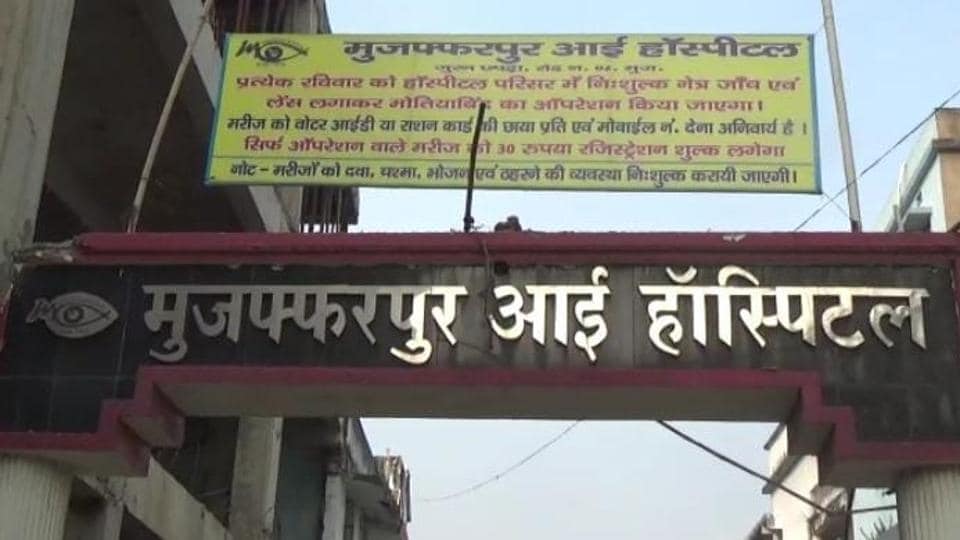
He had two reasons to believe that the Muzaffarpur Eye Hospital had government linkages. First, its website mentions the Tirhut divisional commissioner as the president of the hospital’s managing committee. Second, the government, until recently, reimbursed the hospital ₹2,000 for every cataract surgery done free of cost under the National Programme for Control of Blindness and Visual Impairment (NPCBVI) before the pact ended in March this year.
In truth, the Muzaffarpur Eye Hospital was founded by Sant Shree Biragi Baba as a charitable institution in 1973 under the Societies Registration Act, and the hospital is managed by a committee headed by the commissioner of the Tirhut division as ex-officio president.
On November 22, Darzi was charged only ₹50 for registration, and ₹30 for a blood sugar investigation. In less than a week, however, he and 30 others were battling for their eyesight.
GOVERNMENT ACTION
The government ordered the closure of the hospital OT on December 4, lodged an FIR against the hospital management, including the doctor who operated on the patients, and instituted government inquiries. The police complaint names 14 accused, but no arrests have been made yet.
The government also instructed all districts on December 2 to refer those facing post-operation complications to IGIMS for further treatment. “We sent patient lists to districts and advised civil surgeons of Muzaffarpur, East Champaran, West Champaran, Sheohar and Samastipur, to track the patients and promptly refer them to the IGIMS for free medical treatment, in case of any complications,” said Sanjay Kumar Singh, executive director of the State Health Society, Bihar.
A government inquiry report, dated December 2, by a four-member district level committee headed by additional chief medical officer Dr Subhash Singh said that the cataract operations “prima facie” pointed to medical negligence. A subsequent swab culture report on December 3, a copy of which is with HT, isolated the presence of “Gram Negative bacilli (pseudomonas aeruginosa)”, indicating that the outbreak was linked to improper sterilisation of the OT, said a doctor at Muzaffarpur’s Sri Krishna Medical College Hospital (SKMCH), requesting anonymity. Based on the microbiology report, the committee in its final report to the civil surgeon on December 6, gave a clean chit to the operating surgeon and concluded that infected equipment in the operation theatre was the source of infection. HT has a copy of the inquiry report.
The doctor conducting the surgeries, however, also broke protocol with the number of surgeries conducted in a day -- as high as 65. “As per the national guideline for doing eye camp surgeries, a doctor should not do more than 25-30 surgeries in a day,” said Dr Rajvardhan Azad, former chief of the Rajendra Prasad Centre, AIIMS, New Delhi.
The inquiry headed by Dr Harish Chandra Ojha also found that there were no tiles inside the walls of OT, an important prerequisite, and that the hospital did not have any regular doctors on its rolls, and engaged doctors on a daily basis depending on the caseload at the eye camps. When patients returned to the hospital with complications in their eyes a couple of days after the cataract surgery, an optometrist examined the patients in the absence of regular doctors, the inquiry report said.
Efforts to reach Tirhut divisional commissioner Mihir Kumar Singh were unsuccessful. While one of his official numbers was switched off, the other number, mentioned on the website of the Muzaffarpur district administration website, said: “Incoming call facility to the dialled number is currently not available.” HT also tried to reach the doctor that conducted the operations, but he was unavailable for comment as well.
FAILING HEALTH CARE
It is not without reason that Darzi prefers a private centre for treatment. Just a kilometre away from Darzi’s residence is the additional primary health centre (APHC) at Mahant Maniyari village. The outdoor patient department (OPD) and in-patient department (IPD) facilities there are non-existent. Since the incident, an optometrist from a private hospital comes for around 90 minutes to check the vision of patients once a week.
All the APHC has in the name of equipment are two weighing scales — one for adults and another for infants. It has all of 30 medicines, mostly antibiotics, pain killers and paracetamol tablets in its formulary. Despite the posting of three general duty medical officers, Dr Pooja Singh was the lone medical officer present around noon on December 4, when this reporter visited the two-room APHC. What was earlier the operation theatre (OT) of the Mahant Maniyari Darshan Das Hospital, a private health facility, which now houses the government APHC, is a junkyard. The ward where patients were once admitted is now a storehouse of wheat, cattle fodder, and hay.
“The OT existed between 1982 and 1989-90. Doctors of SKMCH used to come to do post-mortem examination and surgery,” said Anand Gaurav, a local resident.
The district hospital in Muzaffarpur, 15km away, is only a shade better. There is an OPD for eye patients, but no IPD. It is among 16 of 36 district hospitals in Bihar that does not have an operation theatre for eye surgeries, according to the state programme officer for blindness control Dr Harish Chandra Ojha.
What passes off as equipment is a chart to check for vision, and a torch. The ophthalmoscope has not been functional for the last two years. It does not have basic tools such as an autorefractor which is a microscope used during eye examinations. The hospital does not have an OT even for minor surgical procedures either.
In terms of manpower, it has only two doctors. Dr Nitu Kumari is a specialist eye surgeon, and Dr Vaidhehi Kumari is an MBBS with a one-year diploma in ophthalmology. In the absence of basic equipment, both are doing what is an optometrist’s job, the doctors admit. “We are in the process of making an eye OT and purchasing necessary equipment for management of eye complications at the district hospital. As of now, we refer all cases of cataract surgery to SKMCH,” said Dr Vinay Kumar Sharma, civil surgeon of Muzaffarpur.
Despite being a tertiary care centre, SKMCH does not have the equipment for phacoemulsification or a Femto laser, which are advanced methods of doing cataract surgeries and require minimal incisions. At best, small incision cataract surgeries (SICS) are done at the hospital, said doctors at SKMCH, requesting anonymity.
PRIVATE SECTOR PUSH
Given the poor infrastructure of government health care facilities, it is not surprising that private doctors and facilities, including NGOs, have conducted 95% of the total 67,224 cataract surgeries done in Bihar till October this year, as against a target of 345,600 surgeries as per the approved allocations under the National Health Mission for the financial year 2021-22.
There are around 54 private facilities, including NGOs, empanelled with the government and eligible for reimbursement of ₹2,000 per cataract surgery under NPCBVI in Bihar.
The Muzaffarpur Eye Hospital, which reported the botched cataract surgeries, was one such empanelled with the government till March 2021. The hospital performed 259,631 surgeries in its 48 years of existence, of which nearly 75% surgeries were through eye camps, says the hospital website.
“The empanelment ended earlier this year. Moreover, the hospital did not take our permission before conducting the eye camp,” said Dr Sharma, the civil surgeon of Muzaffarpur.
Experts want the state government to frame a common minimum standard for organising such camps. “The government should lay down the minimum infrastructure required in terms of manpower, infrastructure, material required, sterilisation of equipment, OT fumigation, etc. for organising eye camps,” said Dr Azad, who is the chairman of the Bihar State University Service Commission.
He said that the government should constitute a high-power committee, comprising doctors and administrators, to check the quality of infrastructure before an eye camp. It should also be mandatory to take permission for eye camps from a district-level committee of doctors and administrators, he added.
“The system of applying for permission to hold an eye camp should be online. The organiser should mention its track record and submit it online, along with a checklist of available infrastructure. The number of surgeries should be checked as well,” added Dr Azad.
“We are examining the inquiry report threadbare and will try to put in place a system, having proper checks and balance, so that such incidents do not recur,” said Pratyaya Amrit, Bihar’s the state’s additional chief secretary, health.


