E-Paper



India far from any kind of herd immunity against Sars-CoV-2: Govt
Harsh Vardhan said the results of the second Covid-19 sero survey will soon be made public, but cautioned that people should guard against a sense of complacence.

 Prefer HTon Google


Early indications from the second nationwide sero surveillance conducted by the Indian Council of Medical Research (ICMR) show the Indian population is still far from achieving herd immunity against Sars-CoV-2, the virus that causes the coronavirus disease (Covid-19), Union health minister Harsh Vardhan said on Sunday.
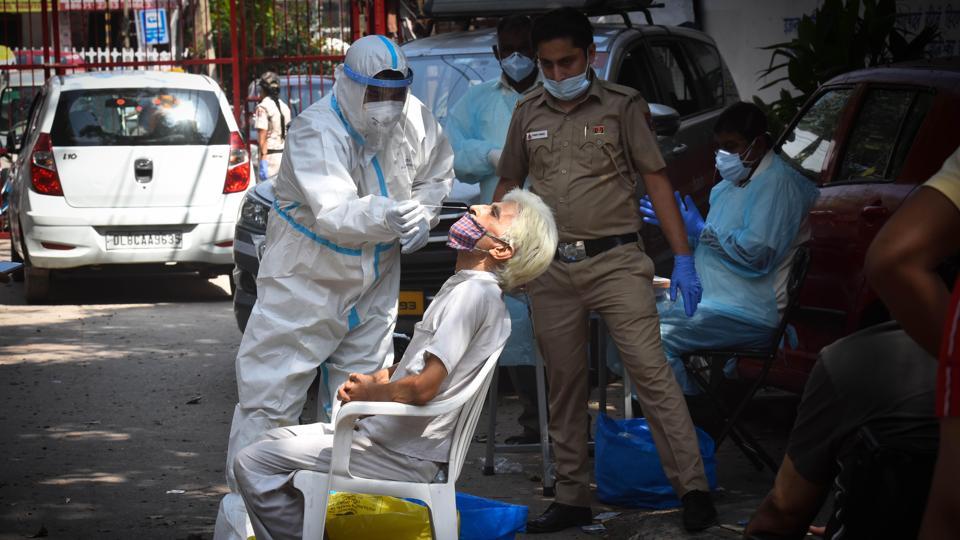
“Even the soon-to-be-released second sero survey indications are that we are far from having achieved any kind of herd immunity which necessitates that all of us should continue following Covid-appropriate behavior,” the health minister said in response to queries from social media users.

Herd immunity is used to describe the indirect protection conferred to a population in which the majority of people have natural or acquired immunity to an infection. This is possible either through a large proportion of the population getting infected or vaccinated.
Taking part in the interaction titled Sunday Samvad (dialogue) with social media users wherein he answers their questions on Twitter, Harsh Vardhan said the results of the second sero survey will soon be made public, but cautioned that people should guard against a sense of complacence.
Also read| Covid-19: What you need to know today
“ICMR’s sero survey report should not create a sense of complacency in people as usually herd immunity is achieved when about 60-70% of a country’s population has developed antibodies against the virus. Since that is not the case for us yet, we must know that a significantly large population in India is susceptible to getting infected, which is why it is extremely important to observe Covid-19 appropriate behaviour,” the minister added.
The blood samples for the sero survey are tested for the presence of IgG (Immunoglobulin G) antibodies that determine if a past infection is due to the virus. Close to 24,000 samples that were lifted around the end of August and early September have been tested across the same 70 districts in 21 states, which were covered in the first sero survey.
Sero surveys are important also to determine whether the disease has entered the community transmission stage or not.
Also read: India’s Covid-19 tally crosses 6 million
“All the parameters for collecting samples were the same around this time also, including the sample size,” the health minister said.
According to ICMR officials, the Phase 2 sero survey is a follow-up of the first, and the process is a repeat of what was done in May, when the movement of people was restricted.
“We have to see how much difference has lifting of lockdown made to the disease prevalence in the country. Same areas/clusters will be covered this time also, but samples will be lifted of different people,” said an ICMR official, requesting not to be identified.
ICMR’s National Institute of Epidemiology in Chennai (Tamil Nadu) is the nodal agency to supervise the survey and is processing the samples and analysing results.
Experts in epidemiology also say India has a long way to go in achieving herd immunity.
Also read: Why adequate testing is crucial to saving lives
“We are way off the mark as far as herd immunity is concerned; however, the goal shouldn’t be to achieve it faster, rather in a graded manner so that our health care system is ready to manage those whose disease progresses to serious levels. Not taking measures to curb transmission, like the way Sweden did, is not an option for us,” said Dr Giridhara Babu, professor, epidemiology, Indian Institute of Public Health, Public Health Foundation of India.
The first sero survey that was conducted by ICMR in May 2020 revealed that the nationwide prevalence of the coronavirus infection was about 0.73%.