
 E-Paper



India inflicted heavy casualties on Chinese forces in June: Rajnath Singh
Rajnath Singh was briefing Parliament about the developments in Ladakh along the Line of Actual Control

 Prefer HTon Google


Defence minister Rajnath Singh on Tuesday said India is committed to a peaceful resolution to the border stand-off with China even as it has conveyed to Beijing that attempts to forcibly alter the border between the two countries is unacceptable. He told Lok Sabha that until now, the two countries have not arrived at a mutually acceptable solution.
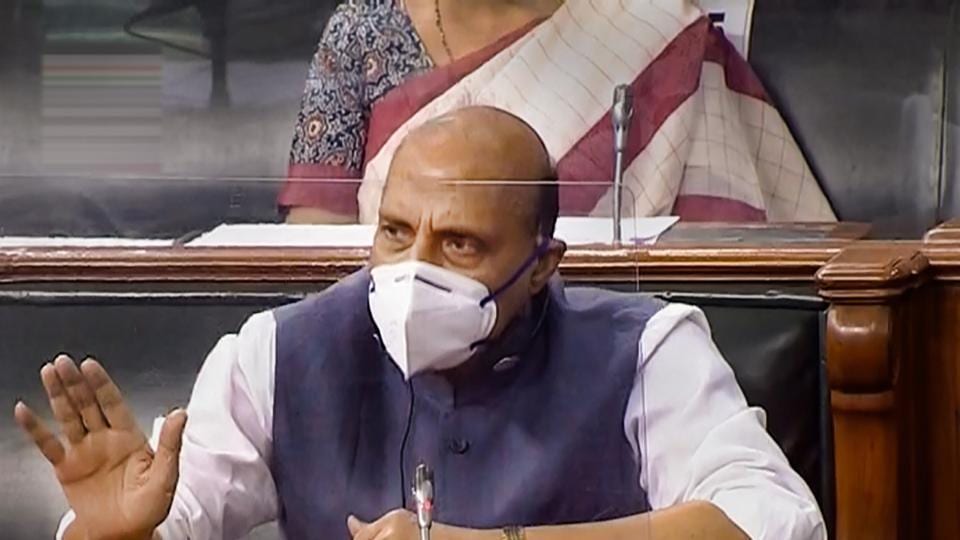
Singh said Indian forces are determined to protect the country’s security and sovereignty and inflicted heavy casualties on Chinese forces when they clashed with them in Ladakh’s Galwan Valley on June 15.
Singh said the violent conduct by the Chinese along the Line of Actual Control (LAC), the de facto border between India and China, in violation of all bilateral agreements including those signed in 1993 and 1996.
“China is not honouring the customary alignment of the boundary with India. The alignment has not only been defined by treaties but has been maintained historically.”
He added China believes that the border is not defined and the issues between the two countries remain unresolved. Singh warned that any serious situation along the LAC is bound to impact bilateral ties.
He said Indian forces will forcefully counter all Chinese aggressive action along the border and added there has been an increase in troops and weapons deployment along LAC in Ladakh since April. Singh added the Chinese side hindered the normal, traditional patrolling pattern of Indian troops in the Galwan Valley area. Singh said the Chinese made several attempts in mid-May to transgress the LAC into other parts of the Western Sector even as the ground commanders were addressing the situation as per the provisions of the bilateral agreements and protocol.
“This included Kongka La, Gogra and North Bank of Pangong Lake. These attempts were detected early and consequently responded to appropriately by our armed forces,” he said. “We made it clear to the Chinese side both through diplomatic and military channels that China was, by such actions, attempting to unilaterally alter the status quo. It was categorically conveyed that this was unacceptable.”
The Congress and other Opposition parties have been critical of the government’s handling of the situation since 20 Indian soldiers were killed in the clash with Chinese troops in June and sought a debate on the issue. Congress lawmakers staged a walkout from the House after speaker Om Birla did not allow them to speak on the issue following Singh’s statement. They later protested in front of the statue of Mahatma Gandhi in the Parliament complex.
Also Read: ‘Xi Jinping has risked his future with LAC incursions’: Report on China border row
Singh, who paid tributes to the 20 Indian soldiers killed in the Galwan Valley, said the border issue is complex. He added the two countries have agreed to resolve it peacefully. “I want to assure you that we are ready to deal with any situation. I request this House to pass a resolution affirming that we stand shoulder to shoulder with our armed forces guarding our borders to safeguard India’s sovereignty and integrity.”
He said India has conveyed to China through diplomatic channels that any “attempts to unilaterally alter the status quo were in violation” of the bilateral agreements. “Violent conduct of Chinese troops is a violation of all past agreements. Our troops have done counter deployments in the area to safeguard our borders.”
There has been a spike in tensions along the LAC after both countries amassed more troops in the Ladakh sector. There have been face-offs on the south bank of Pangong Lake after provocative Chinese movements to change the status quo during August 29-30. India said during the latest face-off on September 7, Chinese soldiers fired in the air after being prevented from closing in on an Indian forward position. This is the first time that guns have been used along the LAC since 1975.
Both sides have strengthened their military presence along the LAC by moving in additional troops, tanks, and other weaponry. India has positioned its troops on several strategic heights to prevent further land grabs on the south bank of the Pangong Lake.
India and China last week finalised a five-point road map to address the standoff that includes disengagement of troops and easing of tensions. The consensus on the five points was reached during talks between external affairs minister S Jaishankar and his Chinese counterpart, Wang Yi, on the sidelines of a Shanghai Cooperation Organisation meet in Moscow on Thursday last.
Also Read: Indian, Chinese top military commanders likely to meet this week
A joint statement issued on Friday said the ministers agreed that both sides should be guided by the consensus of the top leadership on developing India-China relations, “including not allowing differences to become disputes”. They agreed the situation on the LAC is not in the interest of either country. And “therefore...the border troops of both sides should continue their dialogue, quickly disengage, maintain proper distance and ease tensions”. The two countries agreed that both sides would abide by all existing agreements and protocols on boundary affairs, maintain peace and tranquillity in the border areas and “avoid any action that could escalate matters”.
The two sides will continue communicating through the Special Representatives mechanism, and the Working Mechanism for Consultation and Coordination on border affairs. The ministers also agreed that “as the situation eases, the two sides should expedite work to conclude new confidence-building measures to maintain and enhance peace and tranquillity”.
HT last week reported the Indian side highlighted its concern at the massing of Chinese troops and equipment along the LAC without any credible explanation, saying this violated the 1993 and 1996 agreements and created flashpoints.
The five-point roadmap is a broad template for disengagement though differences remain on crucial issues such as how far the troops should be pulled back from the LAC. The Indian side has made it clear the ultimate goal should be to move forces back to their permanent posts, at least 20 km or more from the LAC.


