E-Paper



‘India must be free of colonial mindset’: PM Narendra Modi on new PMO inauguration
Ridding the country of slave mentality and formulating policies for the betterment of the citizens were the underlying themes of the PM’s 35-minute address.

 Prefer HTon Google


Prime Minister Narendra Modi on Friday inaugurated new buildings housing the Prime Minister’s Office (PMO) and the central secretariat and said these structures were an important milestone in India’s journey towards ‘Viksit Bharat’ (developed India) and reflected the government’s commitment to citizen-centric governance and national progress.
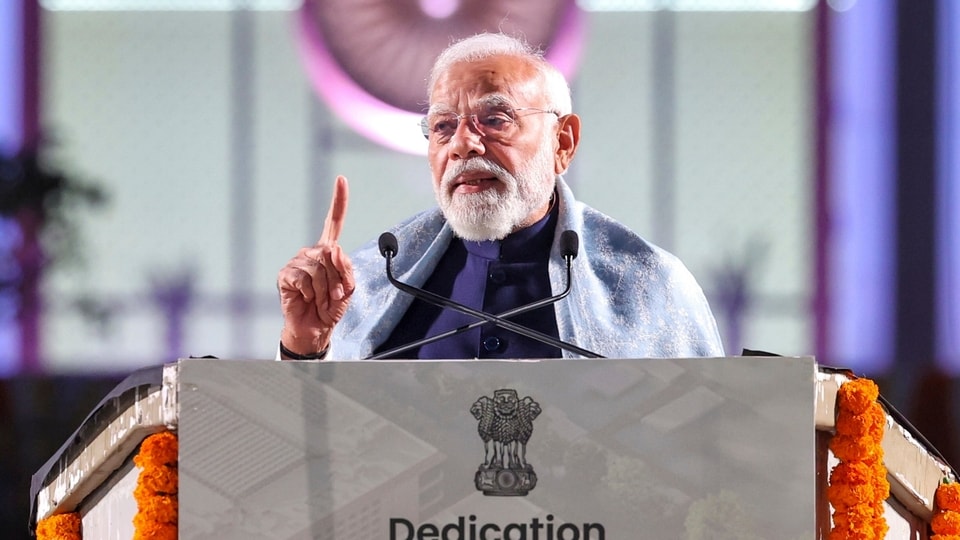
Inaugurating the new PMO, named Seva Teerth, and two buildings of the central secretariat, called Kartavya Bhawan 1 and 2, Modi said it was critical for India to shed every trace of colonial mindset as the country took strides towards the goal of Viksit Bharat by 2047. He also pointed out that decisions taken at the new Seva Teerth and Kartavya Bhavans will be aimed at fulfilling the aspirations of 1.4 billion Indians.
“Seva Teerth, and Kartavya Bhavan 1 and 2 mark an important milestone in India’s journey towards Viksit Bharat. These reflect our commitment to citizen-centric governance and national progress,” he said at an event attended by central ministers, senior bureaucrats and other officials of the central government.
“The first quarter of the 21st century has now been completed, and it is essential that the vision of a developed India is reflected not only in policies and schemes but also in workplaces and buildings.”
After Independence, he said, many important decisions and policies were made from buildings such as South Block and North Block –which earlier housed PMO, ministry of defence, ministry of external affairs, ministry of home affairs and finance ministry— but these structures were built as symbols of the British Empire and intended to keep India chained in slavery for centuries.
Ridding the country of slave mentality and formulating policies for the betterment of the citizens were the underlying themes of the PM’s 35-minute address.
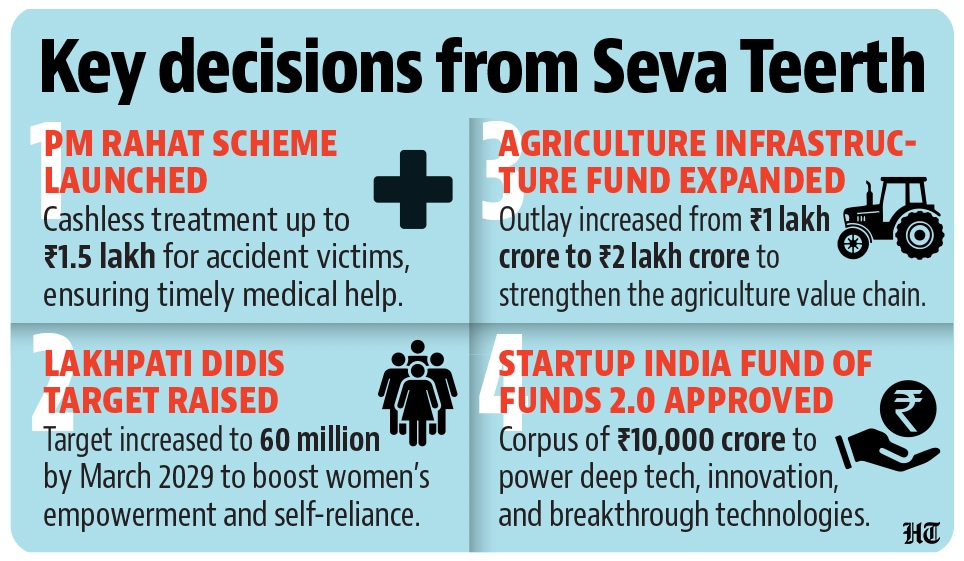
The inauguration of the new buildings marked a transformative milestone in India’s administrative governance architecture and reflected the PM’s commitment to building a modern, efficient, accessible and citizen-centric governance ecosystem, the PMO said. Key decisions taken at Seva Teerth earlier in the day included doubling the target of the Lakhpati Didi scheme –an initiative to help rural women in Self-Help Groups (SHGs) achieve ₹1 lakh annual household income – to 60 million people to boost women empowerment and the Agriculture Infrastructure Fund –a scheme to stimulate investment in agricultural development– target to ₹2 lakh crore to help boost farmer incomes. A Startup India Fund with a corpus of ₹10,000 crore was also approved.
On the same day, the Union housing and urban affairs minister announced the renaming of Udyog Bhawan metro station to Seva Teerth Bhawan.
The PM said when buildings on Raisina Hill were inaugurated in the early 20th century, the then Viceroy had said that the new structures were built in accordance with the wishes of the British monarch, and were meant to impose the thinking of Britain’s king on Indian soil.
“Raisina Hill was chosen so that these buildings would stand above all others, allowing none to be equal. On the other hand, the new Seva Teerth complex is not on a hill but more connected to the ground. Buildings like South Block and North Block were constructed to implement the colonial mindset, but Seva Teerth and Kartavya Bhavan have been built to fulfil the aspirations of the people of India. The decisions taken here will not reflect the thinking of any monarch but will serve as the foundation to advance the expectations of 140 crore citizens.”
The places from where the nation is governed, he said, must be impressive and motivating. “With new technologies rapidly emerging, the old buildings were proving inadequate for expanding facilities and adopting new tools. South Block and North Block faced space constraints and limited amenities, and being nearly a hundred years old, they were deteriorating from within, along with several other challenges,” he said.
Even decades after Independence, several ministries were functioning from more than 50 different locations in Delhi, and every year, ₹1,500 crore was being spent on rent, he said. “With the construction of Seva Teerth and Kartavya Bhavan, these expenses will be reduced and employees’ time will be saved,” he said.
The PM emphasised that in the journey of a developed India, it was vital to move forward free from the colonial mindset. “Unfortunately, even after Independence, symbols of colonial rule continued to be carried. The road the Prime Minister’s residence was on was once called Race Course Road; the vice-president had no designated residence, and the road leading to Rashtrapati Bhavan was called Rajpath in a democracy. Independent India had no memorial for soldiers who sacrificed their lives, nor for police personnel who laid down their lives,” Modi said.
He underlined that the capital of a free nation remained deeply entangled in colonial mentality, with Delhi’s buildings, public places, and historical sites filled with such symbols. “In 2014, the country resolved that the colonial mindset would no longer continue. A campaign was launched to change this mindset, leading to the creation of the National War Memorial in honour of martyrs, and the Police Memorial to recognise police bravery. Race Course Road was renamed Lok Kalyan Marg, which was not merely a change of name but an effort to transform the attitude of power into a spirit of service,” he said.
“Behind these decisions lay a deep sentiment and vision, connecting India’s present, past, and future with national pride…These initiatives of renaming are not mere changes of words, but reflect a consistent ideological thread —an independent India with its own identity, free from colonial imprints,” he added.
Modi acknowledged that amid this change, memories of years spent in the old buildings will remain, as many important decisions were taken there, giving new direction to the nation and initiating reforms. He said those premises were an immortal part of India’s history and would be part of the Yuge Yugeen Bharat Museum.
He said that Viksit Bharat 2047 was not merely a goal but India’s pledge before the world, and therefore, every policy and decision made here must be inspired by the continuous spirit of service. “India rides the Reform Express, writing a new chapter in international relations, opening new doors through trade agreements, and moving rapidly towards saturation targets. The new pace of work and renewed confidence in Seva Teerth and Kartavya Bhavans will play a major role in achieving national goals,” he added.