
 E-Paper



India says 'no bilateral discussion' with US on combined force to reopen Strait of Hormuz
“We are aware this matter is being discussed bilaterally by several countries. We have had no such bilateral discussion yet,” MEA spokesperson said on Monday.

 Prefer HTon Google


After a top US official named India when asked about plans to reopen the Strait of Hormuz currently blockaded by Iran, the Indian government said on Monday that it is "not in any bilateral talks” on being part of any coalition to help reopen the waterway.
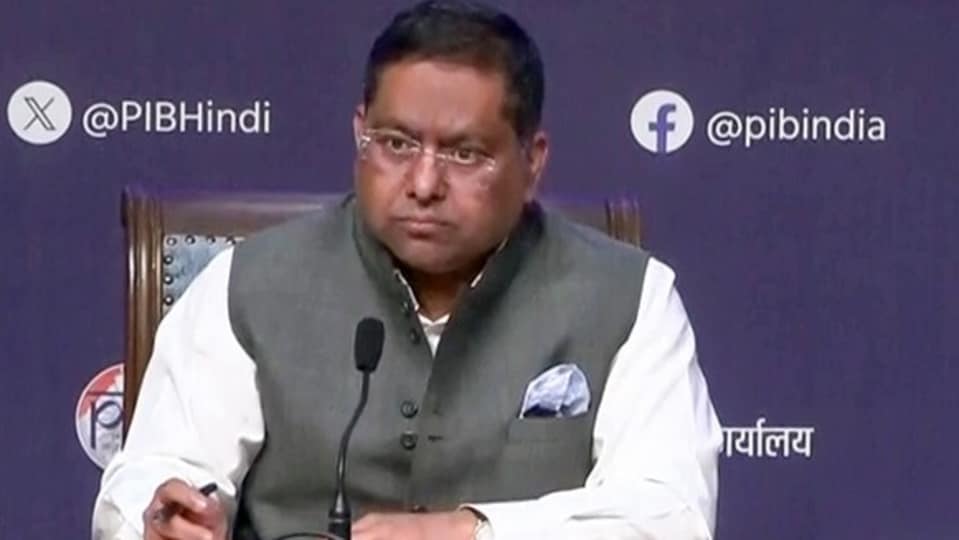
“We are aware this matter is being discussed bilaterally by several countries. We have had no such bilateral discussion yet,” Randhir Jaiswal, spokesperson of the Ministry of External Affairs, said at a press briefing in New Delhi on Monday, March 16. He was asked pointedly if Indian navy ships could be committed to such an operation.
Follow | Live updates on the US-Iran war
The strait, a key oil route through which 20% of the world's supplies pass, has been effectively closed under Iranian watch ever since the US and Israel launched strikes on Tehran over two weeks ago.
As for how some Indian ships have managed passage through the strait, external affairs minister S Jaishankar told the Financial Times that his talks with Iranian officials yielded results, and that the communication continues. Noting that “many more” Indian-flagged ships are yet to cross the strait, he clarified that every vessel moved through the key waterway individually and there was no “blanket arrangement” with Iran on the matter.
“India and Iran have a relationship. And this is a conflict that we regard as something very unfortunate," he added.
When US official mentioned India
On plans to reopen the strait, at a Sunday press conference, US energy secretary Chris Wright said President Donald Trump was “reaching out” to other countries to enlist help. “He named some of the countries — China, Japan, the UK, France and South Korea. He told me some countries have committed to aiding the United States,” Wright told reporters.
Also read | Trump's not-so-straight claims on Hormuz Strait
Asked if he could give more names, Wright said, “The world depends on the flows through Hormuz, and most importantly, (for) the Asian nations — Japan, Korea, China, Thailand, India — a meaningful part of their total energy supply comes from the Strait of Hormuz. So the whole world would be united in opening the Strait of Hormuz, and we will have the support of other nations to achieve that objective.”
On Trump's call for help
Japan’s Prime Minister Sanae Takaichi has told parliament that Tokyo has no plan to dispatch naval vessels to escort oil tankers through the Strait of Hormuz.
Experts have said that any closure of the Strait of Hormuz restricts trade and impact worldwide oil prices. Since the war began, oil prices have soared to over $100 a barrel. Between the start and end of 2022, approximately 17.8 million to 20.8 million barrels of crude, condensate and fuels flowed through the strait every day, data from Vortexa showed.
Members of the Organisation of the Petroleum Exporting Countries (OPEC), Saudi Arabia, Iran, the United Arab Emirates, Kuwait, and Iraq, export the majority of their crude through the strait, especially to Asia.
As for Trump, after days of claiming to “secure” the strait with US forces alone, Trump on Monday said “maybe we (US) shouldn't be there at all”.
He said he has demanded that at least seven countries — he did not name them — send warships to keep the key waterway for oil and gas transport open as Iranian strikes continue to rain down on Gulf countries and the wider region.
“I am demanding that these countries come in and protect their own territory, because it is their territory... they should help us,” he told reporters aboard Air Force One on Sunday night (US time), apparently using ‘territory’ to mean area of interest. "You could make the case that maybe we shouldn't be there at all, because we don't need it. We have a lot of oil," he argued.
Iran's stance
Iranian foreign minister Abbas Araghchi has said the strait is closed only to the US and Israeli vessels. "As a matter of fact, the Strait of Hormuz is open. It is only closed to the tankers and ships belonging to our enemies, to those who are attacking us and our allies. Others are free to pass," Araghchi told MS Now in an interview over the weekend.
Also read | Amid Strait of Hormuz tensions, why UAE's Fujairah port is key to oil trade | Explained
“Of course, many of them prefer not to because of their security concerns. This has nothing to do with us. And at the same time, there are many tankers and ships that are passing through the Strait of Hormuz,” he said.


