
 E-Paper



Trump's not-so-straight claims on Hormuz Strait: What President's Truth Social reveals amid US-Israel war with Iran
Strait of Hormuz reflects gap between Trump's claims and a more complicated reality of the US-Israel war with Iran that's engulfed the Gulf and global economy

 Prefer HTon Google


When Donald Trump announced Operation Epic Fury on his Truth Social account on the morning of February 28, he claimed it would be swift and decisive. More than two weeks on, the Strait of Hormuz — the narrow chokepoint through which nearly a fifth of the world's oil normally flows — remains effectively closed, particularly to US and Israel-linked shipping.
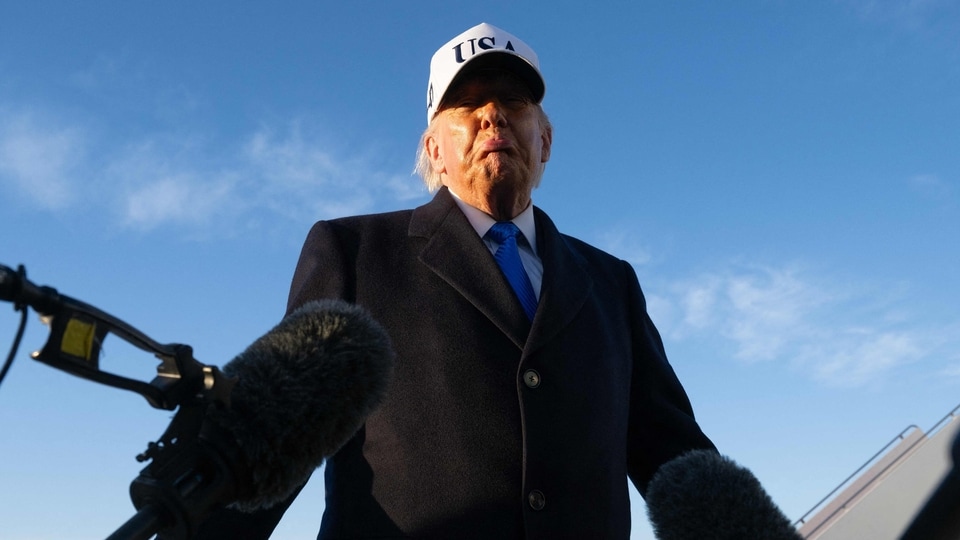
Trump’s many stances on the Iran-controlled strait actually reveal a clear pattern of flip-flops throughout the ongoing US-Israeli war on Iran.
Claims in Week 1
The pattern was set in the opening days of the war, when Trump posted on Truth Social that the US had "destroyed and sunk 9 Iranian Naval Ships, some of them relatively large and important”. He then added some sarcasm: "Other than that, their Navy is doing very well!"
He demanded "unconditional surrender”, as he did back in June 2025 when the fighting stopped after 12 days.
Iran’s President Masoud Pezeshkian, in turn, told the US to take its unconditional surrender demand "to their grave”. Iranian forces struck US bases across the Persian Gulf, widening the war to the UAE, Saudi Arabia and other oil-rich countries.
Trump two days later claimed Iran's military had been "wiped out — very completely”. He also spoke of sending ground troops at one point.
That was the first week of the war, which has so far been limited to airstrikes.
Also read | 'Iran war will end any time I want': Trump makes big claim, says conflict to ‘end soon’
A turn thereafter
By March 9, as oil prices surged above $100 a barrel and ripples were being felt from America’s domestic markets to Europe and the Indian subcontinent, he said the war would end "very soon”.
From Tehran, the Islamic Revolutionary Guard Corps (IRGC) spokesperson said, "Iran will determine when the war ends," and called Trump "the delusional president”.
By March 11, with the Strait of Hormuz closed and petro-products’ shortage in many parts of the world, Trump again made a qualified claim: "Let me say, we've won… in the first hour, it was over… We've already won in many ways, but we haven't won enough.”
Strait at the heart of it
The Strait of Hormuz has been the most prominent gap between Trump's claims and a more complicated reality, wherein Iran's relatively cheap drones and missiles have become a challenge for the US and Israel.
Iran dramatically slowed crucial shipping traffic through the strait almost immediately after it was attacked, raising oil prices that affected the world economy.
By March 2, it was closed. Iran said it did not intend to close it, but the operators of the ships were scared anyhow.
The Strait of Hormuz, which is just 33 km wide at its narrowest point, is between Iran on one side and Oman and the UAE on the other. It connects the Persian Gulf to the Gulf of Oman; further to the Arabian Sea and beyond, That makes it the world's single most important oil transit chokepoint with millions of barrels of crude oil passing through it. Plus, large volumes of gas, which fuels cooking stoves in households across the world.

Trump at first claimed strait was being kept open by US forces.
He said that was "a gift from the United States of America to China, and all of those nations that heavily use the Hormuz Strait”. On Truth Social on March 10, he said Iran must "immediately" remove any mines out into the water.
Simultaneously, he said the US had "no reports" of mines having been placed. "If Iran does anything that stops the flow of Oil within the Strait of Hormuz, they will be hit by the United States of America TWENTY TIMES HARDER than they have been hit thus far," he wrote in that post. He followed up with a similar threat three days later.
Also read | Amid Strait of Hormuz tensions, why UAE's Fujairah port is key to oil trade: Explained
Iran’s foreign minister Abbas Araghchi clarified his country’s position by the weekend.
He said on March 14 that the strait remained closed “only to American, Israeli ships and tankers, and not to others”. Indian ships, for instance, passed through the strait around this time.
Trump then made a series of Truth Social posts declaring the US had "destroyed 100% of Iran's Military capability”. He also spoke about how US forces struck military sites on Kharg Island, Iran's principal oil export terminal.
In the very next post, he said Iran was still capable of sending "a drone or two, drop a mine, or deliver a close range missile”.
Seeking help to open the waterway
Trump thereafter called on "many countries" to send warships, naming China, France, Japan, South Korea, and the UK. “In the meantime, the United States will be bombing the hell out of the shoreline, and continually shooting Iranian Boats and Ships out of the water. One way or the other, we will soon get the Hormuz Strait OPEN, SAFE, and FREE!”
Sharing Trump's post on X, historian and analyst Stephen Wertheim, a senior fellow at the US think tank Carnegie Endowment for International Peace, commented sarcastically: “We have destroyed 100% of Iran’s military capability, except for its drones, mines, missiles, boats, ships.”
None of the named countries had as of Sunday, March 15, confirmed sending warships to open the strait.
Trump’s post from a week earlier had said the US won’t need any help anyway.
“The United Kingdom, our once Great Ally, maybe the Greatest of them all, is finally giving serious thought to sending two aircraft carriers to the Middle East. That's OK, Prime Minister Starmer, we don't need them any longer — But we will remember. We don't need people that join Wars after we've already won!” he wrote.
In a post this Saturday, he called for countries that get oil via the strait to “take care” of it with US help: “This should have always been a team effort."
Iran’s Araghchi was quick to launch a jibe: “US is now begging others, even China, to help it make Hormuz safe.”
Can US keep strait open? What Trump's men say
Not everyone in the US administration is onboard with Trump and his many stances.
US energy secretary Chris Wright had already told CNBC last week that the US was not ready to escort ships through the Strait of Hormuz.
At one point last week — after Trump claimed that the US can escort ships through the strait — the topmost American military leader simply said the waterway is a "tactically complex environment".
“Before we want to take anything through there at scale, we want to make sure that we do the work pursuant to our current military objectives," General Dan Caine of the US Air Force, who is Chairman of the Joint Chiefs of Staff, said.
On objectives, Trump and his team have spoken of regime change, oil security, “freedom for women”, avoiding nuclear war, and general instability among reasons why Iran was attacked. Israel’s leaders have spoke of it in religious terms too. For now, a lot is at stake in the Strait of Hormuz, taking this conflict beyond immediate political, or religious, objectives of just the US and Israel.
Support for the war remains tenuous inside the US. A poll by NBC News found 54% of voters disapprove of Trump's handling of the conflict.


