E-Paper



India, UAE ink key deals to strengthen I2U2 bloc
India and the UAE have finalized four agreements in food processing and renewable energy to strengthen bilateral ties.

 Prefer HTon Google


India and the United Arab Emirates (UAE) on Tuesday finalised four agreements, including in food processing and renewable energy, to take forward cooperation within the I2U2 grouping as Prime Minister Narendra Modi and UAE President Mohamed bin Zayed Al Nahyan held talks on bolstering bilateral ties.
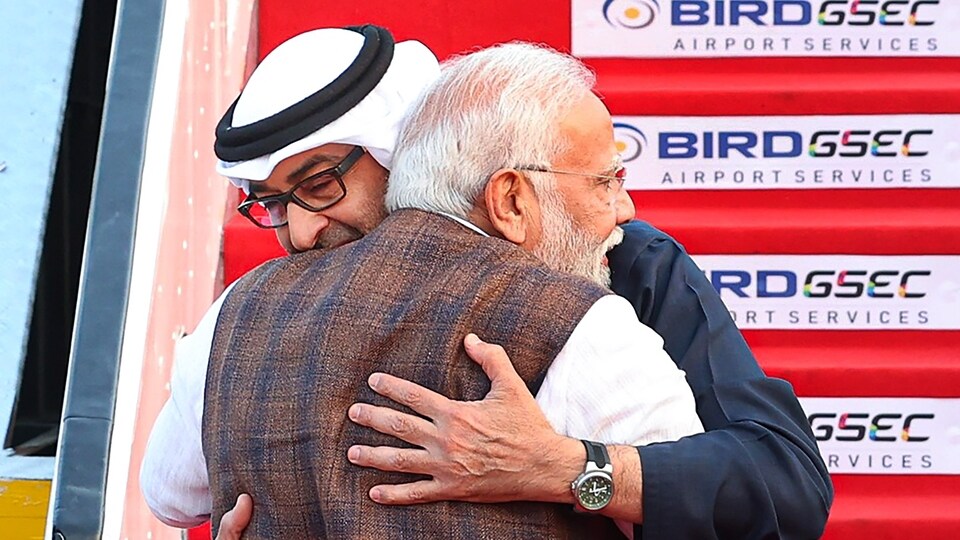
The visit of the ruler of Abu Dhabi, popularly known as MBZ, is being seen as one of the highlights of the Vibrant Gujarat Global Summit in Gandhinagar, and is expected to strengthen trade and investment ties following the signing of the Comprehensive Economic Partnership Agreement (CEPA) in February 2022.
In a special gesture, Modi personally received the UAE President at the Ahmedabad airport, and the two leaders travelled in a motorcade to the venue of their meeting. Hundreds of people lined both sides of the route as the roadshow covered several kilometres in Ahmedabad.
In the past, Modi has held similar roadshows in Ahmedabad with world leaders such as Israel Prime Minister Benjamin Netanyahu, former US president Donald Trump, and late Japanese premier Shinzo Abe. This was the first time Modi hosted the leader of a West Asian country in his home state of Gujarat in such a fashion.
Also Read | UAE president answers Netanyahu's aid request with a zinger: ‘Ask Zelensky…’
The two sides finalised four memorandums of understanding during the meeting between Modi and MBZ, including one between the UAE’s investment ministry and India’s renewable energy ministry on investment cooperation in renewable energy and another between the UAE investment ministry and India’s food processing ministry on investment cooperation to develop food parks.
Another MoU between the UAE’s investment ministry and India’s health ministry will facilitate investment cooperation for innovative health care projects, while DP World, a multinational logistics company based in Dubai, and the Gujarat government concluded an MoU on developing green and sustainable ports.
People familiar with the matter said on condition of anonymity that the MoUs on renewable energy and food processing dovetailed into plans framed by the India-Israel-UAE-United States, or I2U2 grouping, to develop projects in these two sectors in Gujarat.
Following the first I2U2 Summit in July 2022, the four members of the economic bloc had said the UAE will invest $2 billion to develop a series of integrated food parks for which India will provide land and facilitate the integration of farmers. The food parks are aimed at tackling food insecurity in South Asia and West Asia.
The I2U2 had also announced plans to create a hybrid renewable energy project in Gujarat with 300MW of wind and solar capacity. It was stated at the time that UAE-based firms are exploring opportunities to become knowledge and investment partners in this project.
This was the fourth meeting between the Indian premier and the UAE President in less than seven months, and they “hailed the rapidly transforming India-UAE partnership and reaffirmed their commitment to a shared and prosperous future”, external affairs ministry spokesperson Randhir Jaiswal said in a post on X.
The Ahmedabad civic body unveiled a special 3km road, developed through a public-private partnership model, for Tuesday’s roadshow. “Welcome to India my brother, HH@MohamedBinZayed. It’s an honour to have you visit us,” Modi said in a post on X.
Earlier in the day, DP World chairman Sultan Ahmed bin Sulayem met Gujarat chief minister Bhupendra Patel and discussed infrastructure projects. DP World is expected to sign three MoUs during the Vibrant Gujarat Global Summit that envisage investments of more than ₹30,000 crore, an official said.
DP World earlier participated in bidding to develop Nargol port in Gujarat, though the project was scrapped due to viability issues.
The AD Ports Group of the UAE is expected to sign another agreement to develop a port city in Gujarat, the people said. UAE-based Lulu Group International has plans to build India’s largest shopping mall in Ahmedabad, and the retail conglomerate is expected to sign an agreement to invest ₹3,000 crore in Gujarat.
The Indian government has focused on improving ties with key parts in West Asia, which New Delhi perceives as part of the country’s extended neighbourhood and provides nearly 45% of energy supplies. West Asiais also home to some nine million Indians, with a majority of them living in the UAE and Saudi Arabia.
In what is being celebrated as a historic milestone, the Bochasanwasi Akshar Purushottam Sansthan (BAPS) Swaminarayan Sanstha has constructed the first grand Hindu temple in the Middle East. Situated on a sprawling 27-acre government land in Abu Mureikah, Abu Dhabi, the BAPS Hindu Mandir stands as a significant cultural and religious landmark. The much-anticipated inauguration of this iconic temple will be done by Prime Narendra Modi on February 14, 2024, said an official of BAPS.
The Vibrant Gujarat Global Summit, initiated by Prime Minister Modi during his tenure as chief minister in 2003, aims to position the state as a global leader in trade and industry. The theme for the upcoming three-day event from January 10 is “Gateway to the Future”.
The summit is set to witness the active participation of over 100 countries, with approximately 30 nations joining as partners. Additionally, a dozen international organisations have collaborated with the Gujarat government to support and promote the event as a pivotal platform for fostering collaboration and exploring opportunities across various sectors. This global engagement underscores the summit’s significance in facilitating international.
Modi will be joined for the inaugural session on Wednesday by MBZ, Czech Prime Minister Petr Fiala, Timor-Leste President José Ramos Horta, and Mozambique President Filipe Nyusi. The partner countries for the event include Australia, Bangladesh, Czech Republic, Egypt, Germany, Indonesia, Japan, Malaysia, Morocco, Nepal, Poland, South Korea, Singapore, UAE, and the UK.
The 10th edition of the event, being held from January 10-12, will include conferences on topics such as technology and innovation, sustainable manufacturing, green hydrogen, electric mobility and renewable energy.