
 E-Paper



How Indian-American caucus straddled two worlds during Modi’s US visit
The India caucus is a group of five Indian-Americans who informally call themselves the samosa caucus, a reference that came up repeatedly during the PM’s visit last week

 Prefer HTon Google


After Prime Minister Narendra Modi completed his address to business leaders and professionals belonging to the diaspora at the Kennedy Centre in Washington DC on Friday, he decided to step down the dais and walk through the aisle and meet the audience. The crowd, of highly accomplished people in their fields, went wild, applauding, screaming Modi’s name and stretching their hands to shake Modi’s.
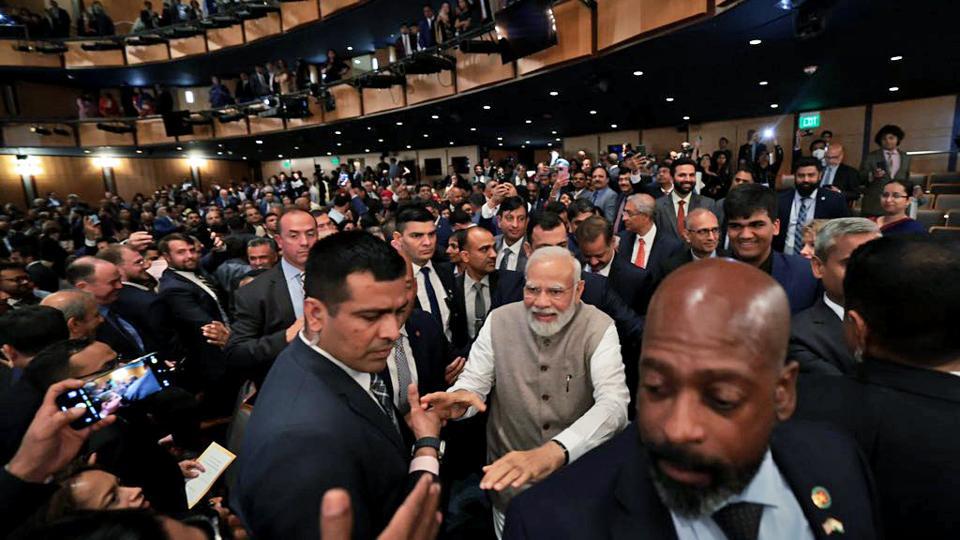
In the middle of the melee, Modi saw Congressman Ro Khanna, the co-chair of the India caucus in the House of Representatives, and said out loud, “Ro Khanna, keep up the good work,” Khanna recounted to HT minutes later.
Khanna had briefly met the PM at the state dinner hosted by President Joe Biden the previous night in White House, and at the joint meeting of the US Congress where Modi spoke to both Senators and Congressional representatives.
While Khanna has been critical of the India’s recent democratic record, including its actions in Kashmir and, most recently, the expulsion of Rahul Gandhi from Parliament, on the strategic front, he has been a strong supporter of India-US ties.
Khanna introduced a resolution in the House last year advocating deeper security ties, condemning Chinese actions, and proposing an India-specific waiver of Countering America’s Adversaries under the Sanctions Act (CAATSA) for its purchase of Russian weapon systems. As co-chair of the India caucus, Khanna also wrote to speaker Kevin McCarthy to invite PM Modi to address the joint meeting — which was one among other factors that led to the invitation. He is also a member of the select committee on China, and, an important voice in taking on Beijing.
Khanna later got an opportunity to meet Modi at the next diaspora event in Reagan Centre in Washington DC the same evening. Here, they discussed Gandhi, the independence movement, Khanna’s grandfather (Amarnath Vidyalankar, a freedom fighter and Congress leader who was a member of Parliament), as well democracy and human rights in India.
When Khanna mentioned his grandfather’s time in jail during the freedom struggle, to Modi, the Congressman said, Modi told him that he should be proud. Modi then said that when India went from being the tenth to the ninth to the eighth to the sixth largest economy, no one really noticed but when India went to the fifth, there was “huge pride”.
“Modi asked if I could guess why? I said because they passed Great Britain? He said that is right. So there is enormous pride in the sacrifice freedom fighters made and India’s rise today as a free nation,” Khanna said recounting his conversation.
The India caucus co-chair, a representative from Silicon Valley, is of a group of five Indian-Americans in the House who informally call themselves, and are called, the samosa caucus, a reference that came up repeatedly during the PM’s visit last week. All five are Democrats and through the visit, they could be seen straddling their own different political worlds and imperatives that govern US statecraft.
In his speech at the Congress, after recognising vice president Kamala Harris’s Indian heritage, Modi said, “I am told that the Samosa Caucus is now the flavour of the House. I hope it grows and brings the full diversity of Indian cuisine here.”
And among those who laughed and clapped was Pramila Jayapal, the representative from Seattle, among the US’s most liberal cities and the chair of the Congressional progressive caucus. Jayapal, who moved to the US in her teens, was critical of the Indian’s government’s actions in Kashmir in 2019. In the run-up to the visit, she wrote a letter to Biden, along with 74 other Congressional leaders, which urged him to strengthen India-US ties but also raise concerns about Indian democracy with Modi.
Later that evening, Biden referred to Jayapal, who was present at the state dinner along with all the others from the samosa caucus. In the context of the contribution of Indian-Americans to diverse fields in America, he first called out the members — “a record number of Indian Americans in Congress, who are here tonight, Ro, Ami, Raja, Shri, Pramila, and — well, I won’t go on. I have a great working relationship with all of you.”
Biden said that, after her “critical leadership on one of the legislative victories”, he had called Jayapal’s mother in India to thank her and wishing her a happy Diwali. “It was an incredible moment. I think she wondered, ‘Who in God’s name is calling me?’,” Biden said.
Sitting next to Jayapal in the House was Ami Bera from California, who serves as a senior member of the House Foreign Affairs Committee. After the speech, outside the Capitol, Bera offered his first reaction to the speech in a conversation with HT.
“I think the PM hit all the right themes. The importance of the US-India relationship, the world’s largest democracy and the world’s oldest democracy. There are so many areas of overlap. Technology, trade, the security issues. I think he touched on some of the threats in the Indo-Pacific region as well and how we have to work together for a prosperous future.”
Along with Gregory Meeks, the ranking member of HFAC, Bera later issued a statement welcoming the visit and speaking of space, tech and people to people ties. They said that the visit helps strengthen a shared commitment to free, open and prosperous Indo-Pacific and a rules based international order, which was “most effective when we demonstrate respect for a rules-based order at home”.
Suggesting that the world looked to US and India for inspiration on treatment of critics, the vulnerable and minorities, the two said, “It is the power of our examples that sends the strongest message.”
Asked if Modi’s emphasis on democracy and diversity would allay apprehensions of those who had written a letter expressing concern, Bera said that Modi certainly spoke about the “vibrancy of democracy, values, freedoms” and touched on those themes. “You will continue to have folks talk about those issues. But I think the broader theme is the importance of the India-US relationship.” He said if Modi’s address in 2016 was aspirational, this year, as the PM had said, the time had arrived.
Sitting with Khanna in the House was Raja Krishnamoorthy of Illinois, the ranking member of the House select committee on China and the House permanent select committee on intelligence, making him an influential and informed voice on foreign policy and national security debates in the US. Last year, Krishnamoorthy had accompanied House speaker Nancy Pelosi, during her trip to Taiwan which led to a sharp dip in US-China ties. Krishnamoorthy has been a champion of India-US ties. Along with the other four, he escorted the PM into the chamber during the address. And besides meeting Modi at the Congress, he could be seen meeting the PM the next day at a lunch hosted by VP Harris and Secretary of State Antony J Blinken.
On June 22, the same day as the PM’s address, Krishnamoorthy — along with Khanna, Andy Barr, Marc Veasey, and Mike Waltz — introduced a bipartisan legislation that will allow weapon sales to India from the US to be fast-tracked.
“I am proud to join my colleagues in introducing this legislation to expand security cooperation between the US and India by adding India to the list of partners included in the Arms Export Control Act. On the Select Committee on the Strategic Competition Between the US and the Chinese Communist Party, where I serve as the Ranking Member, we passed this legislative recommendation with overwhelming bipartisan support. Now we must pass this bipartisan measure into law,” Krishnamoorthy said.
The fifth and newest entrant to the caucus, Shri Thanedar, was also on the same row as Jayapal, Bera, Khanna and Krishnamoorthy. Originally from Belgaum in Karnataka, the Marathi-speaker Thanedar too was among those who escorted Modi into the chamber, and had addressed a press meet the day before in the Capitol, welcoming the visit. At a community event, Thanedar also pledged his support for a Congressional Hindu caucus.
After the final diaspora event, Thanedar, who was seen clapping at different points during Modi’s speech, said, “This is very exciting. I have never seen this kind of enthusiasm for any visiting Prime Minister. I am very very proud of Mr Modi. He is enormously popular. I am looking forward to working with him to broaden our relationship, deepen our relationship. As a US Congressman, that’s what I want to do.”
On the national stage, through elected office, the five Indian-Americans in the US Congress represent the success of the diaspora. Through Modi’s visit, their two worlds came together. At times, for some, it collided, but mostly, it converged, as they felt a sense of pride, ownership and commitment to the land of their origin and the land that they now call home and whose people they represent.


