
 E-Paper



India's hypersonic glide missile LR-AShM debuts at 77th Republic Day parade
The Defence Research and Development Organisation's (DRDO) advanced LR-AShM places India in the elite club of nations with hypersonic missile capability.

 Prefer HTon Google


Advanced LR-AShM, a hypersonic glide missile capable of engaging stationary and moving targets and designed to carry several payloads for ranges up to 1,500 kilometres, debuted at the 77th Republic Day parade at New Delhi's Kartavya Path on Monday.
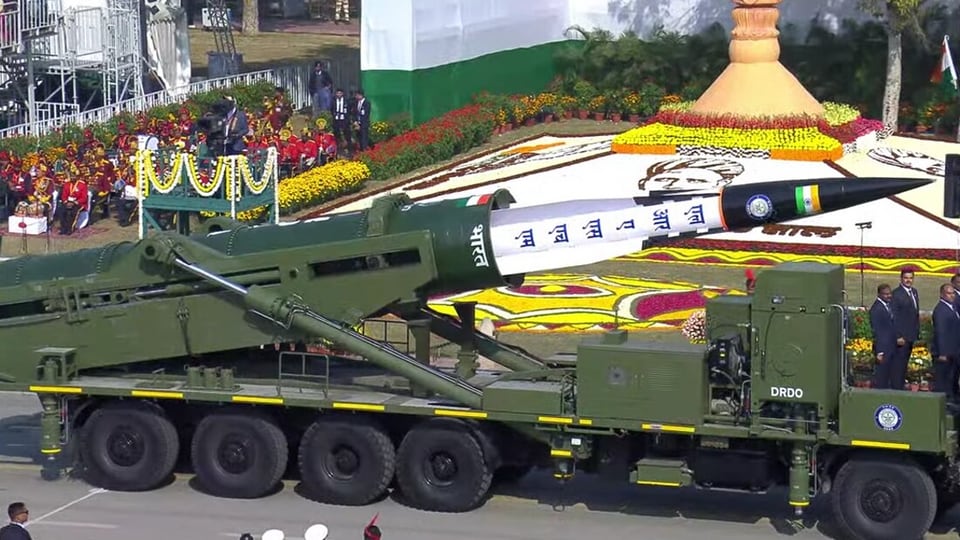
The Long Range Anti-Ship Missile (LR-AShM) is designed to meet the Indian Navy's coastal battery requirements. Follow Republic Day parade 2026 live update
According to a press statement issued by the ministry of defence, the LR-AShM "follows a quasi-ballistic trajectory with hypersonic speeds starting at Mach 10 and maintaining an average of Mach 5.0 with multiple skips. Enemy ground and ship-based radars cannot detect it during most of its trajectory".
The Defence Research and Development Organisation's (DRDO) hypersonic glide missile is configured with a two-stage propulsion rocket motor system, and its successful development places India in the elite club of nations with hypersonic missile capability.
ALSO READ | Republic Day 2026: What to know about parade route and the story behind Sikh Regiment's two salutes tradition
The propulsion systems boost the missile to the required hypersonic velocities, the statement added. The Stage I of the vehicle is separated after it is spent and after the Stage II burnout, "the vehicle performs an unpowered glide with required manoeuvres in the atmosphere before engaging the target".
WATCH:
India showcased its military prowess at the Republic Day parade on Monday, with the lineup including BrahMos and Akash missile systems, the Medium Range Surface-to-Air Missile (MRSAM), Advanced Towed Artillery Gun System (ATAGS), Dhanush artillery gun, Divyastra Battery, and a static display of drones.
Main Battle Tank Arjun and T-90 Bhisma tanks also appeared as part of the mechanised columns, supported overhead by Apache AH-64E and Prachand light combat helicopters.
Other platforms included the BMP-II Infantry Combat Vehicle and the Nag missile system (Tracked) Mk-2.
DRDO Tableau
The theme of the DRDO's tableau this year was ‘Naval Technologies for Combat Submarines’, which showcased indigenously developed technologies/systems that act as force multipliers for the navy's conventional submarines.
"These systems are Integrated Combat Suite (ICS), Wire Guided Heavy Weight Torpedo (WGHWT) & Air Independent Propulsion, which will ensure combat supremacy in the underwater domain," the ministry of defence said in a statement.
ALSO READ | Colonel Sofiya Qureshi, face of Operation Sindoor against Pakistan, on R-Day honours list with Vishisht Seva Medal
The ICS is a new-generation submarine-based defence system crucial for underwater warfare and anti-submarine operations. The WGHWT is a state-of-the-art submarine-launched torpedo to fight contemporary ship and submarine threats in ocean waters. It is considered a lethal weapon in cases of anti-submarine warfare, and is the primary weapon of all submarines.
Meanwhile, the AIP is for long underwater endurance of submarines, thereby enhancing stealth. It is powered by a locally developed phosphoric acid fuel cell with a novel onboard hydrogen generator.


