E-Paper



Red Fort blast case: Investigators seize fourth vehicle, trace ownership to Dr Shaheen Shahid
Investigators suspect the module used four vehicles to ferry firearms from J&K to Delhi-NCR, and move explosive materials in Faridabad and the capital.

 Prefer HTon Google


FARIDABAD/NEW DELHI: Another car — this time a silver Maruti Brezza — has been seized by investigators as they worked to piece together the logistics and transport chain behind Monday’s Red Fort blasts, officials aware of the matter said on Thursday.
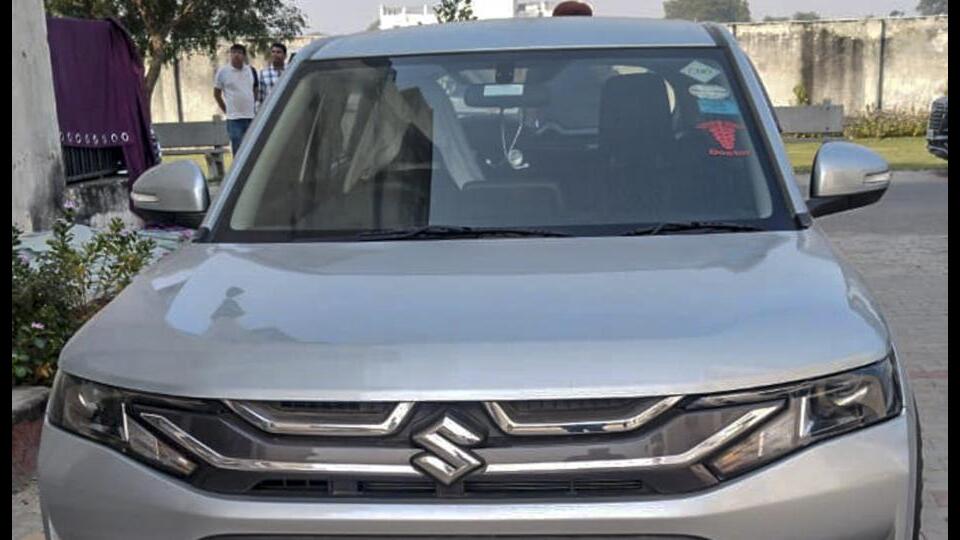
The vehicle (HR87 U 9988), registered on September 25 this year under the name of Dr Shaheen Shahid, is the fourth to come under the scanner in the investigation. The others include the white Hyundai i20 (HR26 CE 7674) driven by Dr Umar Un-Nabi, which exploded outside Red Fort killing at least 10 people; a red Ford EcoSport found in a Faridabad village on Wednesday; and a Maruti Swift Dzire, also owned by Shahid, which was allegedly used by another accused, Dr Muzammil Ghanaie, to transport explosive materials.
Investigators suspect the module used these four vehicles to ferry firearms from Jammu & Kashmir to Delhi-NCR, as well as move ammonium nitrate and other explosive materials in Faridabad and the Capital as part of a wider terror network under probe by the National Investigation Agency (NIA) and J&K Police.
Two of these vehicles – the EcoSport (DL10 CK 0458) and the Brezza (HR87 U 9988) – were traced to Faridabad over the past two days. Yashpal Singh, spokesperson for Faridabad Police, confirmed both were recovered and handed over to central agencies.
Senior officers said the two cars are among several suspected vehicles linked to Al-Falah Medical College in Dhauj – the institution where Umar Un-Nabi, the suspected suicide bomber, and Dr Muzammil, both from Kashmir, were employed. The Brezza, found Thursday, was registered at the university’s address, its publicly accessible registration details show.
The Brezza
The Brezza was found parked inside the Al-Falah University campus, registered under Dr Shaheen Saeed (which investigators said is Dr Shahid), with both permanent and correspondence addresses listed as “Flat No 32, Block 15, Al-Falah School of Medical Science, Dhauj”. Records show the car was purchased from Saluja Complex in NIT Faridabad.
Investigators said Shahid no longer lives in Faridabad, raising questions about who was using her car on campus. “The ownership and use of the vehicle are under verification. Over 30 cars parked inside the medical college are being checked, and their documents scanned for authenticity,” an officer said.
Officials from NIA and J&K Police are examining whether the Brezza, like the EcoSport, was used to move ammonium nitrate or to coordinate logistics for the blast.
The EcoSport
According to investigators, Wasid Khan, a compounder at Al-Falah University and brother of a local garage owner, drove the red EcoSport from his brother’s workshop and parked it outside the home of his brother-in-law, Mohammad Faheem, in Khandawali village, allegedly on Umar’s instructions. Both Wasid and Faheem were detained after the car was found abandoned outside Faheem’s residence during an extensive search.
“The EcoSport, registered in the name of Umar – the primary accused in the blast – was seized by police from Khandawali. Both men are being questioned to determine who ordered the move and when it was last used,” said a senior officer.
Traces of ammonium nitrate were reportedly found inside the car, which is now undergoing forensic analysis. Surveillance footage showed the vehicle being driven through Dhauj and the Al-Falah campus before it was left in the village.
Investigators said Faheem told them that he was unaware of the car’s background and said Wasid had parked it there. Investigators are also verifying the identity of a woman seen with Wasid when the car was abandoned. “Their statements will help determine whether the vehicle was handed over by Umar or shifted later to conceal evidence,” the officer cited above said.
Expanding the probe
Officers from Delhi Police’s Special Cell, assisting NIA in the primary investigation, said the terror module relied on multiple cars to move explosives and weapons across Faridabad and Kashmir.
“This has been confirmed through the vehicle registrations. Shaheen’s name was used to buy one car in which arms were recovered in Lucknow. The name of another accomplice, Amir Rashid, was used to purchase the i20 that was later blown up,” one investigator said.
Another emerging thread suggests that members of the module used the cars to transport rifles and ammunition from Srinagar and Anantnag to Faridabad, said another Delhi Police officer.
“They made several trips over the past year, using the red EcoSport and other vehicles. These were bought with the help of their handler Ukasha, with whom they communicated on the encrypted app Signal,” the second officer said.
Investigators have established that Umar carried five mobile phones under different numbers, each revealing new leads on vehicle movements. “Both the EcoSport and the i20 carried traces of ammonium nitrate. This confirms that multiple cars were used in rotation to distribute explosive materials,” another official said.
The vehicles, investigators believe, are crucial to mapping the module’s movement network stretching across Delhi, Haryana, and Jammu & Kashmir. CCTV footage, parking logs, and digital data from the Al-Falah University servers are being analysed to identify who accessed or used the cars in the days before the blast.
Security has since been tightened in Dhauj, Khandawali, and neighbouring Nuh villages. Multiple raids are planned in the coming days. “The recovery of these cars offers the clearest picture yet of how ammonium nitrate was moved in small batches to avoid detection,” an officer said.
Both Wasid and Faheem remain in custody as questioning continues. Investigators said their testimonies could “fill the missing link” connecting Dr Umar’s operations in Faridabad to the Red Fort explosion.