
 E-Paper



Iron knife recovered from ongoing excavation site in Cuddalore: Minister
Archaeologists have found a 13-cm-long iron knife broken in three parts in the ongoing excavation site in Marungur in present day Cuddalore district


Archaeologists have found a 13-cm-long iron knife broken in three parts in the ongoing excavation site in Marungur in present day Cuddalore district days after chief minister MK Stalin announced with scientific proof that the Iron Age began from Tamil Nadu, minister Thangam Thennarasu said.
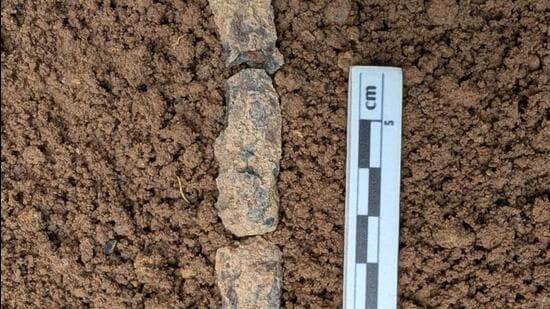
“While iron arrowheads and nails were recovered previous excavations, the recent discovery of a knife indicates that inhabitants of ancient civilisations mastered the art of iron,” Thennarasu (minister of finance who holds additional charge of archaeology) said in a post on X. The knife weighed 23 grams. It was found on Tuesday.
On January 23, Stalin announced that carbon dating of artefacts unearthed from recent archaeological excavations in the state have established that the usage of iron dates back to at least 5,300 years ago – which experts have said is the oldest available date in India and possibly the world. He released the findings in a report compiled by the Tamil Nadu State Department of Archaeology (TNSDA) which was validated by US’s Beta Analytics Lab and 10 archaeological experts from across India.
Thenarasu said on Tuesday that the iron knife was found at a shallow depth of 257 cm from one of the trenches dug at Marungur archaeological site. “The recent discovery of an iron knife has confirmed that this is a historically significant archaeological site...Copper coins, agate, glass beads, and rouletted pottery from the Rajaraja Chola period were discovered from the site in the past,” he said.
The Iron Age, when the discovery of iron smelting technology helped revolutionise agriculture, war and construction, is considered to have begun around 1400 BCE - 1500 BCE in India, and helped catalyse larger settlements and cities. Stalin’s announcement pushed back the date by more than two millennia and suggested that Tamil Nadu might have been among the first places on earth to have begun using molten iron.
Releasing carbon dating results from international institutions, the CM said: “The reports pointed to the use of iron in the region to the beginning of 4th millennium BCE.” Before the announcement, the advent of the Iron Age in India was considered to be the painted grey ware culture in the northern Gangetic plains in around 1,500 BCE.
The findings come amid a polarising debate on India’s ancient history and conflicting theories of Aryan migration – topics that have cast a long shadow on contemporary politics and fuelled regional pride. Since 2021, when the DMK formed the government, Stalin has said that his government will prove scientifically that the Indian subcontinent’s history should be written starting from the Tamil landscape while building up the archaeological expedition of the state. In the same year, the chief minister announced in the assembly that there’s conclusive proof of a civilisation existing in Tamil Nadu around 3,200 years ago, citing scientific evidence - a finding that means a thriving city-based river valley civilisation existed in the state, coinciding with the latter half of the Indus Valley civilisation.


