
 E-Paper



Prashant Kishor exclusive: Jan Suraaj will either get 10 seats or 150, nothing in between
As Bihar elections approach, Prashant Kishor's Jan Suraaj Party aims to disrupt, focusing on change amid declining support for established leaders.

 Prefer HTon Google


As the Bihar assembly elections draw near, Prashant Kishor has positioned his political start-up, the Jan Suraaj Party as a disruptor in the state’s crowded electoral field. Contesting all 243 seats, Kishor has chosen to stay out of the fray personally but is betting big on Bihar’s appetite for change. In an extensive conversation at his Patna residence, he laid out his reading of the political landscape, from Nitish Kumar’s fading clout to the irrelevance of smaller players, and explained why Jan Suraaj could either soar or sink — with nothing in between. Excerpts:
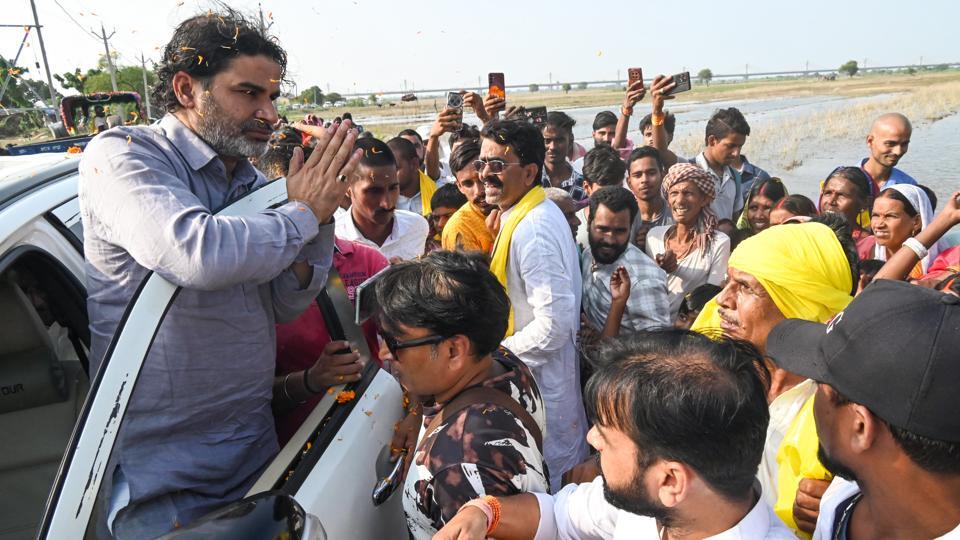
First of all, what is the reason behind the crowd in the Jan Suraaj office complex? Is it the PK effect or something more?
This is a desire for change. And after many years, people have found a way, an alternative.
It is not necessary that they have complete faith in Jan Suraaj. But people have found a way to get out of the political bondage of the last 30-35 years. People have been either voting for Lalu Prasad Yadav or Nitish Kumar. It is not that people don’t understand the problems in their lives. And it is not that they don’t know what is right and what is wrong. But people have been voting for them because of the absence of a political alternative.
They have now found hope in Jan Suraaj. That is why you can see the crowd. It is not the power of Prashant Kishor. It is the power of the desire for a political alternative.
Is Nitish Kumar’s magic intact?
The one who had such a big political legacy and journey, his utility cannot end, but it is completely diminished.
Sometimes you see a statement or something, but the kind of chaos you see in the NDA -- two or three parties have issued a symbol on each seat -- shows that Nitish Kumar is physically and mentally incapable of running a government or even a political system.
But the NDA also has Upendra Kushwaha, Jitan Ram Manjhi, and Chirag Paswan.
They have no effect. You see, the small parties in such alliances ... have been used.
None of these smaller parties have ever achieved any success at the level of the assembly. It is a different matter to win two or four seats.
In 2015, Jitan Ram Manjhi, Chirag Paswan and Upendra Kushwaha, all three were with the BJP and fought for about 80–90 seats. They won one or two seats. Similarly, the VIP was on the side of the Mahagathbandhan, with CPI and CPM. But, if you leave aside the Communist Party of India (Marxist–Leninist) Liberation , then no party has ever got more than five seats.
CPI got two, CPM got two, CPI ML got four or five. People don’t want to ruin these very small parties by giving votes. They know that they have no stability, no thought. They take a few seats and either give it to their family members or give it to the rich.
You said in an interview the day before yesterday that you have decided not to contest polls in the larger interest of your party.
Look, this is purely a physical limitation. It’s not that I don’t have people — I have many people. But a single person has to do all this sometime.
Whereas in other parties, the parties that are already organized, they have a system. So, if you want to start something from scratch...
For the past few days, I have been going to bed at 5 or 6 in the morning.
If I go to contest the elections in the meantime.... Then the whole system can go haywire. That’s why all the senior party members decided that `No, you may win on one seat, but the whole system can be at risk. That’s why you shouldn’t contest the elections’.
There are two things that are very important in your agenda - education and empowering women. Just before the elections, Nitish ji announced several freebies. What will be their impact?
It won’t have any effect. Many people are seeing that the money given in Maharashtra has changed the outcome of the elections. Some people talk about the Jharkhand scheme. But that is a very selective understanding.
If there is some contribution of money given to women in the outcome of the elections in Maharashtra, then there is also the example of Andhra, where lakhs of crores were given by Y. S. Jagan Mohan Reddy, but still that election was badly lost. In those states, money has been given universally to women and money has been given every month.
In Bihar, the women who should have received ₹2 lakh three years ago — out of that ₹2 lakh, the government has distributed ₹10,000. And out of 65 million women, only 10 million women have received it. So, this will only have this much effect.
The dissatisfaction that was there, that dissatisfaction may have reduced a little. Dissatisfaction means, if NDA leaders had gone to ask for votes in the elections, they would have had to face the dissatisfaction of the people. Right now, their situation is so terrible, that after distributing money, there will be a little relief, but this will not do much good.
Where do you place Jan Suraaj in this election?
I have said many times before, Jan Suraaj is either on the sky or on the floor. Either we will get less than 10 seats, or we will get more than 150 seats. It will not be anywhere in between.
If you stay below 10, then who will win?
If I stay below 10, then the Trishanku (hung) government will be formed, which will be elected by the people. Now, one can ask why will it be a hung assembly. The reason is that last time also, both NDA and Mahagathbandhan were equal. But this time, we’ll disturb their poll prospects.
Is there any plan to expand Jan Suraaj in other states?
See, right now, Bihar is the focus. After the declaration of results, we will sit and decide what to do next. Once the political party is formed, then the journey will continue. Now, how far it will go, where it will go, it is all dependent on what kind of success we get.
I want to make an effort from my side. I will not compromise. Rest, what is the result, it is in the hands of the public. Whether we win or lose, that is another matter. Now, whenever the history of this span of time will be written, it will definitely mention that under Jan Swaraj, a very big effort, an honest effort has been made to improve Bihar.
Now, the public has to decide whether to elect educated, intelligent doctors, engineers, social workers, politicians, officers, professors, mafia, alcohol, corrupt people. If the public elects the wrong people, then they should be prepared that the system will continue like this or worse.
If you win, what is the first thing you will do?
We will do six things in the first six months.
The first thing is that in Bihar, there is an illegal liquor ban. In this, liquor shops are closed but liquor is being sold. This law will be abolished.
Secondly, in Bihar, every person who is more than 60 years old will be provided with a pension of at least ₹2,000.
Thirdly, a new department will be formed whose work is that in the next one year, more than five million people who are forced to work outside Bihar, will be given a salary of ₹10,000–12,000 (to work in Bihar).
Next, people who want self-employment will be given a loan at an interest of 4% .
Fifthly, we will directly connect agriculture to MGNREGA. Anyone who wants to do cash crop farming, will be given free labour under MGNREGA.
Sixthly, in every village where the government schools are not in good condition, people will be taught in private schools and their fees will be paid by the government.
Finally, a new law will be introduced in which corrupt people from Bihar will be prosecuted within a year in a special court; the money (they have stolen) will be taken back and deposited in Bihar’s treasury.


