E-Paper



Jantar Mantar denotification followed panel recommendation’, SC told
The Centre said a home ministry panel had recommended the change before the court’s October 9 observations, while Police had earlier linked it to the order.

 Prefer HTon Google


The Centre and Delhi Police on Thursday told the Supreme Court that the decision to denotify Jantar Mantar as a protest site was not prompted by the court’s October 9 observations on the need to identify alternative venues for demonstrations, but followed recommendations made by a committee constituted by the Union home ministry much earlier.
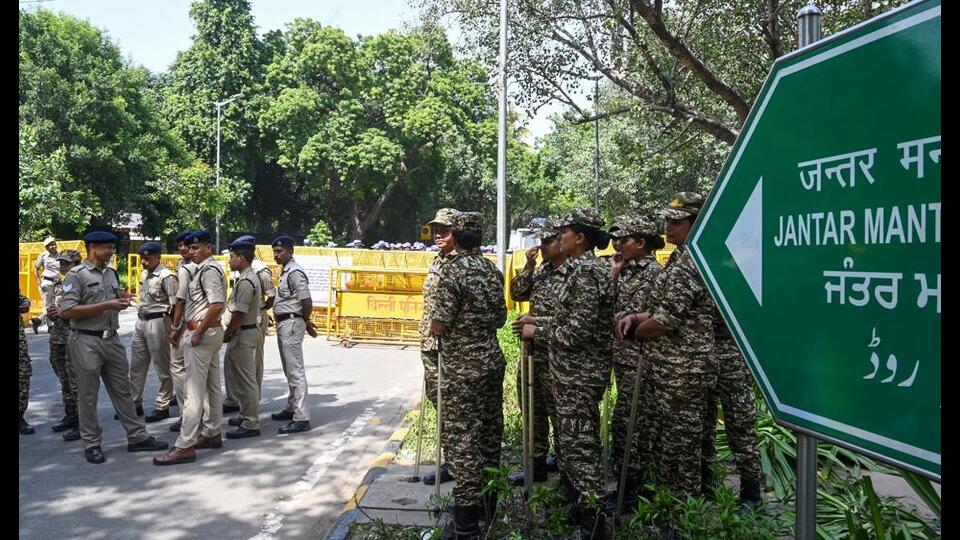
A bench of Chief Justice of India Surya Kant and justice Joymalya Bagchi issued notice to the authorities on a petition challenging the denotification, saying it would examine whether the decision followed primarily from the court’s observations or was based on an independent assessment of the site’s suitability.
“We are issuing notice and we will examine whether it was done primarily because of the oral assurance or some application of mind relating to the suitability of the location was there,” the bench told solicitor general Tushar Mehta, who represented the Centre.
Also read: Jantar Mantar, when it was not a protest site
Centre cites committee recommendations
Mehta said the October 9 observations of the court were not the basis for the denotification. “The committee was constituted long before and the committee gave its report, which led to action. There are reasons recorded,” he told the bench.
To be sure, the SG’s submission came two days after Delhi Police told the Delhi high court on Tuesday that Jantar Mantar was denotified as a designated protest site in view of the Supreme Court’s October 9 order calling for a reconsideration of Delhi’s decades-old arrangement for holding demonstrations.
“We (Delhi Police) (denotified) Jantar Mantar (as a protest site) after Supreme Court’s order dated October 9,” additional solicitor general Chetan Sharma, appearing for the police, told a bench of Justice Amit Mahajan while opposing a plea by Indian Youth Congress president Uday Bhanu Chib challenging the denial of permission to hold a protest seeking chief election commissioner Gyanesh Kumar’s resignation.
Supreme Court calls for a rethink of protest arrangements
The October 9 order had called for a rethink of Delhi’s longstanding arrangement of holding demonstrations at Jantar Mantar, observing that the capital needed a larger, better-equipped space where citizens could exercise their democratic rights without obstructing essential services or compromising public safety.
Meanwhile, in the top court, senior advocate Gopal Sankaranarayanan, appearing for petitioner and advocate Swaty Singh, pressed for an urgent order restoring Jantar Mantar as a designated protest site, saying the authorities had sought to justify the decision by referring to the Supreme Court’s observations.
Senior advocate Mukta Gupta further argued that the denotification of Jantar Mantar and the subsequent designation of three alternative venues would violate citizens’ fundamental right to protest.
The bench said it would examine the government’s explanation before deciding whether judicial intervention was warranted. “We have issued notice. We will go through their reply and then we will decide. If we are not satisfied with their reply, we will intervene,” it said.
The challenge comes days after the Supreme Court, on October 9, asked Delhi authorities to identify a venue that would allow citizens to hold peaceful demonstrations without compromising public safety, access to essential services or the interests of other residents.
Also read: CJP, Congress push to restore protests at Jantar Mantar amid arrest of leaders
Alternative venues and the challenge to denotification
The immediate context was Delhi Police’s refusal to permit a proposed October 10 demonstration at Jantar Mantar, alongside extensive security measures that included restrictions affecting metro services and railway movements. The protest, called by the Cockroach Janata Party (CJP) and other groups, sought the resignation of chief election commissioner Gyanesh Kumar over alleged irregularities in the revision of electoral rolls.
In a circular issued on October 11, Delhi Police denotified Jantar Mantar as a protest venue with immediate effect and designated Ramlila Ground, Burari Ground and CBD Ground in east Delhi as alternative sites. The circular said the decision followed recommendations made by a committee constituted by the Union home ministry to examine alternative venues for demonstrations.
The petition contends that merely notifying alternative sites does not ensure that citizens can meaningfully exercise their fundamental right to assemble and protest peacefully. It argues that the new venues are either commercially expensive, difficult to access or located far from the centre of the capital, potentially diminishing the public impact of demonstrations.
Ramlila Ground, which spans around 12 acres and hosts several events throughout the year, may not be readily available for protests, the plea argues. Burari Ground and CBD Ground, meanwhile, are situated on the outskirts of the city, at considerable distances from Jantar Mantar.
Frequently Asked Questions