E-Paper



January 2024 colder, more polluted, shows Delhi data
The city’s average maximum temperature this month was 17.9°C — 2.2°C below the long-period average for 1970-2020 (20.1°C)

 Prefer HTon Google


Delhi’s nights this January were its coldest since 2013, the days were its coldest since 2015, even as the air was its most polluted since 2016, showed data from monitoring agencies, underscoring what has been a month of weather extremes for the national capital.
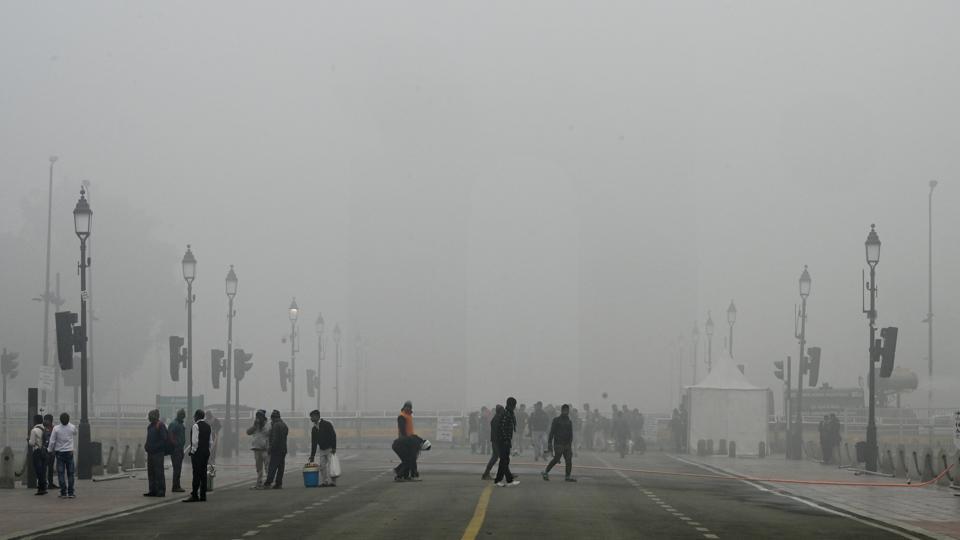
Data from the India Meteorological Department (IMD) shows that the city’s average maximum temperature this month was 17.9°C — 2.2°C below the long-period average for 1970-2020 (20.1°C).
This is Delhi’s lowest average maximum for January since at least 2015, when it was also 17.9°C.
The numbers also corroborated what the Capital’s residents have lived through for a month – that January nights have been chillier than usual.
According to IMD data, the city’s average minimum temperature this month was 6.4°C, almost a degree lower than the LPA of 7.5°C, and the lowest since 2013 (6.1°C).
The lower-than-usual temperatures, coupled with glacially slow winds, deepened and prolonged Delhi’s pollution crisis, force-feeding residents air laced with pollutants well above any accepted standard.
Central Pollution Control Board (CPCB) data shows that till January 30, Delhi recorded three “severe” air days, 28 “very poor” days, and just one “poor” day. As a result, the city’s 24-hour air quality index (AQI) averaged at 354 this month, the highest since the 370 in 2016 – the first full year that CPCB started tracking pollution levels.
In comparison, the average AQI was 311 last January and 279 in 2022. It was 324 in 2021; 286 in 2020; 328 in 2019; 328 in 2018; 304 in 2017 and 370 in 2016.
Delhi had just eight air quality monitoring stations in 2016, while it has 40 now.
The smoke also mingled with the fog to give Delhi a nearly month-long stretch of smog, which hobbled rail and flight services throughout the month and kept passengers stuck at stations and airports, as authorities scrambled to get schedules back on track.
Highway commuters were not spared either, as the smog resulted in a string of pile-ups across the country, especially in northern and eastern India, that have killed dozens of people and injured several others.
January has also been unusually parched, showed IMD data, with only “trace” rainfall recorded in the first 30 days of the month – the lowest till at least 2016.
Delhi clocked 20.4mm of rainfall last January; 88.2mm in 2022; 56.6mm in 2021 and 48.1mm in 2020. Delhi had seen only “trace” rainfall in January 2016.
Experts said weak western disturbances across northwest India have left the region with scanty rain and snow, conversely leading to extremely long spells of dense fog.
“Each time there is a western disturbance, we see strong winds and rain. However, these have been missing this January. All that has happened is more moisture has been introduced into the atmosphere, which has led to fog across the plains. In such a scenario, the skies are obscured, the sun is hidden and days are particularly cold,” said Mahesh Palawat, vice-president at Skymet meteorology.
The shortage of showers have also helped dust and other particulate pollutants travel freely through the air, added experts.
IMD data showed that Delhi recorded five “cold days” and five “cold wave days” in January.
The weather agency classifies a “cold day” as one when the maximum temperature is 4.5°C or more below normal, and when the minimum is below 10°C.
A “cold wave”, meanwhile, is one when the minimum temperature is 4.5°C or more below normal, or when it is below 4°C in the plains.
Delhi’s minimum temperature remained below 4°C for five straight days between January 12 and 16, dropping to a low of 3.3°C on January 15.
Kuldeep Srivastava, scientist at IMD, said five western disturbances hit northwest India this month, but none had any noteworthy impact on Delhi and the National Capital Region (NCR).
“The first half of the month was influenced by upper-level fog, which made days cold. Between January 12 and 16, when we had cold waves, we saw clear skies during the day, but fog would return at night. The second half has seen both upper-level fog and dense surface-level fog persist, which has resulted in isolated cold day conditions in between,” he said.
However, Delhi’s dry streak may be snapped on Wednesday, said IMD, predicting a strong western disturbance that may bring the Capital gusty winds and light rain.
“We expect strong winds of 30-40 km/hr,” he said.
Anumita Roychowdhury, executive director of research and advocacy at the Centre for Science and Environment (CSE) slow winds have been a constant this winter, similar to November and December.
“We have also seen the addition of dense fog in January, which further impacts air quality. Delhi’s background emissions are so high that in the absence of winds to disperse pollutants, we have seen the air remain ‘very poor’ for large parts and spike to severe when winds are completely calm,” she said.