
 E-Paper



Kashmir's separatist leader, once tagged as 'Prisoner of Conscience', has his politics questioned
Shabir Shah, known as the ‘Nelson Mandela of Kashmir’ in some spaces, faces family turmoil as his daughter Sama disassociates from separatist politics.

 Prefer HTon Google


Kashmir’s senior separatist leader Shabir Shah, who recently turned 70 in Delhi’s Tihar jail, has spent almost three decades in different jails of J&K and the country, earning him the sobriquet ‘Nelson Mandela of Kashmir’. In 1992, when militancy was at its peak, Amnesty International named him a ‘Prisoner of Conscience’.
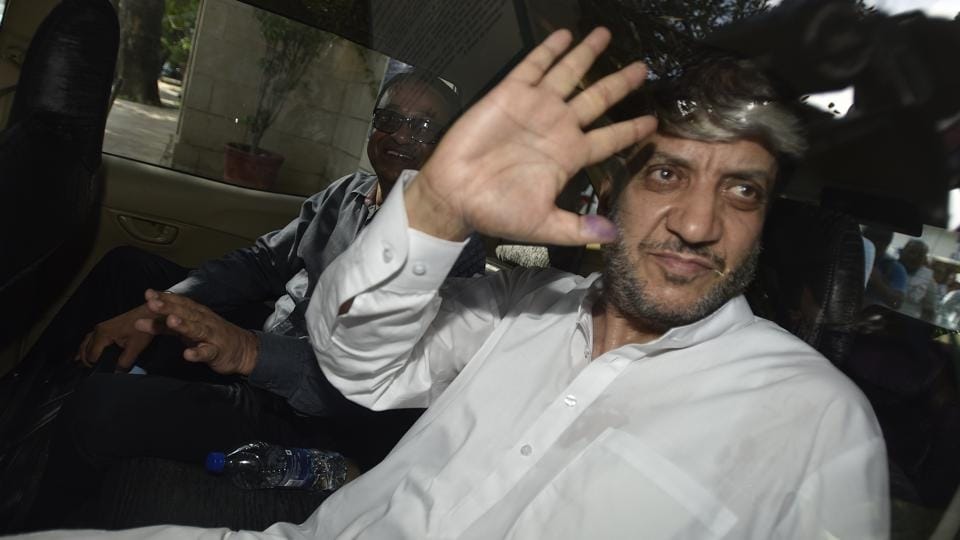
The Jammu and Kashmir Democratic Freedom Party (JKDFP)'s founder-president spent another year behind bars, which didn’t make much noise in the Valley. However, a small notice by his daughter Sama Shabir, in her early 20s, announcing her dissociation from her father’s separatist politics went viral across social media.
Sama, who was the CBSE topper in 2019 and has been pursuing law in the United Kingdom, on Monday, said that she has no association with her father’s party, which was formed in 1998. "I, Sama Shabir, daughter of Shabir Ahmad Shah… want to clarify that I have not been associated with nor have any affiliation with the Democratic Freedom Party, nor do I have any inclination towards the ideology of the Democratic Freedom Party," reads Sama Shabir's notification. She was also summoned by the Enforcement Directorate in 2019, but she was unable to attend the summons as she was out of the country.
The notification further read that she would take legal action if somebody implicates her name in activities of the JKDFP. "I am a loyal citizen of India and I am not affiliated with any person or any organisation which is against the sovereignty of the Union of India," the notification further clarified.
A similarly worded notice was also issued by Ruwa Shah, granddaughter of the late Syed Ali Shah Geelani.
Though the government is tight-lipped on the issue, there have been murmurs among several social circles of the pressure the separatists' families are facing after having been put on the no-fly list, preventing their travel out of the country.
The Bharatiya Janata Party (BJP) says that these public statements of dissociation have been released due to the policies of Prime Minister Narendra Modi. "This open confession directly from those who were known for separatist agenda and ideology is an eye-opener for those who remark what has changed in J&K post the Article 370 roll back,” said BJP state spokesman Altaf Thakur, while welcoming Ruwa and Sama's statements.
Shabir Shah's run-ins with the law
For the past seven years, Shabir Shah has been in jail for "waging war against the country" and in a terror funding case. Recently, the JKDFP, which he established in 1997, was banned by the ministry of home affairs for five years under the Unlawful Activities (Prevention) Act.
Shabir Shah, during his youth, wore his ideology on his sleeve. In the beginning, he was a hardline separatist with pro-Pakistan leanings. However, later on, he turned moderate and even engaged with some top officers of the Central government. In 2001, Shah became the only separatist leader to meet with an official from the Centre, namely, KC Pant, the former minister of defence. In his past interviews, he had said that he wanted a peaceful resolution of the Kashmir issue and vouched for fruitful talks.
The JKDFP chief was detained on July 25, 2017, in a 2005 money laundering case. His wife, Bilquis, was also named in the chargesheet produced in 2020. She was granted bail in 2021. While granting her bail, special judge Dharmender Rana said, "I concur with the defence counsel that placing her under custody now would not serve any purpose. Considering her gender, the nature of allegations against the applicant/accused, and the fact that she was not even arrested by the investigating authority during the course of the investigation, accused Bilquis Shah is admitted to bail."
In August 2017, a businessman and an alleged hawala operator Mohammed Aslam Wani, was arrested by the special branch of Delhi Police. The police claimed to recovered a large amount of money from him, which he told his investigators belonged to Shah. Delhi Police claimed to have recovered ₹63 lakhs from Wani, out of which ₹50 lakhs were meant for Shah.
On October 4, 2019, the NIA filed a supplementary charge sheet in another case against Shah and four others including JKLF chief, Yasin Malik, Masarat Alam, Engineer Rashid and Asiya Andrabi before a Delhi court. The offences included sections 120B (criminal conspiracy), 121 (waging war against the government of India), 121A (conspiracy to wage war) and 124A (sedition) of the IPC.
ED has also attached the house of Shabir Shah at Sanat Nagar under the provisions of the Prevention of Money Laundering Act (PMLA), 2002. ED initiated the money laundering investigation after filing an FIR in May 2017 against Pakistan-based Lashkar-e-Taiba co-founder Hafiz Muhammad Saeed and others under various sections of IPC and Unlawful Activities (Prevention) Act (UAPA), 1967.
During the investigation, ED had then said that Shah was “actively involved in fuelling unrest in Kashmir by the way of stone pelting, processions, protests, bandhs, hartals and other subversive activities”.
The agency also blames Shah for getting funds from militant groups and the Pakistani agencies. "These funds were then being used for fuelling and supporting militant activities in the Kashmir Valley", ED had said.
Shabir Shah's tryst with separatism
Shah's tryst with separatism began around five decades ago, when in 1968, at the age of 14, he led a demonstration against the Central government demanding the "right of self-determination" for the people of Kashmir, following which he was arrested and was kept in police lockup for three months. He has been in and out of jail ever since.
Shabir joined the Jammu and Kashmir Peoples Freedom League (JKPFL) in 1974. After the formation of the separatist amalgam All Parties Hurriyat Conference (APHC) in 1993, the JKPFL was clubbed together with all the separatist outfits of Kashmir and became one of the seven members of the APHC’s Executive Council.
The separatist leader went on to hold talks with KC Pant, former Prime Minister VP Singh and former US ambassador Frank Wisner. However, his parleys didn't go down well with Hurriyat leaders and finally, Shah left Hurriyat Conference along with senior separatist leader Syed Ali Geelani, who formed his own faction of Hurriyat Conference.
Later, Shah also became part of Hurriyat led by Geelani. India's former spy chief AS Dullat in his book, Kashmir: The Vajpayee Years, has also revealed that when militancy was at its top in the early 90's in Kashmir, he used to meet Shah in jail.
After the death of Geelani, Shabir Shah is one of the few separatist leaders who has been still pursuing the ideology of separatism.


