
 E-Paper



Relatives of men linked to Bengaluru riots struggle to pick up the pieces
Relatives say they lost livelihoods even after UAPA charges were dropped, police say no innocent was arrested and they’re preparing tight case


Bengaluru: On the black grill outside an apartment complex in north-eastern Bengaluru’s Shampura, a clutch of “To Let” notices have appeared . While such posters are common in the city during the Covid-19 pandemic, in this particular housing complex, the reason for vacancies is different.
A resident of the building, an elderly woman, said occupants of most of the vacant houses were arrested following the violence near DJ Halli police station last year. “As the breadwinners were in jail, the families had no choice but to vacate their houses. In some cases, the residents wanted to get away from the locality to avoid further police trouble,” the woman added, requesting anonymity.
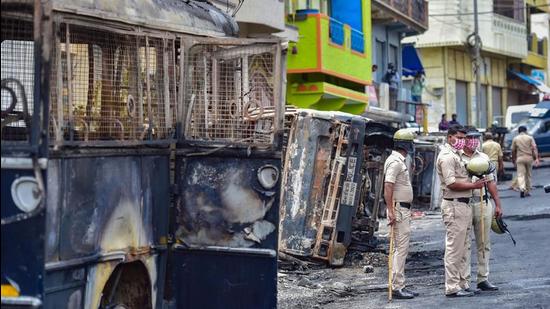
On the night of 11 August 2020, a mob resorted to arson in DJ Halli and KG Halli areas after Naveen P, nephew of Congress MLA from Pulakeshinagar constituency R Akhanda Srinivas Murthy, allegedly posted a derogatory image of Prophet Mohammad on Facebook. Two police stations were attacked, houses were burnt, and scores of vehicles burnt, according to police FIRs. Police resorted to firing, in which three people died; one more succumbed days later to the bullet injuries.
Subsequently, police arrested at least 400 people, including several from the building in Shampura. Tabrez Hussain, a 35-year-old executive in a multinational company, was picked from his apartment by police a day after the violence. According to Hussain, he was playing carrom in the parking lot of his apartment with three others when police barged in. He said three Muslim men including him were picked up while the Hindu watchman was left behind.
“I asked them what was going on, but we did not get an answer. They took us to the main road and made us kneel. Soon, a government bus came, and we were all loaded in it. They initially took us towards KG Halli police station but later changed course,” Hussain told HT.
The bus took them to police quarters in Adugodi, where around 90 men were locked inside a room. “They took our phones and started scanning through them. At that point, I didn’t know why I was picked up. I wanted to explain that I was nowhere near the spot of violence, but there was no one to tell,” he said.
For another two months after his arrest, he remained in dark about the charges slapped against him by police.
From the adjacent building, three men in their 20s from a family were also picked up by the police. All three were asleep when the police came . They were transported in the same bus as Hussain and were lodged in the same room. “All three of us were at home when the violence happened. They took every man they saw. In the room where we were locked in, they kept asking why we attacked the police station and they didn’t listen to us,” said the youngest brother, who didn’t wish to be named.
Another man, who was in quarantine after contracting Covid-19, was also picked up by the police during the raid. “There was no questioning or checking our whereabouts. They had come with the intention of arresting every person in the building,” said the second brother, requested anonymity.
Hussain said after spending hours locked in the room in the police quarters, they were presented before the magistrate through a video call, where a policeman panned the phone to show all the people in the room. “Even at the point, we were not sure what was going on. It was only when I saw one of the forms held by a policeman, which had Parappanna Agrahara central prison written on top, that I realised we were being sent to jail,” said Hussain.
“The day I was arrested, my family didn’t know that I was picked up. It was only after pleading with the prison guard that they allowed me to make a phone call home to tell my family that I was in custody. Some other didn’t even get that chance,” Hussain added.
For the next two months, they were locked up in a cell and they were not allowed to step out . “There was no sunlight and fresh air for two months, and there were 109 of us in the barrack. It was during this time that we heard that we were booked for rioting under UAPA (Unlawful Activities (Prevention) Act). It was more than two months later that we were let out of the barracks for short walks,” said one of the brothers quoted above.
Between 2015 and 2020, Karnataka reported 971 cases of riots, either communal or political, according to the National Crime Records Bureau. This includes the protests against the Citizenship (Amendment) Act (CAA) in Mangaluru (in December 2019), which saw unprecedented violence – including death of two persons. However, it was only in the DJ Halli riots case that the Bengaluru police invoked the stringent UAPA, according to police records accessed by HT.
Following the arrests, Bengaluru police commissioner Kamal Pant on August 20 had said no innocent person had been arrested by teams investigating the August 11 riots. “Arrests were made only after making proper verification and collection of evidence. The investigations are on the right track.” .
In September 2020, the National Investigation Agency (NIA) took over the case.
When NIA filed a charge sheet in the case, almost six months later, it drastically reduced the number of people booked under UAPA, and added sections of the Indian Penal Code against most of the others.
“In the charge sheet filed by NIA, only 47 people have been booked under UAPA. At least 370 people have been booked under various sections of IPC. Initially when the case was filed, most of them were booked under UAPA by Bengaluru police, which the NIA changed. Most of them were denied bail for six months because of the UAPA charges,” said Mohammad Azhar, a lawyer representing some of the accused in the case.
While the UAPA charges being dropped came as a big relief for many like Hussain and the three brothers, their lives changed for the worse during those six months. Hussain said he lost his job while he was in prison. “The company was initially supportive knowing my situation but sometime later, they hired another person as my replacement. Even though the UAPA charges have been dropped and there is enough evidence to prove my innocence, I don’t have a job,” he said.
After he was released on bail in the last week of February, Hussain managed to get another job; however, he was sacked by the company citing the case against him, the 35-year-old said.
Another resident of the building, a 31-year-old transport lorry driver was arrested following the violence and was released on bail after NIA dropped the UAPA charges against him. “The tempo (transport truck) was my only source of income. When I was arrested, my wife was alone at home. Since there was no income, the house owner began cutting rent from our deposit money. Eventually, my wife had no option but to sell the tempo. I lost everything I owed in those six months,” he said, requesting anonymity.
In the same housing complex, at least four families vacated their houses after the men were arrested by the police and the families didn’t have the means to pay rent.
For the three brothers, the expenses during the six months of jail have put the family in severe debt. “We had to keep sending money to the boys for availing facilities in the jail, such as making calls home. The lawyer’s fees and other expenses have come up to ₹1.5 lakh, which is a big amount for us. All three of them have lost their jobs also, which makes our situation worse,” said their mother.
Three senior Bengaluru police officers refused to comment on NIA dropping UAPA charges against several accused, claiming the case is sub-judice. However, one senior officer, on the condition of anonymity, said the trial was yet to begin, and that they were preparing a watertight case.
Officials of NIA Hyderabad, which is investigating the case, didn’t respond to calls made by HT for a comment. However, NIA has claimed that the violence in Bengaluru’s DJ Halli, on August 11, 2020, was coordinated through a WhatsApp group. The central agency made the claim in its charge sheet filed on February 9.
The federal agency claimed that a WhatsApp group “DG Halli 45” was actively organising the mob to gather in front of the two police stations. “Analysis of the WhatsApp group revealed that more than a hundred members were present in the said group during the riot and had hidden their identity… the WhatsApp group was used for spreading incriminating messages, images, videos, audio clips etc related to the incident to instigate people to assemble unlawfully in front of both KG Halli and DJ Halli police stations for participating in the violent activities,” the charge sheet read.


