
 E-Paper



Looking back: Fierce women who mastered the art of war
While the debates over women in combat roles continue, history tells a different story. In the history of Karnataka itself, there are several women like Saviyabbe, who fought or commanded armies in battle.


A virakallu or a hero-stone, dating back to 950 AD talks about a woman warrior – Saviyabbe. The sculpture at the top depicts her as an amazon riding a horse, flourishing a sword against a man on an elephant. The story is not fiction.
As per records, she was the daughter of the chief Bayika and since some Ganga kings had titles with the suffix Vidyadhara, historians believe that Saviyabbe’s husband was a Ganga prince. Saviyabbe fought along with her husband and many other soldiers, finally losing her life during the battle of Bagiyur.
In February 2020, the Supreme Court ordered the union government to ensure that women officers are given a permanent commission in the Army while adding that the officers will be now eligible for command posting. The decisions stood in stark contrast to the Centre’s opinion, which belonged to the school of thought that women were not suitable for commanding posts in the army because male troops were not yet ready to accept their orders.
While the debates over women in combat roles continue, history tells a different story. In the history of Karnataka itself, there are several women like Saviyabbe, who fought or commanded armies in battle.
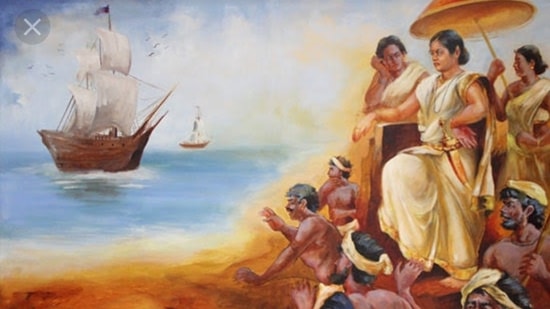
In history books, the story of Rani Abbakka, as a ruler and a military commander, stands out. In the battles against the Portuguese, she not only commanded an army but a navy as well. The Karnataka state gazette, which details the history of ‘Queen of Ullala’ described her as a persistent opposition to the Portuguese expansion.
“She worked in close alliance with the several chiefs of Malabar and against her husband who was an ally of the Portuguese” read the gazette notes on her.
Dr Tukaram Poojary, a retired history professor, who researched Abbakka said that her husband Lakshmanappa wanted to join hands with the Portuguese, so she left him. “She then took over as the ruler of Ullal, which she got as the matriarchal system was practised at that time. She took on the Portuguese in three battles,” he said.
As per records, she took on the Portuguese when she decided to stop paying tributes to them when they attacked the chief of Cannanore (today’s Kerala), her erstwhile ally in 1555. Three years later, the queen took on the Portuguese by assisting naval attack led by the Raja of Cannanore against the Portuguese. “The Portuguese was so incensed at this that he reduced Mangalore to ashes. The queen again ceased to pay tributes to the Portuguese, when they declared war on her ally, the Raja of Cannanore in 1566.”
In 1567, a punitive expedition was sent against her by the Portuguese governor under Joao Peixote, according to the Gazette. The Portuguese army attacked Ullal under General Joao Peixoto. He captured the city and occupied the palace. However, the Queen managed to escape and hide in a mosque. In the dead of night, with 200 soldiers, she raided the Portuguese and managed to kill General Peixoto and 70 soldiers. The invaders fled to their ships. She followed and killed the admiral of the fleet.
In 1588, however, Goa Viceroy Anthony D’ Noronha led another attack against Ullal with a grand Armada. Ullal fell and was destroyed in this attack. The queen also died, as per the legend, leading her men from the front.
But this was not the end. There rose from the ashes like a phoenix, another Abbakka.
“It was under her rule, the Portuguese suffered one of the biggest naval battles in the subcontinent. Abbakka, the second, took over in 1594. She gained great fame throughout the Indian Ocean by attacking and burning the Portuguese fleet in 1618. This ensured that invasions by the Portuguese stopped in the coastal regions of Karnataka,” said Poojary.
The Indian Navy finally acknowledged India’s rare woman naval hero and named a patrol vessel Rani Abbakka after her in 2012.
Another female military commander from Karnataka’s history was Belawadi Mallamma, ruler of today’s Belgavi. She took on Shivaji after his armies began raiding the livestock in her territory. Mallamma led her force of two thousand women soldiers to attack the Maratha garrison. With two hundred men wounded and ten to twelve men dead, the Maratha commander agreed to surrender the livestock.
Shivaji when he heard the news was exasperated and ordered his cavalry to attack Belawadi till it surrendered. The battle between the two rulers raged for fifteen days. During the battle, Mallamma raided Shivaji while he was offering prayers at a temple and following this battle Shivaji came to a truce with the Mallamma.
While Mallamma proved her worth on the battlefield against Shivaji, another commander from Karnataka, Chennamma of Keladi ruled took on the Mughals by sheltering Shivaji’s son Rajaram. Chennamma was the ruler of Keladi on the coast of Karnataka from 1671 to 1696.
As per records, Rajaram approached Chennamma dressed as a monk and sought protection. Soon she received a letter from Aurangzeb demanding that she hand over Rajaram to him. She refused. ”Aurangzeb, the big Moghul force was near Keladi. The soldiers of Keladi prepared and ambushes through a thick jungle and the Moghul soldiers who were accustomed to the dry climate of the North were caught in the heavy monsoon of the Malnad area. Some battles were led by Chennamma,” said Rajesh HG, editor of Itihasa Darapana.
The forces of Keladi had captured several of the Moghul captains, a large number of horses and considerable war material. By then Rajaram had reached Jinji fort and Mughals withdrew from the battle.
In the 1800s the tradition of women leading battles continued with Kittur Chennamma, who took on the British, who wanted to take over her kingdom citing ‘Doctrine of Lapse’. British launched multiple attacks against an army commanded by Chennamma.
British army attacked Kittur on 21 October 1824, with 20,000 men and 400 guns. Despite having a numerically inferior force, Chennamma put up a tough fight and won the first round of battle. The British army faced massive losses and two British officer Walter Elliot was taken as hostages.
However, the British troops launched a second attack. This time, because of the humiliation of losing to a woman in the first battle, they roped in armies from Mysore, and Sholapur for the attack. They also convinced two of her soldiers to betray her by mixing cow dung and mud with the gunpowder used for canons. This time, she was captured and imprisoned for life at Bailhongal Fort. She passed away on 21 February 1829, while in prison.
These were some of the women from Karnataka who led their armies to victory.
In her book “Women medieval Karnataka”, Dr MB Padma wrote that the records talk about many more women like Kanskarve, Chigaladevi, Chola Mahidevi, Dappali Devi and others who organized expeditions fought boldly on the battlefields and spoke courageously for justice. “Even an ordinary woman like Lakshamma Gauvndi, fought robbers to save the cows and had the honour of death on the battlefield itself. Thus, they keep up the martial spirit and the flame of patriotism successfully,” she wrote in her book.
The note perhaps is valuable in the argument for women in combat roles today.


