
 E-Paper



Delhi: Minimum dips to 3.6°C, air nears ‘severe’ again
Delhi experiences its first cold wave of the season, with temperatures dropping to 3.6°C and heavy fog causing visibility issues.

 Prefer HTon Google


The season’s first cold wave engulfed Delhi on Saturday, pushing the minimum temperature down to 3.6°C, the lowest yet this winter, and draping the city in a thick blanket of fog that slashed the visibility and hindered mass transit once again.
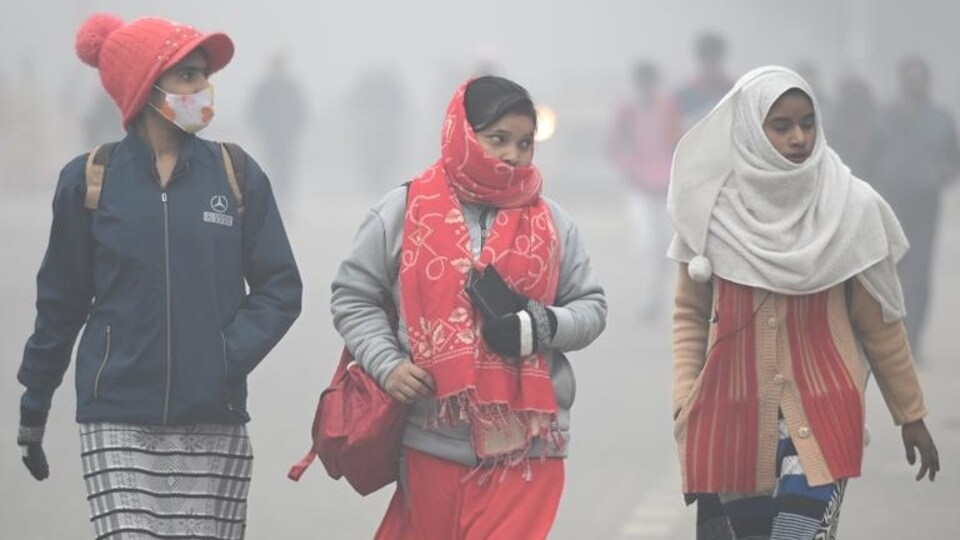
Pollution levels soared as well, with the 24-hour average air quality index (AQI) at 4pm touching 399 — on the cusp of the hazardous “severe” category. This number worsened rapidly through the evening, hitting 433 at 11pm.
Also read: A love affair with Sunder Nursery, faults and all
The India Meteorological Department (IMD) said a dense fog will continue to drape the city for at least three more days and issued a “yellow alert”, which warns people to be prepared against unfavourable weather.
Saturday’s minimum was a drop from 3.9°C on Friday morning, with both temperatures four degrees below normal, said IMD officials.
The maximum temperature, meanwhile, was 18.1°C, two degrees below normal and lower than 19.3°C on Friday.
IMD declares a “cold wave” when the minimum temperature is 4.5°C or more below normal. The agency can also declare a cold wave in the plains when the minimum reading is below 4°C, as was the case with Delhi over Friday and Saturday.
Kuldeep Srivastava, scientist at IMD, said the fog was now largely affecting lower reaches, meaning there is little cloud cover
“The upper-level fog has cleared and the fog that is now persisting is dense, but at the surface level,” he said.
Also read: Key problems bog Delhi’s winter shelters
Maximum temperatures usually dip in a region blanketed by upper-level fog or cloud cover as sunlight does not penetrate to the surface. However, in such a situation, the minimum temperature is usually higher than normal, since this cover keeps heat from escaping into the atmosphere at night.
A clear sky has the opposite effect, resulting in warm days, as ample sunshine reaches the surface. At the same time, nights are cooler, since the same heat is lost equally quickly at night, with no fog or cloudiness to trap it.
On Sunday, several weather stations in Delhi individually recorded “cold wave” conditions. Ayanagar was the city’s coldest spot on Saturday, with a minimum of just 3°C, Lodhi Road was at 3.4°C, while the Ridge and Rajghat stations both clocked a minimum temperature of 3.9°C.
Delhi’s coldest morning last year was on January 19, when the temperature plunged to 1.7°C. That was Delhi’s lowest temperature since January 1, 2021, when the temperature was 1.1°C.
Saturday’s fog cover, meanwhile, was less intense than Friday, but hampered flight and railway operations nonetheless.
IMD officials said the lowest visibility on Saturday was 300 metres in Safdarjung and 350 metres in Palam.
The agency classifies fog as ‘shallow’ when visibility is between 500 and 1000 metres; as ‘moderate’ when it is between 200 and 500 metres; as ‘dense’ when it is between 50 and 200 metres and ‘very dense’ when it is 50 metres or lower. The fog dissipated into a shallow layer in the later part of the day, with visibility staying around 1000 metres.
Delhi airport officials said some flights were delayed, though none were cancelled or diverted.
The Northern Railway, meanwhile, said 18 trains to and from Delhi were delayed by more than an hour in the early hours of the day.
Also read: Health experts warn against rising heart attacks, eye-related complications in winter
IMD officials said the city’s maximum temperature will remain around 20°C throughout the week, even as the minimum stays around 4°C.
“The minimum will stay 4°C or below for the next three days, with cold wave conditions throughout the city. A dense surface-level fog will also be seen from Sunday. A yellow alert has been issued till Tuesday,” Srivastava said.
The lower temperatures also worsened Delhi’s air quality on Saturday, pushing pollution levels to the upper margin of the “very poor” zone and fractions away from the hazardous “severe” category.
The 24-hour AQI was 399 (very poor) at 4pm on Saturday. It was 340 at the same time on Friday.
Delhi last breathed worse air on December 30, when the AQI was 400, a point away from the “severe” zone. The air was last classified as severe on December 24, when the AQI read 411.
The CPCB classifies an AQI between 0-50 as good, between 51 and 100 as satisfactory, between 101 and 200 as moderate, between 201 and 300 as poor, between 301 and 400 as very poor and over 400 as severe.


