E-Paper



Key problems bog Delhi’s winter shelters
At the shelter homes, Dusib is supposed to provide mattresses, bedsheets, blankets, lockers, electricity, drinking water and toilets

 Prefer HTon Google


Icy winds streamed through Delhi on a cold winter night. Meena Devi (35) sat on a small bed in a homeless shelter near the All India Institute of Medical Sciences (AIIMS). A worn-out blanket kept her warm. It was 10pm. Her daughter, Ritika (8) was by her side. They had eaten and were ready to wind down. But one big worry would keep her awake — what if Ritika needed to use the toilet?
“There is no washroom nearby. The closest toilet she can use is inside the hospital, which is a kilometre away. I hope she can wait till morning,” Devi lamented.
When she visited Delhi this summer for her cancer treatment at AIIMS, she stayed on the footpath nearby. The din of traffic, the mosquitoes, reckless drivers, and the fear of unknown men on the road kept her awake at night.
But this time, she was grateful for a roof over her head. Devi, her husband and their daughter have been staying in the temporary 10-bed night shelter since Monday. This is one of roughly 250 shelter homes in pagoda tents set up by the Delhi Urban Shelter Improvement Board (Dusib) as part of the 2023-24 winter action plan, to house 2,000 people. These are over and above the 195 permanent shelters the agency runs, which can accommodate 7,092 people.
At the shelter homes, Dusib is supposed to provide mattresses, bedsheets, blankets, lockers, electricity, drinking water — and toilets.
But Devi’s walk to AIIMS with her daughter in tow each night tells a different story. Dusib has not installed a 24x7 toilet near the shelter home. A toilet run by the New Delhi Municipal Council (NDMC), adjacent to the shelter home, is open only till 7.30pm.
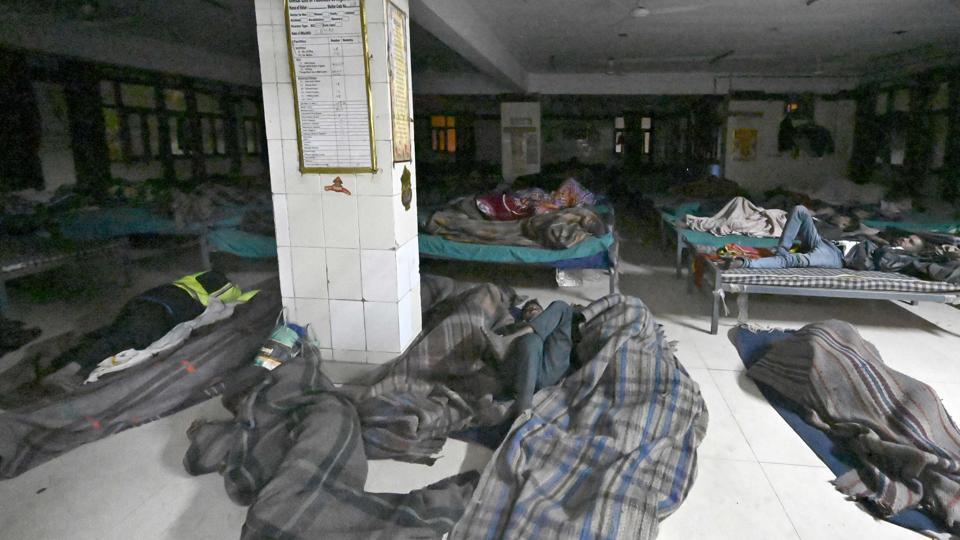
As winter tightens its grip around Delhi, HT visited at least 10 shelter homes in Lahori Gate, Connaught Place, and near AIIMS, and found a number of issues plaguing them. A lack of power supply, filthy toilets, no mattresses, unwashed blankets and bedsheets — many of these shelters had at least one fatal flaw that made them hard to use.
A senior Dusib official took note of the problems and said the agency will resolve all of them.
Connaught Place
Although clean tents were set up in the shelter near Gurdwara Bangla Sahib in Connaught Place, there were only three occupants inside the permanent night shelter, which can otherwise accommodate 140 people, when HT made a spot visit this week. There are separate tents for men, women, and families.
Two weeks after the winter action plan was enforced, the 10 tents at this shelter home have received only half their allotted beds and the mattresses.
“We have not got any bedsheets or pillows. I am yet to receive the orders from my supervisor to install what we have got,” said 21-year-old Dipanshu Kumar, the caretaker of the shelter home, which was set up a few days ago.
“If any lapses are found in the set-up of any tents, we will get it checked and ensure that it’s fixed,” said Bipin Rai, member-expert, Dusib.
For the last two weeks, Kumar turned away people seeking shelter. But on Wednesday night, he relented and let three men stay the night.
“They were shivering. What could I have done? I gave them my own blanket,” said Kumar.
Near AIIMS
Devi said the New Delhi Municipal Council (NDMC) toilet adjacent to the shelter home they are staying in shuts at 7.30pm, even though it’s supposed to be open till 10pm.
“The caretaker of the toilet locks it and leaves by 7.30pm. After that, what option do we have? I can’t let my daughter relieve herself in the open,” said Devi, who is in Delhi from Gorakhpur in Uttar Pradesh to be treated for cancer at AIIMS. Her next appointment is in 12 days. Unable to afford frequent travel, she has decided to stay put in the Capital.
Rai said that if there are NDMC-run toilets close to shelter homes, Dusib does not provide mobile washrooms at those sites.
“Near AIIMS, we coordinate with NDMC to ensure that their toilets are open 24x7. If that’s not happening, we will take up the matter with them,” said Rai.
A critical flaw disrupted life at another nearby shelter.
Manti Devi’s swollen leg was proof that she fell down a few times over the past few days as she helped her 60-year-old husband Raj Kumar Singh, who walks with a limp, in the dark.
The shelter home had no electricity since December 8.
“I end up hurting myself while trying to hold him. It’s too dark here,” she said.
The two hail from Samastipur in Bihar and were in Delhi to be treated for mobility related ailments at AIIMS.
The occupants and caretakers depend on emergency lights that need to be charged every three hours.
“We provide electricity at some places. At others, we give emergency lights, but electricity is provided at the shelter homes near AIIMS. We will address lapses, if any,” said Dusib’s Rai.
Apart from the lack of power supply, occupants said that meals, drinking water, and blankets and bedsheets are provided at the shelter.
At another temporary night shelter opposite AIIMS, Pramod Kumar (25), the caretaker, used his cellphone’s flashlight to make entries of the occupants in the register. There was no electricity and the emergency torch had discharged by 11pm.
“We have emergency lights that we charge at home. We have informed our supervisor about the problem, but he said it will take a few days. Whenever people face problems, we try to help them however we can. Sometimes, I go to the hospital nearby and charge people’s phones,” he told HT.
At this shelter home, around a kilometre away from the hospital, 27-year-old Sooraj Kanodia, the caretaker, said he had informed his supervisor about the electricity supply issue and was told that it will be solved in a few days.
“I told my supervisor about it three days ago, but nothing has happened. We have been given five emergency lights for three tents at this location, which can accommodate 25 people. We have to charge these lights at home and bring them here every day. One emergency light runs only for two hours,” he said.
Apart from electricity trouble, occupants also complained about a lack of water. Manti said that she has to walk about 800 metres to get water. “I get water either from the hospital or from the public tap. It’s a task because my swollen leg gives me trouble,” said Devi.
Lahori Gate
A pile of dirty blankets lay in a corner at the two-storey permanent men’s shelter in Lahori Gate, and another stack of unwashed pillows and bed sheets lay next to it. Every evening, as occupants returned to the shelter, they picked their share of one bedsheet and blanket each from this pile.
“In the last four years that I have worked here, I have never seen the blankets get washed. The bedsheets do get cleaned a few times, and we often ask the occupants who stay here permanently to wash them on their own,” said Shashi Ranjan Kumar (35) caretaker of the shelter.
The shelter home can accommodate over 200 people, and there are six toilets — three on each floor.
Of the six toilets, one did not have a door, in three toilets the flush was not working, and there were no water taps. Suresh Kumar (48), a daily wage worker, said, “I don’t care about dirty blankets but the least one can expect is a functional toilet with water.”
The caretaker said that of the six taps, water is available in two, which are fixed outside the cubicles.
Sunil Kumar Aledia, executive director and founding member of the Centre for Holistic Development, said that the Delhi government doesn’t invest enough in the well-being of the city’s homeless people.
“Our teams do the rounds of nights shelters all year round and flag issues to the authorities. If they set up more permanent shelters, they will not face the issues at temporary shelters. No teams of the government or Dusib actually work on the ground and check if their contractors are maintaining the shelters or not,” he said.